Middle East Conflict Expands as US-Israel War on Iran Intensifies
The joint military campaign by the United States and Israel against Iran has escalated dramatically, spreading violence and destruction across at least nine countries within a ten-hour period on Monday. This expansion marks a significant intensification of the conflict that began with the targeting of Iran's leadership.
Cross-Regional Strikes and Civilian Casualties Mount
Israeli and American warplanes launched fresh waves of strikes across Iran, where the Iranian Red Crescent Society reported more than five hundred fatalities since hostilities commenced. Israel simultaneously conducted intense attacks into Lebanon following Hezbollah's retaliatory strikes against northern Israel. These Lebanese attacks came in response to the Israeli operation on Saturday that resulted in the death of Iran's supreme leader, Ayatollah Ali Khamenei.
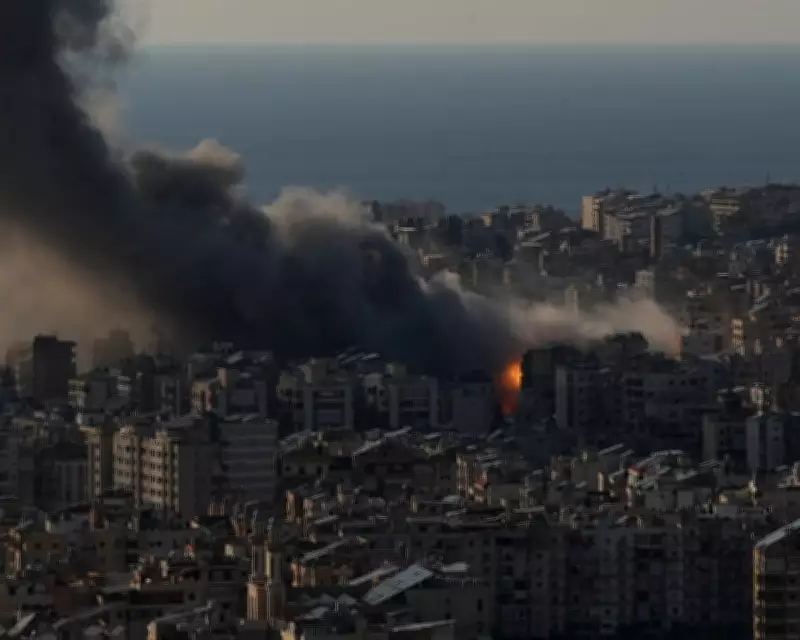
In Beirut, flames and thick smoke billowed from the southern suburb of Dahiyeh following Israeli airstrikes. The conflict has created widespread uncertainty within Iran, with residents fleeing urban centers as bombs continue to fall. Authorities report eleven fatalities in Israel and thirty-one in Lebanon from the ongoing exchanges.

Friendly Fire Incident and Regional Infrastructure Attacks
In a significant friendly fire incident, Kuwait's air defense systems mistakenly shot down three American F-15E fighter jets during an Iranian attack. All six crew members were safely recovered, but video footage showed one aircraft spiraling from the sky with an engine ablaze before impacting the ground in a fiery explosion. Black smoke rose above the area surrounding the US embassy in Kuwait as emergency services responded.
Iranian attacks targeted critical infrastructure across a two-thousand-kilometer swath of the region. From the Gulf of Oman, where a drone boat carrying explosives struck an oil tanker, to Cyprus, where a drone hit Britain's Akrotiri airbase, the conflict reached unprecedented geographical scope. Britain and Cyprus confirmed limited damage and no casualties at the base, marking the first strike against US allies in Europe.
Saudi Arabia was forced to shut its largest refinery following drone strikes that ignited fires, part of a broader campaign against oil installations throughout the region. Loud explosions were reported in Dubai, Samha in the United Arab Emirates, and Doha, Qatar's capital city.
Strategic Implications and Economic Disruption
The effort to remove Iran's leadership represents the most substantial foreign policy gamble by the United States in decades. President Donald Trump reiterated calls for Iranians to overthrow their government, indicating the air campaign could extend for weeks. European allies initially distanced themselves from the decision to go to war, questioning its legal justification, but have since committed to suppressing Iran's retaliatory capabilities.
Shipping through the strategically vital Strait of Hormuz, which handles approximately one-fifth of global oil trade along Iran's coastline, has been suspended following Iranian threats and attacks against tankers. This disruption caused oil prices to surge by double-digit percentages when markets opened on Monday, accompanied by falling stock indices. Shipping data revealed hundreds of vessels, including oil and gas tankers, anchoring in nearby waters as global air travel faced severe disruptions with major Middle Eastern airports closed.
Nuclear Concerns and Leadership Uncertainty
Rafael Grossi, director general of the International Atomic Energy Agency, confirmed that UN nuclear monitors have detected no damage to Iranian nuclear facilities despite claims from Iran's envoy that one site was targeted. Iran's nuclear program remains a primary justification cited by Israel and the US for their attacks, with allegations that Tehran was approaching nuclear weapons capability.

Within Iran, leadership uncertainty persists following Khamenei's death. Elected President Masoud Pezeshkian announced that a temporary leadership council comprising himself, the judiciary head, and a Guardian Council member has assumed the supreme leader's duties. Ali Larijani, head of Tehran's Supreme National Security Council, declared Iran would not negotiate with Trump, asserting that Iran has prepared for prolonged conflict unlike the United States.
US officials confirmed that B-2 strategic bombers targeted Iranian missile launch sites, while an Israeli military spokesperson attributed reduced attacks on Israel to degraded Iranian capabilities from previous strikes. The spokesperson warned that Hezbollah had committed "a big mistake" by aligning with Iran's war effort.
A senior White House official indicated that Washington would eventually engage in talks with Tehran, but not while Operation Epic Fury continues unabated. The conflict's expansion across multiple fronts, combined with economic disruptions and strategic miscalculations like the Kuwait friendly fire incident, creates complex challenges for all involved parties with no clear resolution in sight.