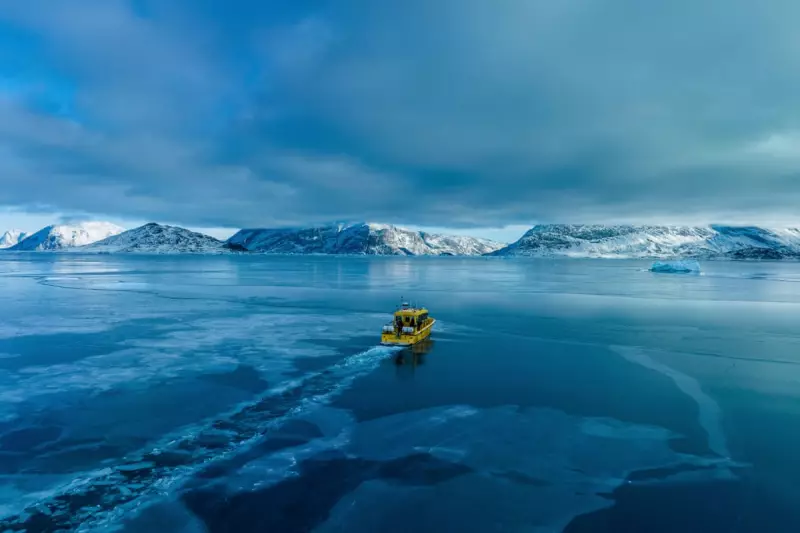
The rapid retreat of Arctic sea ice, driven by global heating, is transforming the remote island of Greenland into a pivotal strategic battleground for world powers. Lying between the United States and Russia, this vast Danish territory is now at the heart of a new scramble for influence, resources, and control over emerging trade corridors.
The Opening of the Arctic: New Sea Routes Emerge
Data from the National Snow and Ice Data Center reveals a stark decline in Arctic sea ice. The average extent over the last five years was 4.6 million square kilometres, a 27% drop compared to the 1981-2010 average of 6.4 million square kilometres. This loss, an area roughly the size of Libya, means the summer ice cap no longer reaches the Russian and Canadian coasts, exposing once-inaccessible seas.
This environmental shift is redrawing the global trade map. The most developed new corridor is the Northern Sea Route, which runs along Russia's Arctic coast and is central to Moscow's ambitions. Further west, the Northwest Passage cuts through Canada, while a central Arctic route across the pole is in long-term planning. These passages offer alternatives to the Suez Canal, potentially slashing the journey from Western Europe to East Asia by almost half.

In a landmark voyage, the container ship Istanbul Bridge became the first liner vessel to travel from China to Europe via this "Polar Silk Road" in 2025, completing its journey from Ningbo to Felixstowe in about 20 days. Traffic is surging; data from the Marine Exchange of Alaska shows 665 transits through the Bering Strait in 2024, a 175% increase from 2010.
Military Posturing and Rising Tensions
The strategic value of the thawing Arctic has not gone unnoticed by military planners. The region is now a zone of increasing competition between Arctic nations: Canada, Denmark, Norway, Russia, and the United States. Russia has opened several new military bases in the last decade and restored old Soviet infrastructure, while the US maintains a significant presence at the remote Pituffik base in north-west Greenland, which hosts critical missile warning and space operations for NATO.
Serafima Andreeva, a researcher at the Fridtjof Nansen Institute in Norway, notes that "there has been an increased military interest in the Arctic over the last 10 to 15 years", a landscape further reshaped by Russia's invasion of Ukraine in 2022 and the subsequent NATO accessions of Finland and Sweden. This Nordic expansion has intensified the focus on collective security and entrenched Russia's desire to assert control over key areas like the Kola peninsula.
The Critical Minerals Race and Greenland's Untapped Wealth
Beyond shipping lanes, Greenland's significance lies beneath its retreating ice. The island is estimated to hold 1.5 million tonnes of rare earth reserves, ranking it eighth in the world. It hosts two of the largest known deposits at Kvanefjeld and Tanbreez. Foreign interest is intense, with China's Shenghe Resources holding a 12.5% stake in the Kvanefjeld project.
While mining has been hampered by inaccessibility—only about 20% of Greenland is ice-free—the ongoing melt is steadily altering this equation, exposing new resources. This potential wealth, coupled with its strategic location, underpinned former US President Donald Trump's controversial interest in acquiring the island, a notion that highlighted its growing geopolitical flashpoint status.
The transformation of the Arctic is no longer a distant climate forecast but a present-day reality fuelling a complex mix of economic opportunity and international rivalry. As the ice continues to shrink, the world's focus on Greenland and the High North is set to intensify.