
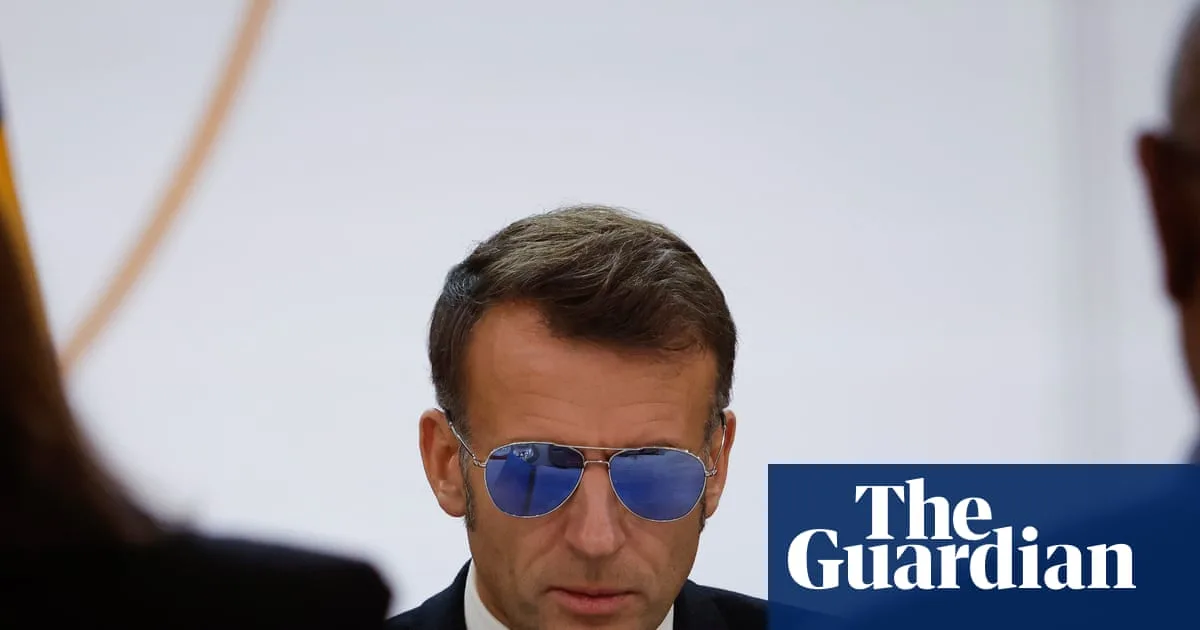
Emmanuel Macron has hit back at Donald Trump’s latest threats to impose tariffs on any country opposing his Greenland takeover, warning that “no amount of intimidation” will persuade European nations to change their course on Greenland. The US president on Saturday announced 10% tariffs on eight European countries from 1 February, with a further 25% tariff from 1 June.
Macron’s message was echoed by the Swedish prime minister, Ulf Kristersson, who warned the EU would not be “blackmailed” by Trump, and the Norwegian prime minister, Jonas Gahr Støre, who said “threats have no place among allies”. In a joint statement, EU leaders said “tariffs would undermine transatlantic relations and risk a dangerous downward spiral”. EU ambassadors are expected to meet for an emergency session on Sunday.
Trump’s threats appear to have fired up the EU, which up to now has been loathe to go down a confrontational path, with MEPs threatening to pause the ratification of the US trade deal next week. Manfred Weber, the head of the European People’s party, the largest voting bloc in the institute, said they would have to pause the legal rubber stamping process.
The tariffs threatened against Denmark, Norway, Sweden, France, Germany, the UK, the Netherlands and Finland target the countries that have been most vocal in their opposition to Trump’s intentions to take over Greenland. European leaders, in Paraguay to sign their biggest trade deal ever with the Mercosur alliance of South American countries, were taken by surprise by Trump’s latest outburst on Truth Social.
Macron immediately called the tariff threats “unacceptable”. He said they had “no place” in a context in which Europe was trying to defend Greenland, and in which Denmark was an EU member state, Nato member and signatory to the UN charter embodying international law. “France is committed to the sovereignty and independence of nations, in Europe and elsewhere. This guides our choices. It underpins our commitment to the United Nations and our charter,” Macron said.
Denmark attempted to lower the diplomatic temperature in the growing crisis. In a statement, its foreign minister, Lars Løkke Rasmussen, referred to “constructive” talks with Marco Rubio last week and an acknowledgment that more had to be done to increase the security in the Arctic. “That is why we and Nato partners are stepping up in full transparency with our American allies,” he said.




