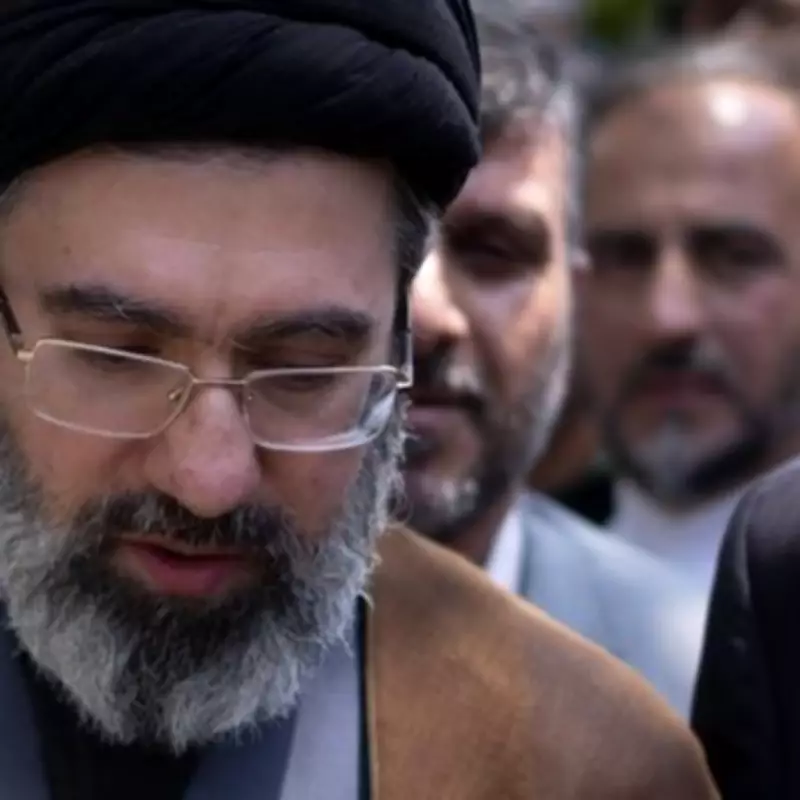
Iran's New Supreme Leader Breaks Silence with Chilling US Threat
Iran's new Supreme Leader, Mojtaba Khamenei, has broken his silence with a chilling threat directed at the United States, as he paid tribute to the slain security official Ali Larijani. The statement comes amidst swirling claims that Khamenei may have died or sustained severe injuries in recent attacks, adding a layer of tension to his first public remarks since assuming leadership.
Khamenei's Statement and Warning to Washington
In a statement released on Wednesday, Khamenei expressed profound sorrow over the death of Ali Larijani, who served as Secretary of the Supreme National Security Council and the Leader's representative on that council. "It is with great sorrow that I received the painful news of the martyrdom of Mr. Dr. Ali Larijani, as well as his distinguished son and some of his colleagues," Khamenei said. He went on to describe Larijani as "a learned, far-sighted, intelligent, and committed individual with diverse experiences in various political, military, security, cultural, and managerial arenas."
However, the statement quickly escalated into a direct warning to the United States. Khamenei added, "The enemies of Islam should know that shedding this blood only makes the mighty tree of the Islamic system stronger, and of course, every drop of blood has its price, which the murderous killers of these martyrs will soon have to pay." This represents the second time Khamenei has released a statement in recent days, following reports that he had lost a leg and was in a coma. Notably, he did not appear on camera this time, unlike a hastily drafted message delivered by a news presenter on Iranian TV last week.

Background and Context of the Threat
It is highly probable that Khamenei is currently concealed at an undisclosed location to avoid assassination attempts. His father, former Supreme Leader Ayatollah Ali Khamenei, was killed in a major strike by Israel and the United States at the beginning of the ongoing conflict. Mojtaba Khamenei has been regarded as an even more stringent hard-liner than his father, with concerns that his ascension could signal a regression to Iran's former hereditary monarchy, albeit with a religious dimension.
Those worries appeared to dissipate temporarily with the air strikes on Tehran that eliminated Iran's senior leadership, strikes that wounded Mojtaba Khamenei and took the lives of his father and wife. Prior to his appointment, Khamenei had occupied a position comparable to that of Ahmad Khomeini, a son of Iran's first Supreme Leader Ruhollah Khomeini—described by United Against Nuclear Iran, a U.S.-based pressure group, as "a combination of aide-de-camp, confidant, gatekeeper and power broker."
Khamenei's Rise and Current Challenges
The younger Khamenei assumed the role of supreme leader with Iran's military engaged in war and with reserves of highly enriched uranium that could potentially be utilised to build a nuclear weapon. Born in 1969 in the city of Mashhad, approximately a decade before the 1979 Islamic Revolution that reshaped Iran, Khamenei grew up while his father campaigned against Shah Mohammad Reza Pahlavi. An official biography recounts an incident when the shah's secret police, the SAVAK, stormed their home and attacked the cleric, with Mojtaba and other children being told their father was going on holiday—a lie he later confronted.
As tensions escalate, Khamenei's threat underscores the volatile state of Iran-US relations, with his hard-line stance likely to influence future diplomatic and military actions. The situation remains fluid, with ongoing updates expected as the conflict develops.