Iran Supreme Leader's Compound Targeted in Coordinated US-Israel Military Strikes
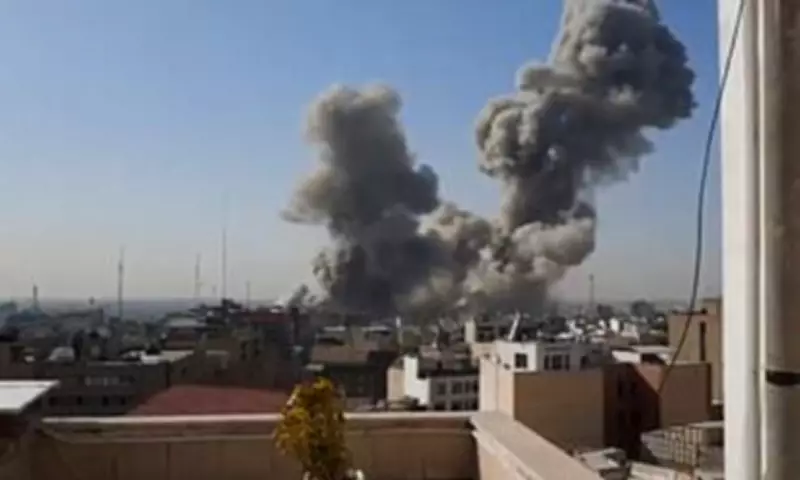
In a dramatic escalation of Middle East tensions, the compound of Iran's Supreme Leader Ali Khamenei in Tehran has been struck by airstrikes, with footage capturing women reacting with a mixture of disbelief and nervous laughter as they witnessed the attack from a nearby rooftop. The coordinated military operation by the United States and Israel targeted both Khamenei and Iranian President Masoud Pezeshkian on Saturday, though the full outcome of these precision strikes remains unclear according to Israeli officials.
Onlookers React with Shock as Smoke Billows Over Tehran
Video evidence shows thick black smoke rising dramatically into the sky above the Supreme Leader's complex, with audible screams and giggles emanating from observers positioned on adjacent rooftops. "Oh my God they hit it. They struck it. Oh my God," one woman can be heard exclaiming in the footage, capturing the surreal moment when the reality of the attack became apparent to civilian witnesses.
The initial strike occurred in close proximity to Khamenei's offices, with Iranian media reporting additional strikes across multiple locations nationwide. Visible smoke plumes were documented rising from various points across the capital city, indicating a widespread military operation rather than an isolated incident.

Trump Announces Major Combat Operations as Nuclear Tensions Escalate
Former President Donald Trump confirmed the military action through a social media video statement, declaring that the United States had initiated "major combat operations in Iran." Trump specifically cited Iran's continued development of its nuclear program and missile capabilities designed to reach American territory as primary justifications for the offensive action.
Israeli military spokesperson Lt. Col. Nadav Shoshani provided additional context during a briefing with reporters, identifying "a sharp acceleration" in Iran's missile production capabilities. According to Shoshani, Iran had begun manufacturing dozens of ballistic missiles monthly, representing a significant escalation in weapons development that prompted the preemptive strikes.
Iranian Government Responds with Security Measures and Warnings
Iran's Supreme National Security Council officially confirmed that the nation's armed forces had "commenced a decisive response to these hostile acts." In an official statement, the council warned Iranian citizens to avoid areas designated as potential target zones while assuring the public that the government had implemented "prior arrangements" to maintain essential supplies and services.
The Iranian government ordered the immediate closure of all schools and universities as a precautionary measure, though banking institutions were instructed to continue normal operations despite the security situation. These emergency measures indicate the seriousness with which Iranian authorities are treating the military confrontation.
International Reactions and Regional Security Implications
The German government confirmed it had received advance notification about Israel's military strikes on Iran, with officials stating they were engaged in close consultation with European partners. Germany activated its crisis management team to discuss the developing situation and urged German citizens in Iran, Israel, and surrounding regions to register with official systems and follow local authority instructions for their safety.
Regional security concerns have intensified following revelations that Iranian officials and allied Iraqi militias conducted planning meetings two months prior to prepare coordinated responses in case of an attack on Iran. According to anonymous militia officials speaking to The Associated Press, these contingency plans included distributing specific tasks among Iraqi armed groups, with potential targets including U.S. forces and interests in Iraq's Kurdish region and neighboring Jordan.

The prominent Iraqi militia Kataib Hezbollah issued a public statement urging its fighters to prepare for "a war of attrition that may be prolonged and exceed the expectations of the U.S. administration." The group additionally warned the Kurdish regional government in Iraq against collaborating with "hostile foreign forces," suggesting that such cooperation could jeopardize regional security and stability.
This military escalation occurs against the backdrop of ongoing U.S. troop repositioning in Iraq, following agreements to conclude the American-led coalition mission against the Islamic State. While U.S. forces have vacated bases in areas controlled by Baghdad's central government, military presence continues in the semi-autonomous Kurdish region, creating complex geopolitical dynamics as regional tensions reach new heights.