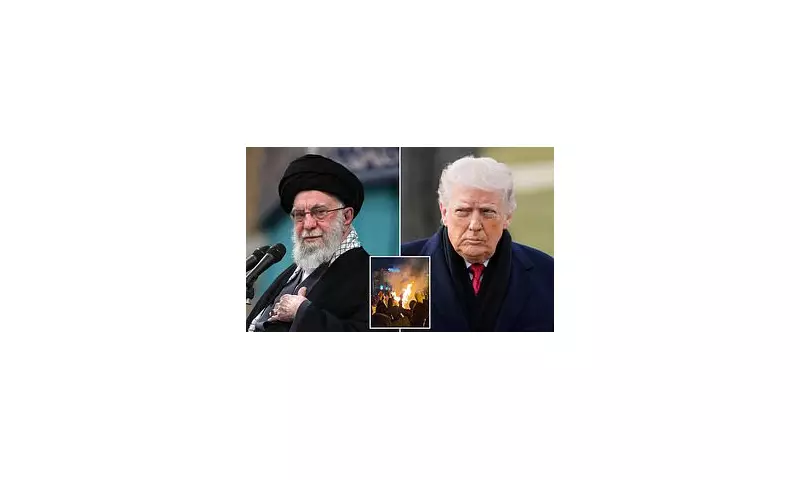
Iran's Supreme Leader has launched a blistering attack on the United States, labelling President Donald Trump a 'criminal' for his support of anti-government protesters and directly blaming Washington for the bloody crackdown that has left thousands dead.
Unprecedented Casualty Figures Confirmed
In a significant admission, Ayatollah Ali Khamenei confirmed for the first time that the wave of protests, which began on December 28, resulted in the deaths of 'several thousand' people. This marks the first official indication from Tehran of the scale of the casualties, aligning with reports from the US-based Human Rights Activists News Agency, which placed the death toll at over 3,000 Iranians.
This figure starkly surpasses the number of deaths recorded during the country's 1979 revolution. Khamenei, who holds final authority on all state matters, accused the US president of personally encouraging 'seditious people' and offering military support. 'We do consider the US president a criminal, because of casualties and damages, because of accusations against the Iranian nation,' the Ayatollah stated.

A War of Words and Threats
The Iranian leader's inflammatory comments followed days of escalating rhetoric from President Trump, who had told demonstrating Iranians that 'help is on the way'. Trump had vowed his administration would 'act accordingly' if the killing of demonstrators continued or if detained protesters were executed.
Khamenei described the protesters as 'foot soldiers' of the United States, alleging they destroyed mosques and educational centres and were armed with live ammunition imported from abroad. He reiterated long-standing accusations that Washington seeks domination over Iran's economic and political resources.
The situation reached a critical point when Trump claimed Iran had cancelled scheduled executions of over 800 people, a move that signalled a potential de-escalation and a step back from the brink of military action. The threat level to US forces in the region was subsequently lowered.
Aftermath and Continued Tensions
While the protests in Tehran and across the country have now subsided, the diplomatic fallout continues. Iranian officials, including President Masoud Pezeshkian in a call with Russian leader Vladimir Putin, have repeatedly accused the United States and Israel of fomenting the unrest.
Furthermore, Iran's Islamic Revolutionary Guard Corps (IRGC), designated a terrorist organisation by many Western nations, has issued a direct threat to US forces. An IRGC-affiliated Telegram channel warned it had pinpointed a hotel in Qatar used by top American commanders, telling them to 'watch your heads'. This followed the evacuation of US troops from several Middle Eastern bases.
During the height of the unrest, authorities imposed a near-total internet blackout on January 8. Limited services, including text messaging and restricted domestic internet access, only began to return briefly days later, with some citizens relying on VPNs to reach the global web.
The crisis underscores the dangerously volatile state of US-Iran relations, where fiery rhetoric and proxy confrontations risk spiralling into a broader, more direct conflict.