Iran Unleashes Missile Barrage in Retaliation for Supreme Leader's Death
Iran has fired a substantial barrage of missiles at targets in Israel and several Gulf Arab states, marking a dramatic escalation in regional hostilities following the killing of Supreme Leader Ayatollah Ali Khamenei. The 86-year-old cleric was killed in a joint United States and Israeli airstrike on his Tehran office on Saturday, an attack that has plunged the Islamic Republic into uncertainty and heightened fears of widespread instability across the Middle East.
Vows of Retribution and Presidential Threats
Iran's Cabinet declared that this "great crime will never go unanswered," while the paramilitary Revolutionary Guard threatened to launch its "most intense offensive operation" ever, specifically targeting Israeli and American military installations. In a televised address on Sunday, Iran's parliamentary speaker, Mohammad Bagher Qalibaf, warned, "You have crossed our red line and must pay the price. We will deliver such devastating blows that you yourselves will be driven to beg."
U.S. President Donald Trump responded forcefully on social media, stating, "Iran just stated that they are going to hit very hard today, harder than they have ever hit before. THEY BETTER NOT DO THAT, HOWEVER, BECAUSE IF THEY DO, WE WILL HIT THEM WITH A FORCE THAT HAS NEVER BEEN SEEN BEFORE!" Trump also framed the situation as a pivotal moment, asserting, "This is the single greatest chance for the Iranian people to take back their Country."

Immediate Military Retaliation and Regional Impact
Following the initial strikes that killed Khamenei, Iran immediately launched missiles and drones toward Israel and U.S. military bases in Bahrain, Kuwait, and Qatar. The Israeli military reported that dozens of missiles were fired at Israel, with many successfully intercepted by defense systems. Tragically, the Magen David Adom rescue service confirmed that a woman in the Tel Aviv area died from wounds sustained in the Iranian missile attack.
The retaliatory strikes caused significant disruption across the Middle East. Flights were widely cancelled or rerouted, and air defense fire was heard over Dubai, the commercial capital of the United Arab Emirates, with explosions continuing into Sunday morning. State media reported that shrapnel from an Iranian missile attack on the UAE capital killed one person, while debris from aerial interceptions ignited fires at the city's main port and damaged the facade of the iconic Burj Al Arab hotel.
Saudi Arabia stated that Iran targeted its capital and eastern region in an attack that was ultimately repelled, and Jordan confirmed it "dealt with" 49 drones and ballistic missiles. The attacks have raised serious concerns about global market stability, particularly regarding the Strait of Hormuz, a critical chokepoint through which a third of worldwide oil exports passed by sea in 2025. Any disruption to commercial traffic in the strait could trigger significant economic repercussions.
Leadership Vacuum and Internal Turmoil
The killing of Khamenei, which occurred during the second Trump administration assault on Iran in eight months, has created a profound leadership vacuum. The supreme leader held final authority on all major policies during his decades in power, overseeing both Iran's clerical establishment and the Revolutionary Guard, the twin pillars of the governing theocracy. With no clear successor immediately apparent, Iran quickly formed a council to govern the country until a new supreme leader can be selected.
State media also reported the deaths of the head of Iran's Revolutionary Guard and a top security adviser to Khamenei in the airstrikes. Major General Mohammad Pakpour has assumed command of the Guard, replacing the previous commander who was killed by Israel in a conflict last June. The adviser, Ali Shamkhani, was described by IRNA as a long-standing figurehead within Iran's security establishment.

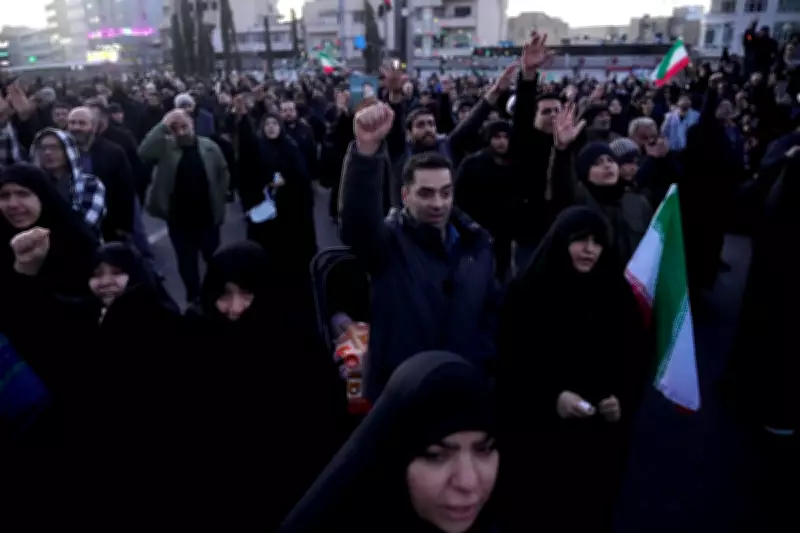
As news of Khamenei's death spread, eyewitnesses in Tehran told The Associated Press that some residents were openly celebrating, cheering from rooftops, blowing whistles, and performing traditional ululations. Conversely, mourners raised a black flag over the Imam Reza shrine in Mashhad, and the Iranian government declared 40 days of public mourning along with a seven-day nationwide public holiday to commemorate Khamenei's death.
The semiofficial Fars news agency, citing unidentified sources, reported that several relatives of Khamenei were also killed, including a daughter, son-in-law, daughter-in-law, and grandchild.
Months of Planning and Coordinated Strikes
The joint U.S.-Israel operation, which officials say was meticulously planned for months, commenced on Saturday during the Muslim holy fasting month of Ramadan and at the start of the Iranian workweek. It followed protracted negotiations and repeated warnings from the Trump administration. The U.S. military stated that targets in Iran included Revolutionary Guard command facilities, air defense systems, missile and drone launch sites, and military airfields. Despite "hundreds of Iranian missile and drone attacks" in retaliation, the U.S. reported no casualties and only minimal damage at its bases.
Democratic lawmakers criticized President Trump for taking military action without congressional authorization. White House spokesperson Karoline Leavitt countered that the administration had briefed several Republican and Democratic leaders in Congress in advance of the operation.
Escalating Tensions and Nuclear Concerns
Tensions had been building for weeks as the Trump administration assembled the largest concentration of American warships and aircraft in the Middle East in decades. President Trump had insisted he sought a deal to constrain Iran's nuclear program, even as the country grappled with internal dissent following nationwide protests. Although Trump previously declared the Iranian nuclear program obliterated in strikes last year, a senior U.S. official, speaking anonymously to discuss the decision-making process, revealed that Iran was rebuilding lost infrastructure.
Intelligence indicated that Iran had developed the capability to produce its own high-quality centrifuges, a crucial step toward producing the highly enriched uranium required for nuclear weapons. Iran maintained its right to enrich uranium but stated it hoped to avert a war. The country claims it has not enriched uranium since June, but it has blocked international inspectors from visiting the sites bombed by the U.S. Satellite imagery analyzed by AP shows new activity at two of these sites, suggesting Iran is attempting to assess and potentially recover material.
Civilian Casualties and International Response
Israel confirmed that the operation was coordinated with the United States over several months. Israeli Air Force pilots struck "hundreds of targets across Iran," according to a statement from military chief of staff Lt. Gen. Eyal Zamir. Targets included Iran's military assets, government symbols, and intelligence locations, as reported by an official briefed on the operation who spoke on condition of anonymity.
Tragically, civilian casualties were reported in Iran. In southern Iran, at least 115 people were killed when a girls' school was struck, with dozens more wounded, according to the local governor speaking on Iranian state TV. U.S. Central Command spokesperson Capt. Tim Hawkins acknowledged awareness of these reports and stated officials were investigating. An Iranian diplomat told the United Nations Security Council that hundreds of civilians were killed and wounded in the strikes. Iran's state news agency IRNA reported at least 15 deaths in the southwest, quoting the governor of the Lamerd region, Ali Alizadeh, who said a sports hall, two residential areas, and a hall near a school were hit.
The attack on Iran represents a startling new chapter in U.S. military intervention, carrying significant potential for further retaliatory violence and a broader regional conflict. This aggressive action marks a surprising shift for a president who campaigned on an "America First" platform and vowed to avoid entanglements in "forever wars." The situation remains highly volatile, with the risk of escalation posing a grave threat to regional and global stability.