Iran Temporarily Shuts Strait of Hormuz for Military Drills During US Nuclear Talks
Iran announced the temporary closure of the Strait of Hormuz on Tuesday for live-fire military drills, marking a rare show of force as its negotiators engaged in another round of indirect talks with the United States in Geneva over its disputed nuclear program. This closure represents the first time Iran has publicly shut the key international waterway, through which approximately 20% of the world's oil passes, since the US began threatening Iran and deploying military assets to the region.
Escalating Tensions in the Middle East
The move signals a further escalation in a weeks-long standoff that risks igniting another conflict in the Middle East. As the talks commenced, Iran's state media reported that live missiles had been fired toward the Strait, and it would be closed for several hours due to safety and maritime concerns. The semiofficial Tasnim news agency, which has close ties to the paramilitary Revolutionary Guard, stated that missiles launched from inside Iran and along its coast successfully struck their targets in the Strait.
Iranian state television later confirmed that the talks concluded after nearly three hours. Earlier reports indicated that the negotiations would be indirect, focusing solely on Iran's nuclear program and excluding domestic policies, such as the recent bloody crackdown on protests. US President Donald Trump has repeatedly threatened to use military force to compel Iran to constrain its nuclear activities, while Iran has vowed to respond with its own attacks.

Details of the Indirect Negotiations
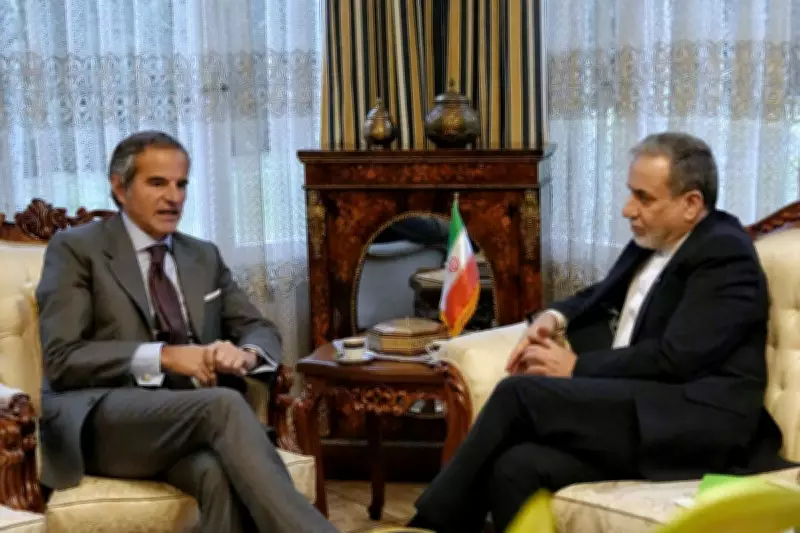
The first round of talks on February 6 took place in Oman, a sultanate on the eastern edge of the Arabian Peninsula, and were also conducted indirectly. The latest discussions were held inside the residence of the Omani envoy to Geneva, with both sides meeting separately with mediators. Trump's envoys, Steve Witkoff and Jared Kushner, traveled for this new round of talks.
Iranian Foreign Minister Abbas Araghchi, leading the talks for Iran, met with the head of the UN nuclear watchdog agency on Monday in Geneva. In a post on X, Araghchi wrote, I am in Geneva with real ideas to achieve a fair and equitable deal. What is not on the table: submission before threats. A diplomat close to the UN nuclear watchdog confirmed that director general Rafael Grossi was also in Geneva to provide technical advice to both parties when requested, speaking anonymously due to the sensitivity of the talks.
Speaking to reporters aboard Air Force One on Monday night, President Trump indicated he planned to be involved in the talks, at least indirectly, stating, I think they want to make a deal. I don't think they want the consequences of not making a deal.
Military Drills and Warnings
Iran's Revolutionary Guard initiated a drill early Monday in the Strait of Hormuz, the Persian Gulf, and the Gulf of Oman, crucial international shipping routes. This marks the second live-fire exercise in the Strait in recent weeks. Iran's Supreme Leader Ayatollah Ali Khamenei escalated warnings to the US over its military buildup in the Middle East, remarking via state TV, Of course a warship is a dangerous apparatus, but more dangerous than the warship is the weapon that can sink the warship into the depths of the sea. He also cautioned that forcing the result of talks in advance is a wrong and foolish job.
US Military Presence and Regional Concerns
Last week, Trump announced that the USS Gerald R. Ford, the world's largest aircraft carrier, was being deployed from the Caribbean Sea to the Middle East to join other warships and military assets accumulated in the region. The Ford will join the USS Abraham Lincoln and its accompanying guided-missile destroyers, which have been stationed there for over two weeks. US forces recently shot down an Iranian drone that approached the Lincoln on the same day Iran attempted to stop a US-flagged ship in the Strait of Hormuz.

Gulf Arab nations have warned that any attack could spiral into another regional conflict, exacerbating tensions in a Middle East still recovering from the Israel-Hamas war. The Trump administration seeks a deal to limit Iran's nuclear program and prevent the development of nuclear weapons, while Iran insists its program is peaceful and resists demands to halt uranium enrichment or surrender its stockpile of highly-enriched uranium.
Background and Recent Conflicts
US-Iran talks were previously halted in June when Israel launched a 12-day war against Iran, during which the US bombed Iranian nuclear sites, likely destroying many centrifuges used to enrich uranium to near weapons-grade purity. Israel's attacks also targeted Iran's air defenses and ballistic missile arsenal. Prior to the June war, Iran had been enriching uranium up to 60% purity, a short technical step from weapons-grade levels.
Domestic Unrest and Mourning Period
Iran is currently observing 40 days, the traditional Muslim mourning period, since one of the deadliest days in the crackdown on protests that swept the country last month. Activists report at least 7,015 people killed, many during a bloody crackdown overnight between January 8 and 9. The US-based Human Rights Activists News Agency, which has accurately counted deaths in previous unrest, provided these figures based on a network of activists in Iran. The Associated Press has been unable to independently verify the death toll due to internet disruptions and restricted international calls.
Iran's state news agency stated that the government will hold a memorial marking 40 days at the Grand Mosalla mosque in Tehran, blaming the demonstrations on violent actions by armed groups allegedly directed by foreign intelligence agencies.