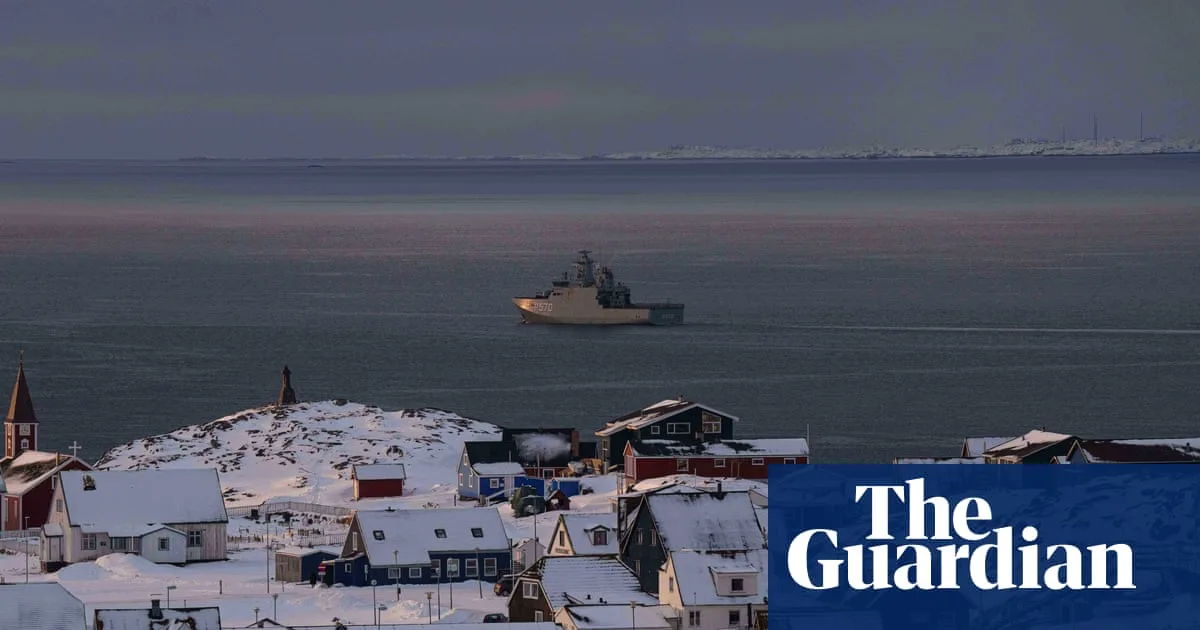
US President Donald Trump's increasingly bellicose demands for control of Greenland have sparked one of the greatest crises for the transatlantic partnership in its history, potentially forcing Europe to draw a line in the snow, officials have said. European leaders have entertained Trump's demands for nearly a year, but his repeated calls for Denmark to cede or sell the semi-autonomous island have raised questions about sovereignty and Europe's ability to stand up for itself.
Danish Foreign Minister Lars Løkke Rasmussen told Fox News after talks with US Vice President JD Vance and Secretary of State Marco Rubio: “The president’s ambition is on the table. Of course we have our red lines. This is 2026, you trade with people but you don’t trade people.” Rasmussen and Greenland’s Foreign Minister Vivian Motzfeldt were seen smoking cigarettes outside the Eisenhower Executive Office Building in Washington DC after the hour-long meeting.
Kristine Berzina, a senior fellow at the German Marshall Fund, said: “When it comes to Greenland, the Europeans have found a red line that they really want to stand by. Everything else has been subject to negotiation … but the Greenland situation is different because it comes to the question of sovereignty, and it comes to the question of whether Europe is capable of standing up for itself in terms of its own territory, its own rights.”
However, Europe is at a “diplomatic disadvantage” due to its dependency on the US for security, said Latvia’s former prime minister Krišjanis Kariņš. “Europe is not, unfortunately, in a strong position to strongly object, because, say, if Europe were to open up the dispute into the trade area, I’m certain that the US would respond in kind or more than in kind. At the end of the day, Europe still needs the US.”
The strain on Danish and Greenlandic officials has been enormous. An emotional Motzfeldt said she had been overwhelmed by the negotiations. Marisol Maddox, a senior fellow at Dartmouth University’s Arctic studies institute, said: “Denmark has really only been a good ally to the US. So that’s also a part of what makes this so extraordinary, is this was like going up to your best friend and just randomly slapping them in the face ... There’s nothing to provoke this.”