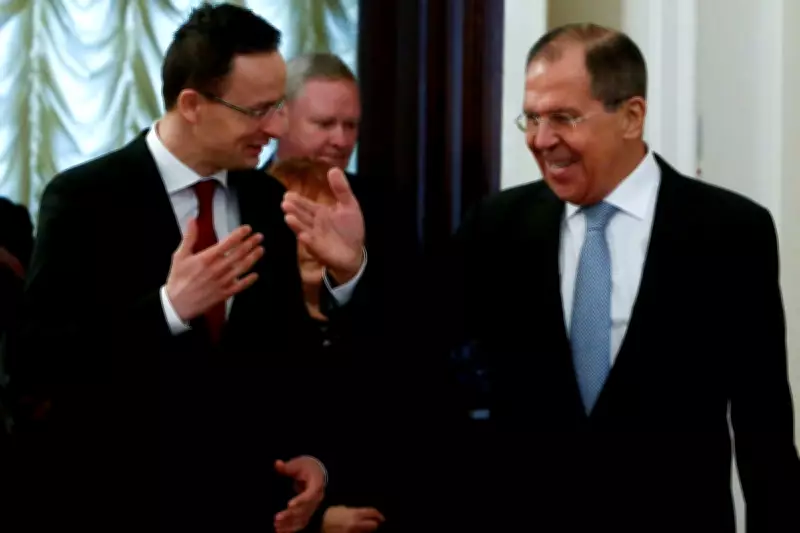
Leaked Audio Reveals Hungary's Foreign Minister Discussed EU Sanctions with Russia
A leaked audio recording has surfaced, allegedly capturing Hungarian Foreign Minister Peter Szijjarto discussing the removal of European Union sanctions with his Russian counterpart Sergei Lavrov. The recording was released by Warsaw-based investigative outlet Vsquare.org on Tuesday, just days before Hungary's pivotal parliamentary election on 12 April.
Content of the Controversial Call
According to the published recording, which Vsquare claims is from an August 2024 phone call, Lavrov reminded Szijjarto of a promise to help remove the sister of a Russian businessman from the EU's sanctions list. In the English-language audio, Szijjarto responds that Hungary and Slovakia would submit a proposal the following week to achieve this removal.
"We will do our best in order to get her off," Szijjarto states clearly in the recording. Vsquare also reported on a separate call, for which it did not provide audio, in which Szijjarto allegedly told Russia's Deputy Energy Minister Pavel Sorokin that he was working to repeal EU sanctions targeting Russia's shadow fleet of oil tankers.

Political Fallout and Election Implications
The leak follows Prime Minister Viktor Orban's recent order for an investigation into alleged wiretapping of Szijjarto, aiming to contain fallout from media reports about Hungary's Russia ties. This development underscores growing EU unease that Hungary may be serving Russian interests, potentially undermining bloc efforts to support Ukraine against Russian aggression.
Mr Orban, a veteran nationalist leader, faces what many consider his toughest election in 16 years. The centre-right Tisza party currently leads most independent polls significantly, adding pressure to the political landscape. Szijjarto did not deny that the call with Lavrov took place and acknowledged that his conversations had been intercepted, calling the wiretapping a "huge scandal" in a video on his Facebook page.
Broader Context of Hungary-Russia Relations
Orban has consistently fostered warm ties with President Vladimir Putin despite Russia's ongoing war in Ukraine, while maintaining Hungary's heavy reliance on Russian oil and gas supplies. Szijjarto has travelled frequently to Moscow since Russia's full-scale invasion of Ukraine in 2022, including a meeting with Putin on 4 March to discuss oil supplies among other issues.
Earlier this month, the Washington Post reported that Szijjarto had for years made regular phone calls during breaks at EU meetings to brief Lavrov with what the paper described as "live reports on what's been discussed." Szijjarto initially dismissed that report as "fake news" but later acknowledged consulting with non-EU countries before or after meetings of EU foreign ministers, including Russia, the United States, Turkey and Israel, describing this practice as "perfectly natural."
International Reactions and Verification Questions
The Russian government has not immediately commented on the leaked recording. Meanwhile, the Slovak Foreign Ministry stated it "will not comment or convey the details of its negotiating positions or those of other member states." Slovak Prime Minister Robert Fico emphasized at a news conference that removing someone from an EU sanctions list requires the agreement of all 27 member states.
"So you cannot accuse anyone of being a Russian agent; then you must accuse all 27 member states of being Russian agents if they have reached a decision," Fico argued. A Vsquare representative told Reuters that the outlet independently verified the audio recording using sources in more than one country and with the help of external audio experts, though Reuters itself was unable to independently verify the authenticity of the recording or the account of the call with Sorokin.