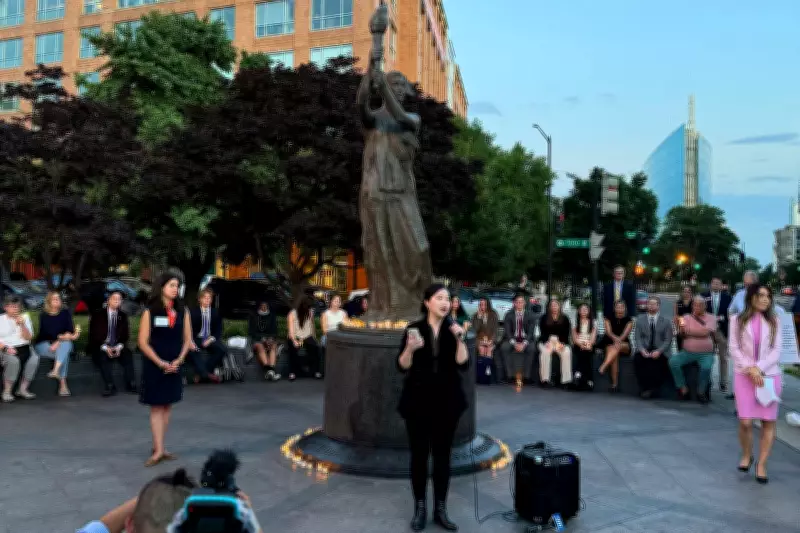
Hong Kong Court Sentences Father of US-Based Activist to Eight Months in Prison
A Hong Kong court has handed down an eight-month prison sentence to the father of a US-based pro-democracy activist, marking the first prosecution of a family member under the city's stringent national security legislation. The landmark case unfolded on Thursday, with the court convicting 69-year-old Kwok Yin-sang for attempting to deal with financial assets belonging to an individual classified as an "absconder" under the 2024 security law.
Details of the Case and Conviction
Kwok Yin-sang was found guilty earlier this month of trying to withdraw approximately $11,000 from an insurance policy he had purchased for his daughter, Anna Kwok, when she was a toddler. The court heard that in 2025, he sought to terminate the policy and access the funds, leading to his arrest that same year. The charge stemmed from allegations that he was attempting to handle finances for an "absconder," a designation applied to his daughter, who is the executive director of the Washington-based Hong Kong Democracy Council.
Acting Principal Magistrate Cheng Lim-chi delivered the sentence on Thursday, despite arguments from Kwok's lawyer for a mere 14-day term. The defence contended that no evidence suggested Kwok intended to send the money to his daughter. However, the magistrate upheld the conviction, which carries a maximum penalty of seven years imprisonment, though cases in magistrates' courts typically result in sentences not exceeding two years.

International Reactions and Broader Context
Anna Kwok, who is among 34 individuals targeted by police bounties offering 1 million Hong Kong dollars (about $127,900) for information leading to her arrest, condemned her father's conviction as an act of "transnational repression." She asserted that "my father was convicted simply for being my father," labelling the charge as based on an "incoherent fiction." Authorities have prohibited anyone from handling funds for her, accusing her of demanding foreign sanctions, blockades, and engaging in hostile activities against China and Hong Kong during meetings with foreign politicians.
The case is part of a wider crackdown on dissent following the massive anti-government protests in 2019. Police have also issued bounties for other overseas-based Hong Kong activists, including pro-democracy former lawmakers Nathan Law and Ted Hui. In response, the US and UK governments have condemned these bounties, with Washington sanctioning six Chinese and Hong Kong officials in 2025 for involvement in "transnational repression" and actions threatening Hong Kong's autonomy. Beijing retaliated by announcing sanctions against US officials, lawmakers, and NGO leaders it accused of poor performance on Hong Kong issues.
Legal and Political Implications
This sentencing underscores the expansive reach of Hong Kong's national security laws, including the 2024 legislation, locally known as Article 23, and the Beijing-imposed law enacted in 2020. The Hong Kong and Chinese governments maintain that these laws are essential for the city's stability, but critics argue they are being used to suppress opposition and target activists' families. The case highlights the growing tensions between Hong Kong authorities and pro-democracy advocates abroad, with implications for international relations and human rights concerns.
As the first prosecution of a relative under these laws, it sets a precedent that could affect other families of activists living overseas. The outcome may influence future legal actions and diplomatic standoffs, particularly as Western nations continue to voice objections to what they perceive as erosions of Hong Kong's autonomy and freedoms.