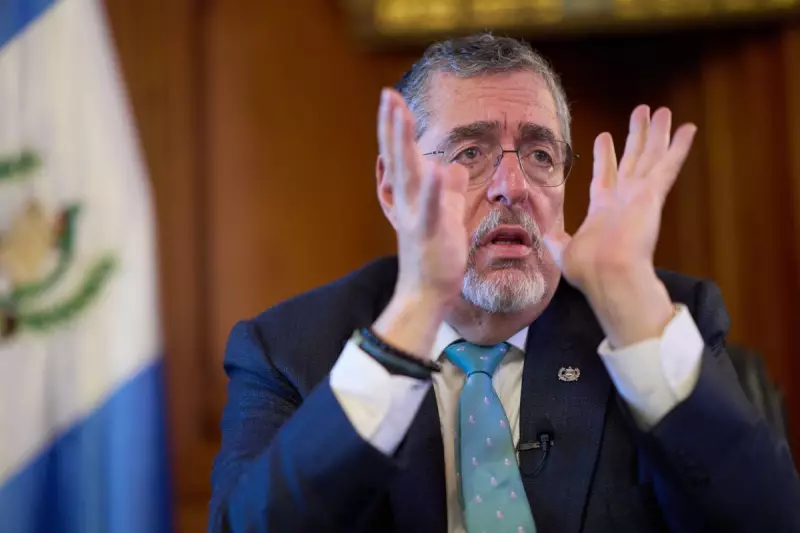
Guatemalan President Bernardo Arévalo has outlined his nation's delicate diplomatic strategy, aiming to preserve a strong partnership with the United States while firmly advocating for international law and national sovereignty. His comments come against a backdrop of what he describes as a global phase of profound disorder.
A Legacy of Intervention and a New Path
Speaking in an interview on Thursday, 15 January 2026, Arévalo acknowledged the complex history between his country and the US. He is the son of former President Juan José Arévalo, who was forced into exile in Uruguay following the US-backed CIA coup in 1954 that ousted President Jacobo Arbenz. That event ushered in decades of military rule and civil conflict.
Now, as Guatemala's leader, Arévalo brings his background in international dispute resolution to the presidency. He faces the modern challenge of engaging with a US administration under President Trump that has threatened further interventions in the region.

Walking a Diplomatic Tightrope
Arévalo's approach mirrors that of neighbouring Mexico, involving a careful balancing act. On one hand, Guatemala is eagerly cooperating with Washington on shared interests, notably the fight against cross-border drug trafficking. On the other, it is working diligently to protect its own sovereignty and promote peaceful conflict resolution on the world stage.
"The world in general is experiencing a phase of disorder, disorder in the sense that the norms of the old order are breaking," Arévalo told The Associated Press. He posed the central question: "The problem is how do we recover that sense of order to get the world to fit together again."
A Strategic Relationship for a Chaotic Era
Despite the historical tensions and current global uncertainties, President Arévalo struck a notably positive tone regarding the present state of bilateral relations. He emphasised that the connection is now so robust that the prospect of renewed US intervention is not a consideration for his government.
"We have right now a level of relations so strong and strategic that we don’t even consider that scenario," he stated confidently. This declaration underscores his administration's primary goal: to maintain a productive, mutually beneficial partnership with the United States, built on contemporary shared interests rather than the painful legacy of the past.
Arévalo's stance is particularly significant following the recent US removal of Venezuela's president, a stark reminder of Washington's continued willingness to involve itself in hemispheric affairs. For Guatemala, the path forward is one of pragmatic diplomacy, seeking stability in an increasingly chaotic world.