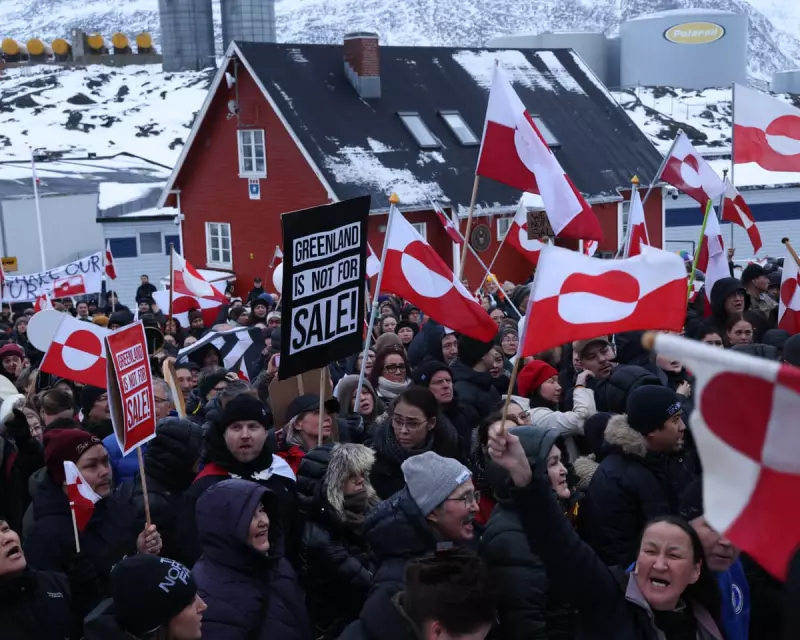
Residents of Greenland have taken to the streets in front of the US consulate, bearing the distinctive white and red Greenlandic flag, in a direct protest against former President Donald Trump's stated intent to acquire the world's largest island. This public demonstration underscores the growing anxiety in the sparsely populated, strategically vital territory as it finds itself thrust into the centre of global power politics.
The Melting Ice Reveals a Strategic Prize
The accelerating pace of climate heating is rapidly shrinking the Arctic ice cap, transforming Greenland's geopolitical significance. Once considered a frozen backwater, the island is now viewed as a crucial gateway between North America, Europe, and Russia. The retreating ice is opening up new sea lanes for shipping and exposing vast, untapped mineral resources, including rare earth elements critical for modern technology and defence systems.
This newfound value helps explain why Trump's previously dismissed threats are now being taken with utmost seriousness in European capitals. The US, Russia, and China have all significantly increased their polar activities, with Russia rebuilding Cold War-era bases and China declaring itself a "near-Arctic state." For Trump, the goal appears to have shifted from cooperation to control.

Political Fault Lines and a Society on Edge
The pressure is having a direct impact on Greenland's domestic politics. While all major parties support eventual independence from Denmark, Trump's rhetoric has forced a brutal reprioritisation: security concerns are now overshadowing long-term sovereignty ambitions. Greenland's Premier, Jens-Frederik Nielsen, has firmly stated, "Greenland does not want to be part of the US," affirming the territory's current status within the Kingdom of Denmark.
However, divisions exist. The Naleraq party, the second-largest in Greenland's parliament (Inatsisartut), believes the territory should negotiate directly with Washington, a potential crack that external powers could exploit. On the ground in the capital, Nuuk, the threat has moved from abstract to palpable. Families are reportedly tracking military flights on apps and discussing with their children what it would mean to become American.
"People are thinking through things they never imagined having to think about," said the Guardian's Nordic correspondent, Miranda Bryant, after a recent visit. "Do you leave before it happens? Do you wait? If soldiers arrive, do you submit? Do you protest?"
Europe's Dilemma and the Spectre of a Trade War
Europe faces an impossible strategic dilemma. Denmark has increased its military presence in Greenland but remains a minor power compared to a nuclear-armed United States openly discussing conquest. The principle that borders cannot be changed by force now appears fragile. Over the weekend, Trump escalated tensions by threatening a tariff trade war with Europe over Greenland, a move criticised by British Prime Minister Keir Starmer in a call with the US president.
This approach mirrors actions in Trump's second term, where he forced Ukraine into an agreement granting the US a share of future mineral profits. Greenland, with its immense rare earth deposits, fits the same pattern of linking security with resource extraction. The emotional strain on Greenlandic leaders was visible after meetings in Washington, with Foreign Minister Vivian Motzfeldt describing the intense pressure faced.
As the Arctic ice continues to melt, the world is witnessing a stark return to a form of realpolitik where might and opportunity threaten to override established international norms. For the 56,000 people of Greenland, the changing climate has brought not just environmental transformation, but the unnerving gaze of a superpower.