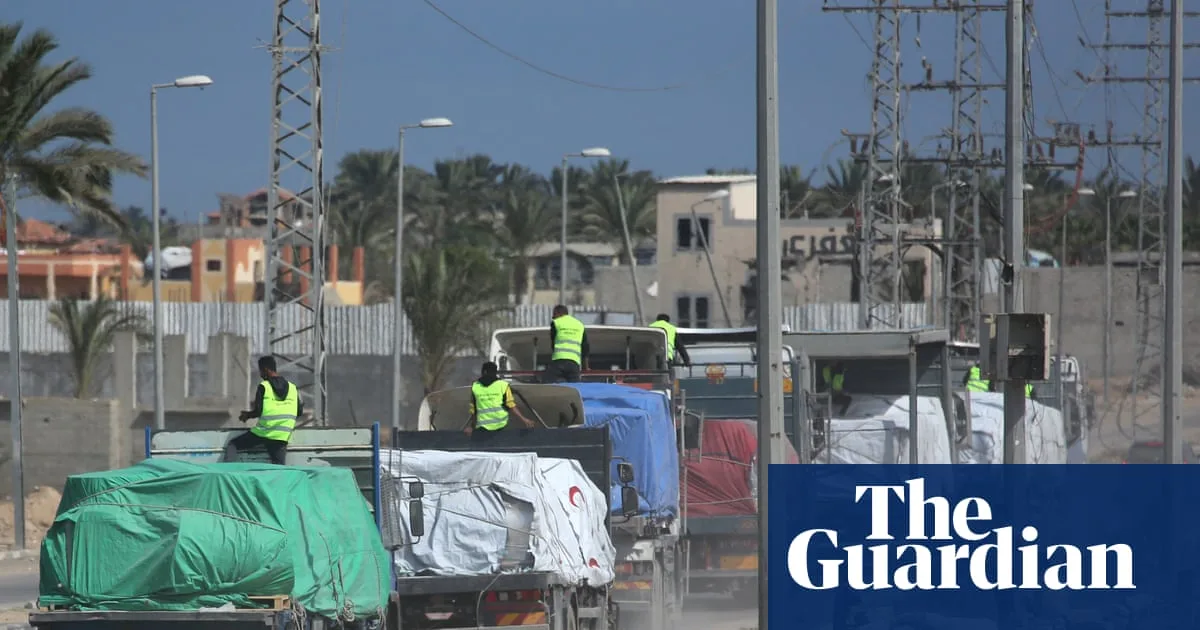
Aid remains critically scarce in Gaza one week into the ceasefire, humanitarian agencies have warned, as Israel delays the entry of food convoys into the territory. The UN World Food Programme (WFP) said on Friday that it had brought about 560 tonnes of food a day on average into Gaza since the ceasefire began, but it was still below what was needed.
WFP spokesperson Abeer Etefa said: 'We’re still below what we need, but we’re getting there ... The ceasefire has opened a narrow window of opportunity, and WFP is moving very quickly and swiftly to scale up food assistance.' Aid trucks were lined up at the Kissufim crossing between Israel and Gaza since the early hours, with drivers often waiting for hours for clearance to pass.
Although 600 trucks are meant to enter Gaza each day, fewer than half that number make it through. Stringent restrictions on what can be transported mean that some convoys are forced to turn back. The UN said it would take time to reverse the famine in Gaza and urged the opening of all crossing points, particularly Zikim and Erez to the north, where the humanitarian crisis is most acute.
The World Health Organization (WHO) has warned that infectious diseases are 'spiralling out of control', with only 13 of the territory’s 36 hospitals even partially functioning. Hanan Balkhy, the regional director for the UN health body, said: 'Whether meningitis … diarrhoea, respiratory illnesses, we’re talking about a mammoth amount of work.'
Meanwhile, Israel continued to fire on Palestinians. The Israeli army shelled a car which had crossed past the ceasefire line in the Zeytoun neighbourhood of Gaza, killing nine people. Mahmoud Basal, the spokesperson for the Gaza civil defence, said: 'They had crossed the so-called “yellow line”, an imaginary boundary mentioned by the Israeli army. I am certain the family couldn’t distinguish between the yellow and red lines because there are no actual physical markers on the ground.'