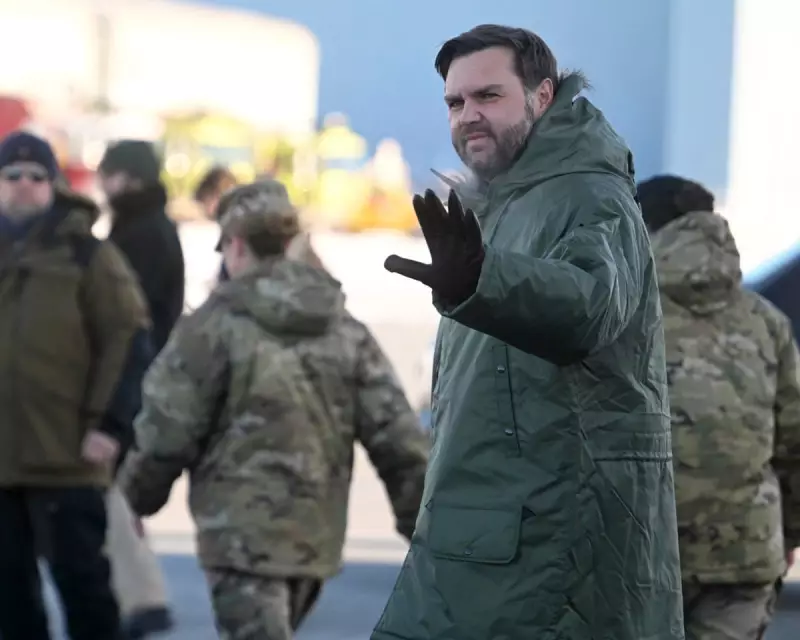
The visit of US Senator JD Vance to the Pituffik military base in Greenland on 28 March 2025, captured in a photograph by Jim Watson of AP, is more than a routine trip. It symbolises a pressing challenge for Europe. According to Fabian Zuleeg, Chief Executive of the European Policy Centre, the continent faces a critical litmus test for its credibility in a volatile new world order.
A New World Order: Interventionist Isolationism
Donald Trump's recent actions, including the seizure of Venezuela's President Nicolás Maduro, are not isolated shocks. They represent a coherent doctrine of interventionist isolationism, driven by a revisionist and neo-nationalist agenda. In this worldview, international rules are optional, power is exercised bluntly, and alliances are purely transactional. Zuleeg warns that in such a dog-eat-dog world, European hesitation and ambiguity are not stabilising forces but vulnerabilities to be exploited by a predatory Washington.
The combination of the Venezuela operation and Trump's renewed interest in acquiring Greenland—potentially through military means—should shatter any illusion that this is mere erratic behaviour. It reflects a stance where sovereignty is conditional, spheres of influence are legitimate, and coercion is normalised if it serves the administration's interests. The central question for Europe is no longer about disapproval, but about crafting a robust response.

Three Imperatives for a Grown-Up Europe
Zuleeg outlines three critical imperatives for European liberal democratic forces. The first is to unequivocally oppose actions that undermine the international order. Trump's Venezuela policy strikes at the very principle of sovereignty, signalling that powerful states may override it at will. Europe's cautious response, often justified by fears of jeopardising US support for Ukraine, is flawed logic. By normalising coercive regime change, Trump's actions ironically undermine the case for defending Ukraine's sovereignty, echoing Russia's own justifications for its aggression.
Appeasement does not restrain Trump, nor does acquiescence preserve stability. It simply confirms that coercion works. European leaders like France's Emmanuel Macron and Germany's Frank-Walter Steinmeier have begun speaking out in the right direction, and this must continue.
Building Resilience and Enforcing Unity
The second imperative is to rededicate Europe's existing capabilities to resilience and security. This is not solely about future investment but about reorienting current military, economic, and industrial assets towards deterrence. True resilience means the ability to absorb shocks—be it in energy, supply chains, or defence—without capitulating. Support for Ukraine remains a frontline test of whether sovereignty matters in Europe's neighbourhood.
The risks are tangible. The logic linking Venezuela and Greenland could be applied elsewhere, such as Russia testing European resolve in the Arctic around Svalbard. US moves on Greenland could be part of a broader agenda to weaken the EU and bolster internal political forces aligned with Trumpism. Weakness invites experimentation.
The third imperative concerns unity with consequences. European unity is essential but cannot be an excuse for paralysis. Governments that are unwilling to act, like Hungary or others on a case-by-case basis, must face exclusion from certain benefits of collective defence and security cooperation. Solidarity, Zuleeg argues, is a two-way street. Simultaneously, Europe must widen its circle of cooperation with like-minded partners such as the UK, Norway, Canada, and Japan, engaging in pragmatic cooperation to maintain global guardrails.
Greenland: The Litmus Test for Credibility
Europe cannot prevent Trump from making destructive choices, but it can shape the incentives. If Washington moves on Greenland or pursues similar coercion, there must be clear costs. These cannot be symbolic gestures but measures that resonate domestically in the US and impact Trump's political base. Europe possesses significant leverage through trade, market access, regulatory cooperation, and industrial partnerships.

Deterrence requires signalling that aggression carries consequences—not because Europe seeks confrontation, but because their absence invites escalation. Greenland is Europe's credibility litmus test.
The era where Europeans could rely on others to uphold rules while benefiting from restraint is over. The choice is now between passivity and responsibility. Europe must grow up, recognising that playing for time and acquiescing only increases its vulnerability in a harsher, more transactional world.