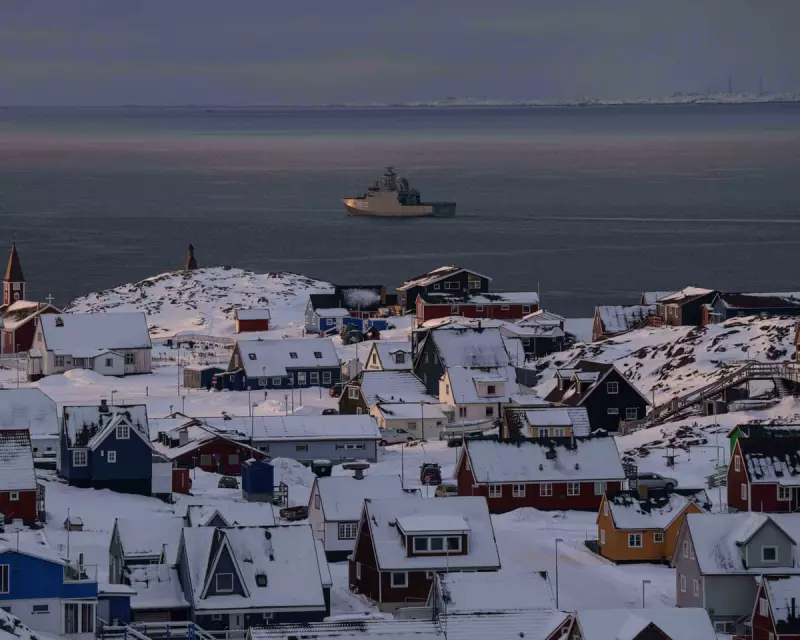
The simmering diplomatic crisis over Greenland has escalated into what analysts describe as a pivotal test for European sovereignty and the future of the transatlantic alliance. The catalyst is a series of increasingly bellicose demands from US President Donald Trump for Denmark to cede or sell the vast, semi-autonomous Arctic territory.
A Red Line in the Snow: Europe's Sovereignty at Stake
Following an hour of tense talks in Washington D.C. with US Vice-President JD Vance and Secretary of State Marco Rubio, Danish Foreign Minister Lars Løkke Rasmussen and Greenland's Foreign Minister Vivian Motzfeldt stood grim-faced outside the Eisenhower Executive Office Building. "The president's ambition is on the table," Rasmussen later told Fox News. "Of course we have our red lines. This is 2026, you trade with people but you don't trade people."
Experts argue this confrontation over territory marks a fundamental shift. "When it comes to Greenland, the Europeans have found a red line that they really want to stand by," said Kristine Berzina of the German Marshall Fund. She noted that while other US demands—from increased NATO defence spending to a softened stance on Ukraine—were negotiated, Greenland strikes at the core of territorial sovereignty and Europe's ability to defend itself.

The strain on the Danish and Greenlandic officials has been palpable. A visibly emotional Motzfeldt confessed to being overwhelmed by the negotiations, describing the US pressure as a profound betrayal. Marisol Maddox of Dartmouth University's Arctic Institute likened it to "going up to your best friend and just randomly slapping them in the face."
Trump's Obsession and Europe's Precarious Position
President Trump's interest in acquiring Greenland, first seeded by friend Ronald Lauder in 2019, has only intensified. While the White House cites national security concerns regarding Russian or Chinese activity in the Arctic, Trump himself admitted to the New York Times that ego is a key driver, stating ownership was "psychologically needed for success." His threat on Friday to impose tariffs on nations not supporting his annexation ambition has raised the stakes further.
Europe finds itself in a bind due to its continued reliance on American security guarantees. Latvia's former Prime Minister Krišjānis Kariņš pointed out the bloc's "diplomatic disadvantage," warning that any European retaliation in trade would likely be met with a disproportionate US response. "At the end of the day, Europe still needs the US," he conceded.
European diplomats also view Vice-President Vance's direct involvement in talks as a negative signal, interpreting it as a desire to escalate tensions with allies. One diplomat noted, "It's clear why he's gotten involved and it will make the talks more emotional."
Europe's Response: Military Deployments and Diplomatic Manoeuvres
In a direct effort to undermine the US security pretext for annexation, European nations have initiated a military reinforcement of Greenland. A small French contingent arrived on the island last Thursday, joining troops from Germany, Sweden, Norway, Finland, the Netherlands, and the United Kingdom. Danish Prime Minister Mette Frederiksen emphasised that "the defence and protection of Greenland is a common concern for the entire NATO alliance."
Kariņš argued this move is strategically vital, as it "takes away a public argument by the Trump administration" that the territory is vulnerable. Alongside military steps, more radical diplomatic countermeasures are being debated within the EU. These include:

- Convening an international Arctic security summit in Nuuk, co-hosted by Denmark, Greenland, the EU, and non-EU states like the UK and Canada.
- Freezing the European Parliament's ratification vote on the EU-US trade deal agreed with Trump last year—a move suggested by socialist and green MEPs to avoid "rewarding" his actions.
However, the EU's public response remains cautiously diplomatic. European Commission President Ursula von der Leyen reiterated the US as an ally while pledging deeper support for Greenland, including a proposed doubling of EU financial aid. "Greenland can count on us, politically, economically and financially," she stated.
As Danish and Greenlandic ministers prepare for talks with NATO Secretary General Mark Rutte, the crisis over the remote Arctic island has crystallised a long-brewing dilemma for Europe. It must now navigate its dependency on a mercurial American partner while defending the very principles of sovereignty that underpin its alliance. The line, as Rasmussen indicated, has finally been drawn in the snow.