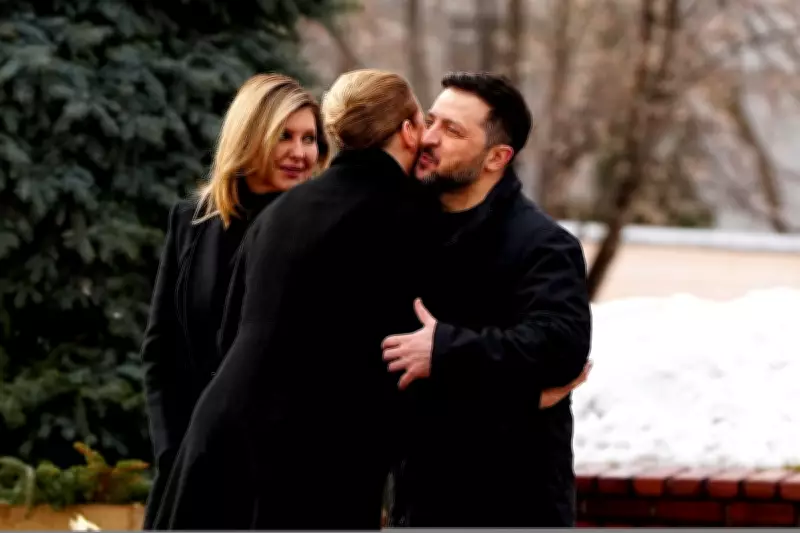
European Leaders Gather in Kyiv to Mark Fourth Anniversary of Russia's Full-Scale Invasion
More than a dozen senior European officials arrived in the Ukrainian capital on Tuesday in a powerful display of solidarity, as the nation solemnly marks the fourth anniversary of Russia's all-out invasion. This grim milestone underscores a conflict that has claimed tens of thousands of lives and left European leaders deeply concerned about Moscow's expansive ambitions across the continent.
Zelenskyy Reflects on Resilience Amid Ongoing Struggle
Ukrainian President Volodymyr Zelenskyy asserted that his country has successfully withstood the onslaught from Russia's larger and better-equipped military. According to data from the Washington-based Institute for the Study of War, Russian forces captured only 0.79% of Ukrainian territory over the past year of intense fighting.
"Looking back at the beginning of the invasion and reflecting on today, we have every right to say: we have defended our independence, we have not lost our statehood," Zelenskyy declared in a social media statement. He emphasized that Russian President Vladimir Putin "has not achieved his goals" and "has not broken Ukrainians; he has not won this war."

Peace Talks Stalled as War Enters Fifth Year
As this corrosive war of attrition moves into its fifth devastating year, a U.S.-led diplomatic initiative to end Europe's largest armed conflict since World War II appears no closer to achieving breakthroughs. Negotiations remain deadlocked on critical issues, including:
- The future of Donbas, eastern Ukraine's industrial heartland, which Russian forces largely occupy but have failed to seize completely.
- The terms of a postwar security arrangement that Kyiv insists is necessary to deter any future Russian aggression.
A recent report from the Center for Strategic and International Studies estimated that the number of soldiers killed, injured, or missing on both sides could reach two million by spring. The analysis suggests Russia has sustained the highest number of troop deaths for any major power in any conflict since World War II.
European Security Concerns and Global Implications
European leaders view their own nations' security as inextricably linked to Ukraine's fate, amid growing apprehensions about Putin's broader strategic objectives. They have demanded inclusion in the ongoing U.S.-brokered peace discussions.
German Chancellor Friedrich Merz expressed this sentiment on social media, stating: "For four years, every day and every night has been a nightmare for the Ukrainians — and not just for them, but for us all. Because war is back in Europe." He added, "We will only end it by being strong together, because the fate of Ukraine is our fate."
The conflict has evolved into a global crisis, drawing in nations far beyond Ukraine's borders and threatening to exacerbate shortages, hunger, and political instability across developing regions. While NATO countries have provided crucial assistance to Ukraine, Russia has received support from:
- North Korea, which has dispatched troops and artillery shells.
- Iran, which has supplied advanced drone technology.
- China, which the United States and analysts say has provided machine tools and semiconductor chips.
High-Profile Delegation and Reconstruction Challenges
The European delegation visiting Kyiv on Tuesday included prominent figures such as European Council President Antonio Costa, European Commission President Ursula von der Leyen, and Finnish President Alexander Stubb. They were joined by seven prime ministers and three foreign ministers, underscoring the continent's unified stance.
With Ukraine unable to sustain its defense against Russia without external support, NATO nations are now facilitating military aid through purchases of American weaponry. This shift occurred after the Trump administration altered previous Washington policy by halting direct arms transfers to Kyiv.
The European Union has also extended financial assistance, though this has occasionally faced resistance from member states like Hungary and Slovakia.

British Armed Forces Minister Al Carns described Russia's war on Ukraine as "the most defining conflict" in decades, noting that "I don't think anyone of us would be able to guess (when the war started) the scale and size of what has taken place."
The monumental task of rebuilding war-ravaged Ukraine presents staggering economic challenges. According to a joint report released Monday by the World Bank, the European Commission, the United Nations, and the Ukrainian government, reconstruction costs are projected to reach nearly $588 billion over the next decade. This figure represents almost three times Ukraine's estimated nominal GDP from last year, highlighting the profound devastation wrought by four years of relentless conflict.