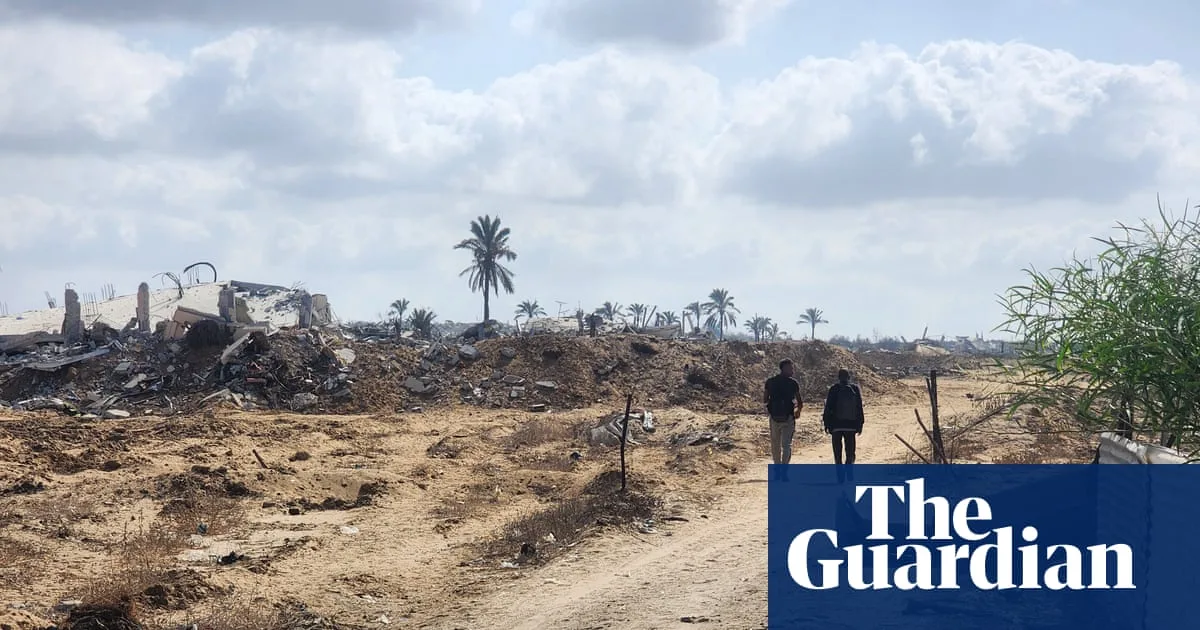
In the Gaza Strip, an invisible and inconsistently marked boundary known as the "yellow line" has become a deadly frontier where Palestinian civilians, including children, are being shot by Israeli troops. The line was established as part of a ceasefire agreement in October 2025, but its ambiguous placement and enforcement have led to numerous fatalities.
A Deadly Frontier of Fear and Ambiguity
According to the Gaza Health Ministry, at least 77 of the 447 Palestinians killed between the ceasefire and Tuesday 13 January 2026 died from Israeli gunfire near this line. The Associated Press confirmed that among these casualties were teenagers and young children. Those sheltering near the boundary describe living in constant fear, with Israeli soldiers directing near-daily fire at anyone who crosses or even lingers close to it.
The Israeli military has placed some yellow barrels and concrete barriers to mark the limits of the Palestinian zone. However, the line remains completely unmarked in certain areas. In other places, mapping experts and Palestinians report it has been laid nearly half a kilometre deeper into Gaza than was agreed in the ceasefire deal, effectively expanding the territory under Israeli control.
"We stay away from the barrels. No one dares to get close," said Gaza City resident Ahmed Abu Jahal. He noted the markers are less than 100 metres from his house, instead of the roughly 500 metres outlined on an Israeli military map.
Tragic Casualties and Disputed Accounts
The human cost of this ambiguous demarcation is stark. Hospital director Fadel Naeem of Gaza City's Al-Ahli hospital reported that people of all ages, some already dead, arrive almost daily with bullet wounds from straying near the line. He emphasised the difficulty of detecting the boundary amid Gaza's widespread destruction, recounting a personal near-miss in Khan Younis where locals had to shout at him to turn back.
One tragic case involved 17-year-old Zaher Shamia. On 10 December, he was playing with his cousin and friends near the line in Jabaliya refugee camp when shots rang out. A witness stated soldiers approaching with an armoured bulldozer fired on the teens, hitting Zaher. His grandfather, Kamal al-Beih, said his body was later found crushed by the bulldozer. "We only recognised him from his head," he said. Two doctors confirmed the teen was shot and then run over.
In another incident on 7 December, Maram Atta said her three-year-old daughter, Ahed al-Bayouk, was playing outside their tent near the southern coast line when a stray projectile struck and killed her. "I lost my daughter to what they keep calling a 'ceasefire'," Atta cried. The Israeli military has denied this killing.
Disputed Maps and a 'Permanent' Takeover?
The line's exact location is a source of major dispute. Maps issued by the Israeli military and the White House differ, and neither matches the boundary troops appear to be enforcing on the ground, according to geolocation specialists.
Open source intelligence analyst Chris Osiek, who has geolocated yellow blocks from social media videos, found at least four urban areas where troops set markers several hundred metres deeper into Gaza than the official military map specified. He criticised the lack of a proper coordinate system, stating the ambiguity allows the Israeli Defence Forces (IDF) to interpret the line as they wish.
An Israeli military official, speaking anonymously, dismissed such criticism, saying any deviations amounted to just a few metres. The military has acknowledged killing 57 people around the yellow line, claiming most were militants and that troops follow rules of engagement, issue warnings, and mark the line to prevent misunderstandings.
However, with Israeli forces digging into positions and the defence minister describing the yellow line as "a new border line," Palestinians fear a permanent land takeover. Demolitions have continued inside the Israeli-held zone, and in some areas, like Gaza City's Tuffah neighbourhood, satellite imagery shows levelling extending hundreds of metres beyond the official line.
For Ahmed Abu Jahal, who returned to his damaged house in Tuffah, the encroaching line is a daily threat. After Israeli fire hit a nearby house on 7 January, he fears his family of ten may soon have to flee again. "The line is getting very close," he said.






