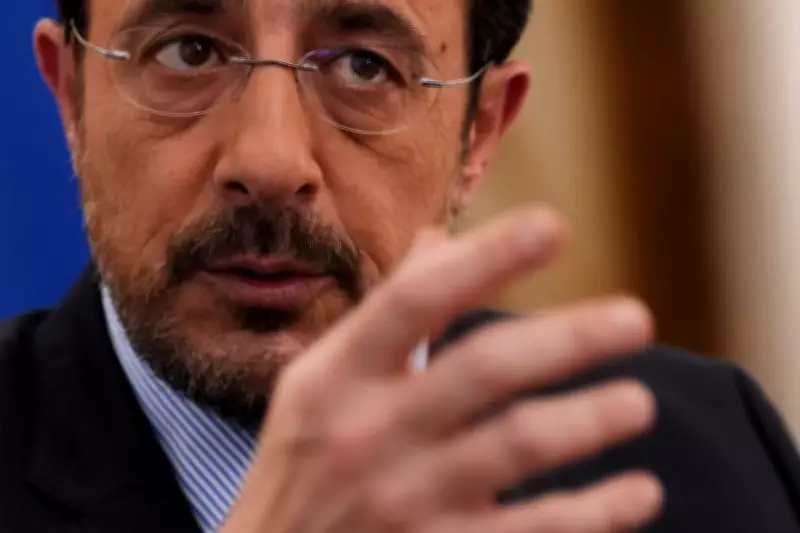
President Nikos Christodoulides of Cyprus has issued a compelling call for European Union leaders to urgently develop a comprehensive defence playbook, outlining precise procedures for when member states face armed aggression and request assistance from their bloc partners. This appeal comes as EU leaders gather for an informal summit on the Mediterranean island, with regional security high on the agenda.
The Critical Need for a Defence Protocol
In an exclusive interview with The Associated Press, President Christodoulides emphasised that EU leaders must begin substantive discussions on "giving substance" to Article 42.7 of the bloc's foundational treaties. This crucial article mandates that all twenty-seven member states provide mutual aid and assistance "by all the means in their power" when a fellow nation suffers armed aggression on its territory.
"We have Article 42.7 and we don't know what is going to happen if a member state triggers this article," Christodoulides stated ahead of the EU-Middle East summit he is hosting this week. "So we're going to have a discussion and prepare, let's say, an operational plan of what is going to happen in case a member state triggers this article, and there are a number of issues."

Addressing the NATO Overlap Challenge
The Cypriot leader highlighted a particularly complex dimension of this defence coordination: many EU countries simultaneously hold membership in the North Atlantic Treaty Organization. Christodoulides stressed that any EU defence playbook must clearly delineate how these dual-member nations would respond to calls for assistance from EU partners without creating conflicts with their existing NATO obligations.
"So what is going to happen in this situation if a member state is both NATO member state and an EU member state? What is going happen?" Christodoulides questioned, pointing to the need for clarity between Article 42.7 and NATO's own collective defence guarantee under Article 5.
Cyprus's Recent Security Experience
The issue carries particular resonance for Christodoulides following a recent security incident that tested regional defence cooperation. Last month, Cyprus appealed for assistance from fellow EU nations after a Shahed drone struck a British air base on the island's southern coastline. Cypriot officials identified the drone's launch point as Lebanon, whose capital Beirut lies just 207 kilometers (129 miles) from Cyprus's southern coast.
In response to this incident, several EU nations including Greece, France, Spain, The Netherlands, and Portugal dispatched naval vessels equipped with anti-drone capabilities to help defend the island nation. This real-world scenario underscores the practical necessity for established protocols governing such multilateral defence responses.
Strengthening EU-Middle East Relations
Beyond immediate defence concerns, Christodoulides expressed satisfaction that fellow EU leaders now "understand the importance" of strengthening the bloc's ties with Middle Eastern nations. He highlighted initiatives like the Mediterranean Pact, which implements specific collaborative projects addressing health, education, and energy challenges across Middle Eastern countries.
"We can represent the interest of the countries of the Greater Middle East to Brussels, but at the same time, and this is very, very important, the countries in the region, they trust Cyprus to represent them in the European Union," Christodoulides affirmed.
Advancing Strategic Connectivity Projects
The Cypriot president emerged as a strong advocate for the India-Middle East-Europe Economic Corridor (IMEC), an ambitious trade, energy, and digital connectivity initiative designed to link Europe with the world's largest democracy while promoting peace and stability throughout the Middle East region.
Under Cyprus's EU presidency, a "Friends of IMEC" group has been established to promote this initiative, though Christodoulides acknowledged that more specific projects are still needed. He cited the Great Seas Interconnector—an electricity cable connecting the power grids of Greece, Cyprus, and eventually Israel—as one such project that has faced implementation delays.

Energy Security and EU Enlargement
The ongoing conflict involving Iran has sharply highlighted the European Union's urgent need to diversify its energy sources. Christodoulides revealed that he is engaged in discussions with the EU's executive arm regarding how Cyprus's offshore natural gas deposits might contribute to the bloc's search for alternative energy sources and supply routes.
He announced that European Commission President Ursula von der Leyen will unveil "very specific proposals" this Friday addressing energy costs and strategies for achieving greater energy independence across the union.
While acknowledging that the EU has made "significant strides" in accelerating its decision-making processes, Christodoulides expressed concern about the bloc's failure to deliver on its enlargement promises over the past two years. This delay, he warned, has diminished trust among prospective member nations.
"So we have a strong geopolitical tool that we are losing mainly because of our mistakes," Christodoulides observed. "And enlargement is one of the geopolitical tools that, as a European Union, we need pretty soon to have specific decisions."
The Cypriot leader's comprehensive remarks underscore the multifaceted security challenges facing the European Union as it navigates complex defence relationships, strengthens ties with neighboring regions, and addresses fundamental questions about its future expansion and energy independence.