Cuba's Humanitarian Crisis Deepens Under US Embargo and Internal Failures
This report comes from an island nation under severe duress, effectively cut off from the world and paralysing the lives of approximately ten million citizens whose situation deteriorates with each passing hour. From the 39th floor of Cuba's tallest structure—a largely vacant new hotel—the normally vibrant streets of Havana appear hauntingly empty, a direct consequence of an almost complete absence of petrol.
Electricity is critically scarce, with frequent blackouts casting doubt on whether this dispatch will successfully transmit. As night descends, the city's dangerously potholed avenues are plunged into darkness. In the bay, a solitary Mexican naval frigate delivering emergency aid is the only vessel observed in six days; others risk interception by US Marine helicopters.
A Stranglehold on an Island Nation
With the airport depleted of kerosene, the skies remain devoid of aircraft. Former US President Donald Trump recently underscored the severity of the American stranglehold, stating with stark indifference that Cuba has "no oil, no money, no anything." The draconian embargo enforced earlier this month, prohibiting fuel exports to Cuba under threat of severe tariffs, is rapidly escalating from a major disruption into a full-scale humanitarian emergency.

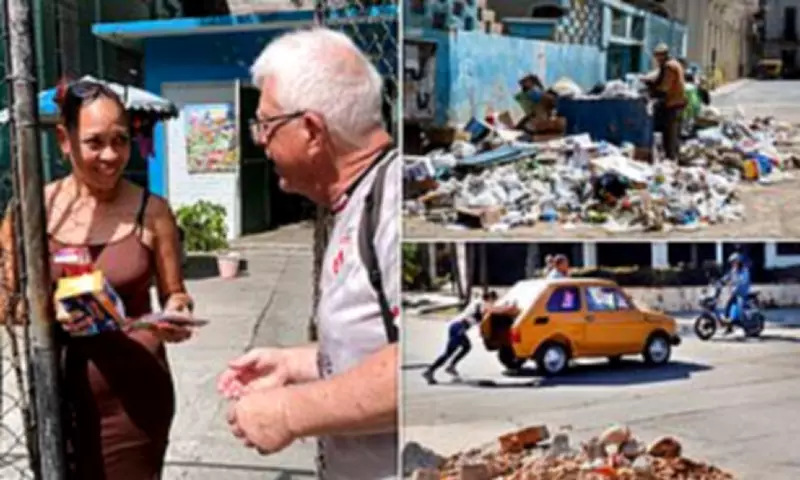
As ever, ordinary, blameless citizens bear the heaviest burden. Over seven days on the ground, scenes unfold that could potentially stir even the US President's conscience. With shops nearly empty of food and rampant inflation rendering basic staples unaffordable, parents are seen scavenging through mountains of festering, uncollected rubbish in desperate hopes of finding scraps for their families. Disease spread by vermin and mosquitoes is widespread.
Young mothers trade their meagre savings for baby formula and children's medicine. The profound gratitude witnessed when handing a bottle of Calpol to a couple with a four-year-old daughter was palpable. With pharmacy shelves barren, paracetamol tablets brought from Britain are treasured like gold. Despite characteristic resilience shown through shrugs and smiles forged during years of socialist austerity, Cuba has effectively ground to a halt.
The Collapse of Daily Life and Institutions
Offices, colleges, theatres, cinemas, and the dilapidated zoo have all closed indefinitely. An education system once the envy of Latin America, achieving a 99% literacy rate under Fidel Castro's prioritisation, now sees only children under twelve attending school. Older students, their classrooms shuttered, roam the streets aimlessly, playing basketball or hustling the few remaining tourists, predominantly wealthy Russians.
At the El Salvador junior school, where lunch for 350 pupils is cooked over charcoal fires that pollute Havana's air, headmaster Juan Renier expresses fear that prolonged closures will spawn a generation of delinquents turning to drugs and crime. It is little surprise that an estimated two million people have fled in recent years, mostly to the US, with their remittances sustaining countless families back home.
Those profiting from the embargo are few: e-cycle taxi drivers and exclusive shops selling Chinese-made solar panel kits for $700—nearly six times the average Cuban's annual salary. The inequalities in this supposedly socialist society have become grotesquely obscene, with luxuries accessible only to an affluent few connected to the communist party rulers, who enjoy $10 cocktails and pizza at chic establishments like Bleco while their compatriots starve.
A Dystopian Reality in Old Havana
Walking through Old Havana, once an enchanting experience amidst Spanish colonial ruins and refurbished classic American cars, now feels dystopian. In a square dominated by a giant Che Guevara poster, a dead rat squished underfoot. On Valentine's Day evening along the elegant Paseo del Prado, a young woman calling herself "Claudia," who appeared far younger than her claimed 24 years, solicited for prostitution—a first for her, driven by desperation to support her four-year-old son after travelling 550 miles from Santiago.

"A lot of young women are selling their bodies because of this crisis," she said, quoting $30 to $50. "I hope Trump will change things so I don't have to do this." Meanwhile, older citizens like 80-year-old Sahara Liang Sanchez, who suffered under the pre-Castro Batista dictatorship, remain loyal to the revolution despite acknowledging that current conditions are "far worse" than the tough period following the Soviet Bloc's collapse.
Government Blame and Public Discontent
This sentiment is echoed repeatedly as desperate people defy state censorship laws. President Miguel Diaz-Canel attributes the catastrophe entirely to Trump. However, with tourism having collapsed since the pandemic and the economy becoming overly reliant on now-cut-off Venezuelan oil, many Cubans believe the government is using the embargo as an excuse for its own corruption and ineptitude, particularly among the younger generation with no memory of Castro's early social improvements.
The regime's greed is exemplified by the Iberostar Selection La Habana hotel, a 508-foot architectural monolith rumoured to have cost up to $500 million. Owned by the regime's commercial arm GAESA, it enrages Habaneros as its cost could have built a hospital or repaired crumbling buildings. The US State Department has blacklisted it and hundreds of other profit-sharing enterprises, citing their design to enrich the ruling elite.
The Export of Medical Professionals and Internal Anger
The regime's most lucrative venture is the export of tens of thousands of medical professionals, generating an estimated $8 billion annually while domestic healthcare standards decline. One Havana medical student revealed her mother, an eye doctor in Mexico, receives only half her $800 monthly salary, with the government taking the rest. Many young people desire regime change but insist it must come from within, not on Trump's terms.
Stories of exploitation, such as a Cuban driver killed in Venezuela who kept only $100 of his $2,000 monthly salary, fuel public anger. President Diaz-Canel, a hardliner lacking Castro's charisma, faces the critical question of whether he can survive this crisis. In Alamar, Castro's decaying "City of the Future," a resident named Ricardo summarised the widespread sentiment: "This is a tropical island with wonderful natural resources... Life should be good but the problem is their corruption. They call it socialism but it's not real socialism—it's lies."
Historical Echoes and an Uncertain Future
Ricardo believes 90% of people are "mad" and "hanging by a thread," restrained only by fear of severe punishment. Journeying to Playa Larga, site of the failed 1961 Bay of Pigs invasion, perspectives diverge. Nemesia Rodriguez Montano, 78, a revolutionary symbol, maintains distrust of America, viewing Trump's actions as "psychological warfare." In contrast, Orlando Exposito, who also lived through the invasion, speculates that had the counter-revolution succeeded, Cuba might now be "peaceful and prosperous"—a dangerously seditious statement.
For over six decades, US presidents have sought to bring democracy to Cuba through various means, including CIA assassination attempts on Castro. As Trump's ruthless siege exacts an ever-heavier toll, the question remains: will he succeed where his predecessors failed? The answer may become apparent very soon, as the island's ten million people endure a crisis of unprecedented scale.