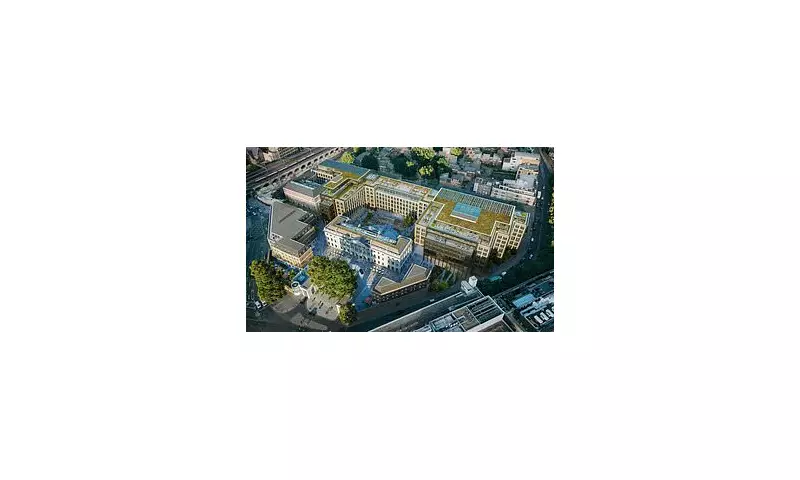
After months of bureaucratic delays, the UK government has finally granted planning permission for China's ambitious new embassy complex on the historic former Royal Mint site opposite the Tower of London. The decision, announced yesterday, follows a detailed 240-page assessment document from Housing Secretary Steve Reed that systematically addressed and dismissed numerous objections to the controversial development.
Ethical and Security Objections Dismissed
The planning document acknowledged that opponents had raised significant concerns about China's record, including what were described as "allegations of political interference and the identity of the proposed occupants." However, Mr Reed firmly stated that "ethical or similar objections to the provision of an embassy for a specific country" cannot legally form the basis for planning decisions, nor could "any moral, ethical or cultural considerations."
Furthermore, the minister clarified that general national security fears fall outside the remit of the planning system entirely, establishing clear boundaries for what considerations could legally influence the decision-making process.

Transparency Concerns Over Secret Drawings
One particularly contentious issue involved the architectural plans submitted by Chinese authorities. Last year, planning officials requested full blueprints after receiving 52 drawings with significant areas deliberately blacked out, raising suspicions about the true purpose of these concealed spaces.
Remarkably, nine of these drawings were returned unchanged, with Beijing asserting that revealing the intended use of smaller rooms was "irrelevant" to the planning process. While Mr Reed acknowledged that if some rooms were used for overnight accommodation it could create "materially harmful impacts in terms of amenity, accessibility and fire safety," he ultimately concluded that no "lawful embassy use of the unmarked rooms would give rise to material adverse planning impacts."
London Planning Rules Flexibility
The Cabinet minister admitted that "strictly speaking" the proposed development did not fully comply with aspects of the London Plan, which governs expansion in the capital. Specifically, the site is not officially deemed suitable for tall building construction under current guidelines.
However, Mr Reed exercised ministerial discretion, concluding that overall compliance with this particular requirement was not sufficiently important to justify rejecting the application, demonstrating the flexibility sometimes applied to major diplomatic projects.
Managing Protest and Security Risks
Public Demonstrations
Widespread concerns were raised about the potential for large-scale public protests outside the embassy, given China's controversial international standing. Mr Reed agreed that the location sits on a "very busy part of the strategic highways network" and acknowledged that demonstrations "which spilled on to the streets could cause significant disruption" to London traffic and daily life.
Nevertheless, he maintained that "the public are generally expected to tolerate a degree of disruption from lawful protest," establishing a precedent for how protest-related inconveniences are weighed against diplomatic needs.
Terrorism Threats
Local residents expressed fears that the embassy would become a prime target for terrorist attacks, potentially endangering the surrounding community. The minister addressed these concerns by describing them as "somewhat academic," noting that since a nationwide terrorist threat exists generally, "an attack somewhere in the UK is likely" regardless of specific locations.
Critical Infrastructure Protection
One particularly sensitive issue involved the embassy's proximity to vital telecommunications infrastructure. Mr Reed specifically considered the "potential sensitivity and security risks to telecommunications cables" linked to the nearby Wapping Telephone Exchange, following concerns that financial data transmitted to City of London banks could be vulnerable to interception or hacking.

Perhaps optimistically, the minister asserted there was no significant risk "as long as embassy staff did not break the law." He further noted that neither the Home Office nor Foreign Office—the departments responsible for MI5 and MI6 respectively—"objected to the proposal on the basis of the proximity of the cables," suggesting intelligence agencies had raised no formal objections.
Public Access and Safety Compromises
The historic site contains the ruins of a Cistercian Abbey that will remain accessible to the public—but with significant caveats. Because this archaeological feature will sit within embassy premises, visitors could potentially be searched by Chinese police officers, while British emergency services would require permission to access the area during incidents.
The planning document addressed this unusual arrangement by stating: "The Secretary of State notes that the need to manage the safety and health of nationals from other countries on embassy premises is not unique to this case," suggesting similar arrangements exist for other diplomatic properties.
Staff Accommodation Standards
The development will include residential accommodation for embassy staff, but the proposed one and two-bedroom flats will not meet standard UK requirements for daylight and sunlight exposure. Mr Reed justified this compromise by asserting the accommodation would still "be of a sufficient quality" because it will only be used by "embassy staff for limited periods of time," establishing different standards for diplomatic versus civilian housing.
The approval represents a significant victory for Chinese diplomatic ambitions in London, allowing the creation of what critics have termed a "mega-embassy" on one of the capital's most historically significant sites, despite numerous objections regarding security, transparency, and public safety.