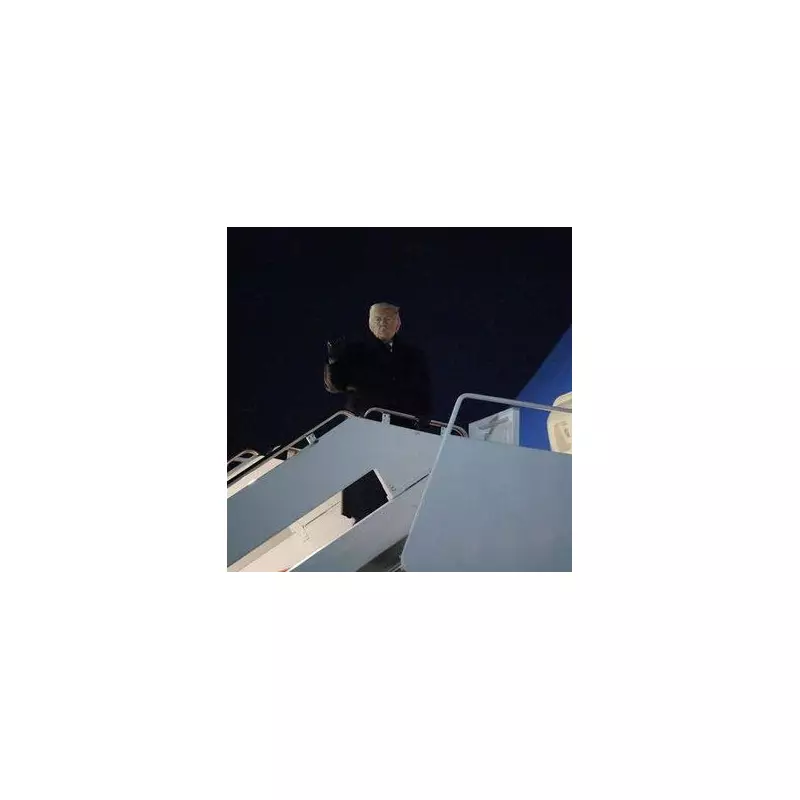
President Donald Trump's official aircraft, Air Force One, was compelled to execute an unexpected return to Washington's Joint Base Andrews after encountering an electrical fault shortly after departure for the World Economic Forum in Davos, Switzerland.
Flight Disruption and Official Confirmation
The incident occurred on Tuesday evening as the presidential plane embarked on its transatlantic journey. White House press secretary Karoline Leavitt confirmed that the flight crew identified "a minor electrical issue" during the initial phase of the flight, prompting a decision to turn back as a precautionary measure.
Journalists travelling aboard the aircraft reported observing the press cabin lights flickering off momentarily just before departure, though no immediate explanation was provided at that time. Approximately thirty minutes into the flight, reporters were formally notified that the aircraft would be returning to its point of origin.

Alternative Arrangements and Controversial Context
Following the unscheduled return, President Trump transferred to an alternative aircraft to complete his journey to Davos, where his scheduled appearance at the prestigious global forum was already anticipated to generate significant controversy and international attention.
The current fleet of two Air Force One aircraft, which have been in active service for nearly four decades, are specially modified Boeing 747-200B planes equipped with advanced security features including radiation protection, anti-missile defence systems, and sophisticated communications equipment that enables the president to maintain command capabilities while airborne.
Aging Fleet and Replacement Challenges
This incident highlights ongoing concerns about the aging presidential aircraft fleet. Boeing has been developing replacement models for the iconic planes, but the programme has encountered multiple setbacks and delays in recent years, complicating the modernisation timeline for this critical component of presidential infrastructure.
Qatari Gift and Security Modifications
In a related development, Qatar's Royal family presented President Trump with a premium Boeing 747-8 jumbo jet last year to join the Air Force One roster. This diplomatic gift attracted widespread criticism and is currently undergoing extensive modifications to meet stringent United States security requirements for presidential transport.
Following Tuesday's electrical incident, press secretary Leavitt reportedly remarked humorously to journalists aboard Air Force One that the Qatari jet was sounding "much better" at that particular moment, highlighting the ongoing discussions about fleet composition and capabilities.
Historical Precedents and Safety Protocols
This is not the first recent incident involving high-profile United States government aircraft. In February 2025, an Air Force plane transporting Secretary of State Marco Rubio to Germany was similarly forced to return to Washington due to an unrelated mechanical problem, underscoring the complex maintenance and operational challenges facing official government aviation assets.
The Air Force One fleet's design incorporates multiple redundant systems and emergency capabilities specifically engineered to handle various potential crises during presidential travel, making the decision to return based on an electrical issue particularly notable from a safety protocol perspective.