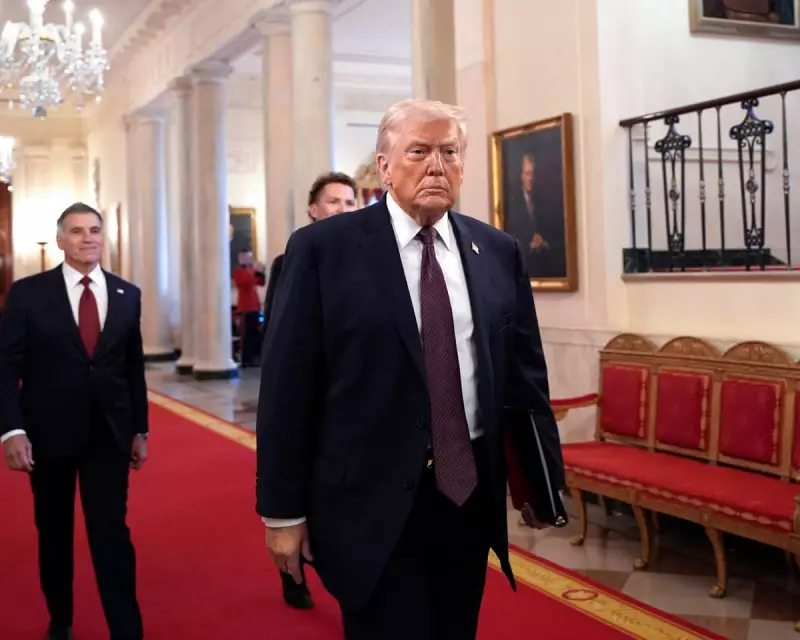
Recent polling data indicates a significant majority of the American public disapproves of President Donald Trump's approach to international affairs, casting a shadow over his aggressive interventions in Venezuela and persistent ambitions regarding Greenland.
Public Rejects 'Donroe Doctrine' and Imperial Ambitions
A Quinnipiac University poll reveals deep public scepticism towards President Trump's recent foreign policy ventures. The survey found that 57% of Americans oppose the idea of the US 'running' Venezuela, with an overwhelming 73% against sending American troops to the South American nation. Furthermore, 55% disapprove of taking over Venezuela's oil sales.
Trump's foreign policy, which he has branded the 'Donroe Doctrine', has involved the dramatic seizure of Venezuelan leader Nicolás Maduro on 3 January. During a press conference that day, Trump focused heavily on economic interests, mentioning 'oil' 27 times and 'money' 13 times, while not uttering the word 'democracy' once. He declared his intention to control Venezuela's money and oil industry 'indefinitely', even releasing a White House photo depicting him as 'The Acting President of Venezuela'.

However, his efforts to attract major oil companies to invest in Venezuela's dilapidated infrastructure have faltered. The chief of ExxonMobil reportedly told the President that the country was 'uninvestable'.
Greenland Gambit and Widespread Disapproval
Parallel to the Venezuelan situation, Trump has revisited his desire to annex, purchase, or invade Greenland, an autonomous territory of NATO ally Denmark. Public opinion is firmly against this, with 86% opposed to a military seizure of Greenland and 55% against purchasing it, according to the same Quinnipiac poll. A Reuters-Ipsos poll showed only 17% in favour of acquiring Greenland, with a mere 4% supporting the use of military force.
The collective disapproval of these policies is captured in an AP-NORC poll, which found that 61% of Americans disapprove of Trump's foreign policy in general. This negative rating now nearly matches public disapproval of his handling of the economy and cost-of-living issues.
Historical Parallels and Political Peril
Political analysts are drawing cautionary parallels with past presidents who focused on foreign triumphs while neglecting domestic economic concerns. The article references insights from Richard Darman, a key figure in both the Reagan and George H.W. Bush administrations.
Darman explained how President George H.W. Bush's massive popularity surge to 89% following the successful Gulf War ultimately worked against him. The public, convinced of his strength after vanquishing the 'wimp factor' perception, later believed he would not help them during a deepening recession, leading to his 1992 election defeat by Bill Clinton.
The article suggests a similar dynamic may be at play: Trump's projection of supreme strength in foreign affairs could exacerbate public bitterness if he is seen as ignoring domestic economic plight. Trump has repeatedly dismissed the 'affordability crisis' as a 'hoax' or 'fake word'.
Meanwhile, the Republican Party has largely deferred to Trump, with the Senate blocking a resolution on 14 January that would have required him to seek congressional approval for military force in Venezuela. The article concludes that this combination of a strongman foreign policy and contempt for domestic hardship creates a potent political vulnerability as the midterm elections approach.