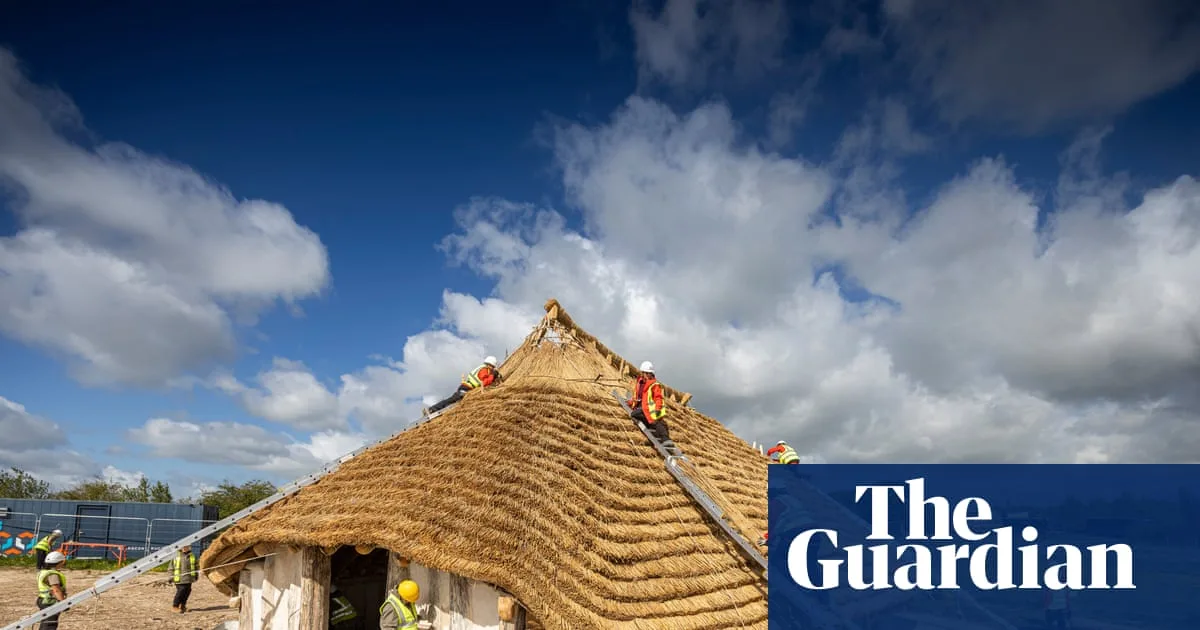
English Heritage has unveiled a 7-metre-high reconstruction of a 4,500-year-old Neolithic hall near Stonehenge, offering visitors a glimpse into the lives of the prehistoric builders. The £1m project, built entirely by hand over nine months by more than 100 volunteers, is based on the archaeological footprint of Durrington 68, a unique structure discovered two miles away near Woodhenge.
The Kusuma Neolithic Hall, which opens to the public this summer, will serve as an immersive learning space for schools. It features a horseshoe-shaped ring of post holes surrounding four massive internal roof support pillars, and aligns with the winter solstice, similar to Stonehenge itself. Experimental archaeologist Luke Winter, who designed the hall using replica stone tools, noted that every material used was growing in the landscape 5,000 years ago.
The original purpose of the structure remains a mystery, as centuries of ploughing destroyed the floor and hearths. However, discoveries of animal bones and grooved ware pottery nearby suggest winter feasting, ritual gatherings, or communal storage. Winter, initially sceptical, now believes there is a 75% chance it was a roofed building.

The project is part of a broader educational expansion by English Heritage, which aims to double its capacity to nearly 100,000 students annually by 2026. A new learning centre, including the Clore Discovery Lab and Weston Learning Studio, is scheduled to open by the end of that year. Iona Keen, English Heritage's head of learning, said the site and resources would be free for educational groups, allowing children to gather around an open fire and make prehistoric cheese and pinch pots.
Stonehenge curator Win Scutt emphasised that the monuments were driven by a society seeking connection, not science. He described the structures as a 'pure expression of the society', reflecting a collective identity rather than individualism. Volunteers Sarah Davis and James Humphrey described the project as transformative, bringing history to life through hands-on experience.