

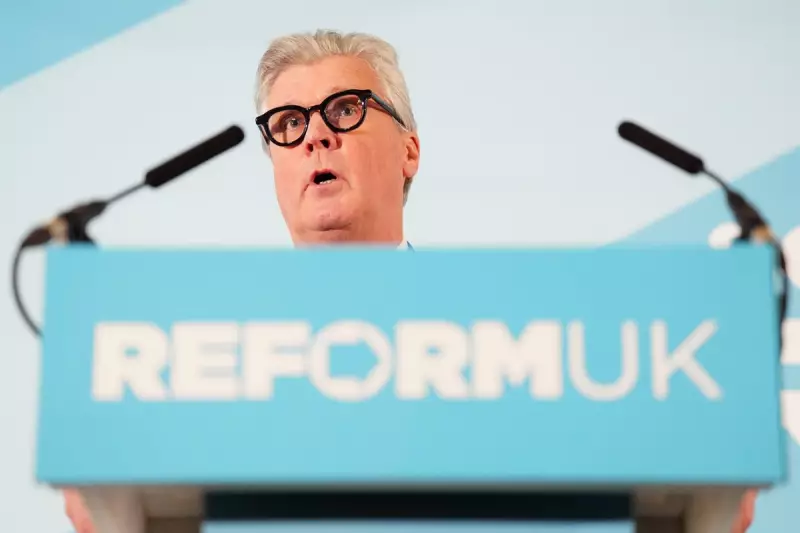
Malcolm Offord, the recently appointed Scottish leader of Reform UK, has made a significant declaration regarding the nation's constitutional future. Speaking at a press conference on Monday, 26th January 2026, Mr Offord stated unequivocally that his party would not entertain the possibility of a second Scottish independence referendum for at least a decade.
A Decade-Long Pause on Constitutional Debate
Mr Offord's announcement represents a clear strategic shift, urging Scottish voters to set aside the divisive independence question in favour of more immediate priorities. "My appeal to Scots is to deal with the constitution later," he emphasised during the briefing. This stance positions Reform UK as a party seeking to move beyond the entrenched binary politics that have dominated Scotland in recent years.
Building Common Ground Beyond Traditional Divides
The Reform UK leader articulated a vision that seeks to unite voters across traditional political lines. He suggested that "moderate Unionists no longer represented by the Conservatives" and "rational nationalists no longer represented by the SNP" could discover shared objectives. Mr Offord believes these groups can find "common ground and unite their own one single ambition to make Scotland the most successful and the most fair country in the world."

This approach represents an attempt to reframe Scottish political discourse around practical outcomes rather than constitutional status. "My appeal to all Scots is to unite their own common vision of prosperity and justice for all now, and deal with the constitution later," Mr Offord stated, positioning his party as the sole political vehicle offering this particular perspective.
A Decade of Economic Transformation Proposed
Central to Mr Offord's argument is the belief that Scotland requires a sustained period of economic development before revisiting constitutional questions. "I believe it will take 10 years… to turbocharge the economy of Scotland," he explained. The leader contends that this economic acceleration would subsequently "unleash the innovation required to deliver significant improvements to our health service, our education, our housing and our infrastructure."
This economic focus forms the foundation of his opposition to an early independence referendum. "That is why I say no to distraction of another referendum, or at least another ten years, without ruling one out in the future," Mr Offord clarified, leaving the door slightly ajar for potential constitutional discussions beyond the proposed decade-long moratorium.
Tax Reforms and Political Context
Alongside his constitutional comments, Mr Offord announced specific policy proposals that align with Reform UK's broader platform. He revealed plans to re-align Scotland's tax system with the rest of the United Kingdom, accompanied by an immediate 1p-in-the-pound income tax cut across all bands. Furthermore, he pledged that within the first five years of a Reform UK administration, a total of 3p would be cut from income taxes.
These announcements come just eleven days after Mr Offord's appointment as Reform UK's Scottish leader, indicating a rapid start to his tenure. The political landscape he enters remains shaped by the 2014 independence referendum, in which 55% of Scottish voters chose to remain part of the United Kingdom against 45% who supported independence.
Mr Offord's statements suggest Reform UK aims to position itself as a viable alternative for voters disillusioned with both the Scottish National Party's focus on independence and the Conservative Party's recent challenges. By proposing a decade-long pause on constitutional debates coupled with specific economic policies, the party seeks to carve out a distinct space in Scotland's crowded political arena.






