

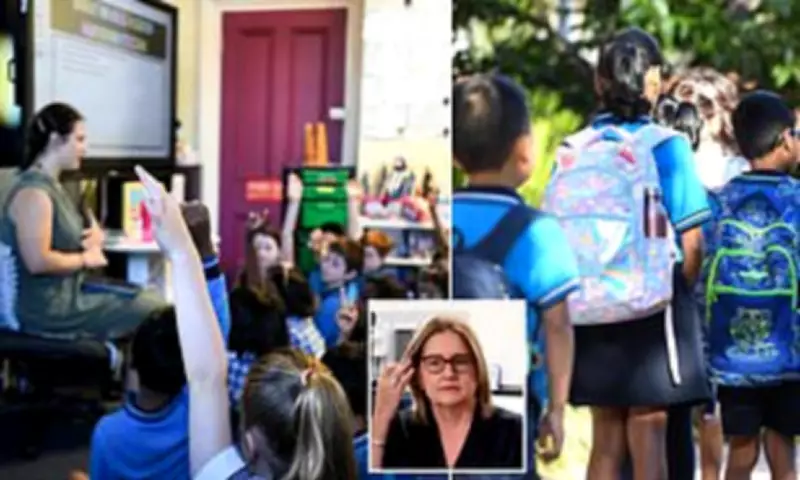
Australian Education Union Advocates for Four-Day Week Trial in Victoria Schools
The Australian Education Union has put forward a bold proposal for a four-day working week trial specifically targeting public school teachers across the state of Victoria. This initiative is designed as a strategic response to severe and persistent staffing shortages that are plaguing the education sector. The union, which represents approximately 45,000 teachers throughout Victoria, has formally recommended implementing a 30.4-hour job-share model within state schools. This model aims to explore and facilitate working from home opportunities for educators, providing them with greater flexibility in their professional roles.
Aligning with Broader Remote Work Legislation
This proposal emerges concurrently with Premier Jacinta Allan's progressive plans to legislate a right for workers to engage in remote work for up to two days each week. The anticipated 'Right to Disconnect' or 'Work from Home' laws are expected to encompass both the public and private sectors, with parliamentary introduction projected for later this year. The union's submission, lodged in September as part of the state government's industry consultation on the work-from-home scheme, argues that such rights are crucial for enhancing workforce participation, particularly for women, and for addressing the gender pay gap.
Union president Justin Mullaly emphasized, "Working from home rights are a key measure which will help address barriers to women's participation in the workforce and the gender pay gap." He further warned that without similar flexibility, the public education sector risks becoming less attractive compared to other industries that can more readily offer and advertise remote work options to potential employees.

Addressing the Critical Staffing Shortfall
Currently, Victoria is grappling with approximately 900 vacant teaching positions, a clear indicator of the chronic workforce crisis. While supporting the principle of work-from-home rights, Mullaly has called for tailored flexibility for teachers, whose roles often require physical presence during school hours for direct student interaction. The union suggests that remote work could be viable for tasks performed outside standard teaching times, such as marking reports, participating in staff meetings, or planning lessons during after-hours or school holidays.
"If you're working with students directly in non-teaching roles, then you need to be on the school premises. There's no question about that," Mullaly stated. "So what we think is that there needs to be considerably more flexibility provided to school staff, because it's not always the case that they need to be on the school premises to do their job." Importantly, under this proposed trial, students would continue to attend school for the standard five-day week, ensuring no disruption to their educational schedule.
Broader Context and Industrial Action
This proposal is part of a wider discourse on workplace flexibility, with the Victoria Police Association recently raising analogous concerns for its members. Police Minister Anthony Carbines, however, has contested any notion that the forthcoming work-from-home legislation would adversely affect police recruitment, citing ongoing graduate intakes.
Simultaneously, Victorian public school teachers have voted to undertake a 24-hour stoppage on March 24, marking the first such industrial action in 13 years, unless their pay dispute with the state government is resolved. The union highlights that Victorian teachers are earning significantly less than their counterparts in New South Wales, with a yearly disparity of up to $15,359. Compounded by an average of 12 hours of unpaid overtime weekly, these conditions are driving experienced staff away and deterring new entrants.

Mullaly concluded, "In the middle of chronic shortage of school staff, it is not possible to retain experienced, dedicated teachers, principals and support staff in the public school system – and attract the next generation – when they are being underpaid and overworked." The proposed four-day week trial represents a critical attempt to innovate within the profession, enhance job attractiveness, and ultimately stabilize the education workforce in Victoria amidst these multifaceted challenges.





