Ukraine's Robot Army Captures Russian Position in Historic Unmanned Combat Operation
Ukrainian forces have achieved a groundbreaking military milestone by capturing a Russian position using exclusively armed robots and drones, signaling a rapid transformation toward automated warfare that significantly reduces human casualties. President Volodymyr Zelensky revealed earlier this week that Putin's soldiers surrendered without any Ukrainian infantry being exposed to danger.
Historic First in Warfare
'For the first time in the history of this war, an enemy position was taken exclusively by unmanned systems – ground systems and drones,' Zelensky declared in a speech marking Ukrainian Gunsmith Day. 'The occupiers surrendered, and the operation was carried out without infantry and without losses on our side.'
These unmanned ground vehicles (UGVs) are deployed on the battlefield for multiple critical functions:

- Assault operations against enemy positions
- Evacuation of wounded troops from combat zones
- Detection and neutralisation of explosive mines
Rapid Development and Deployment
Zelensky reported that over 22,000 missions have been conducted in the last three months using robot systems, with more than 280 companies rapidly developing these advanced units. 'In other words, lives were saved more than 22,000 times when a robot went into the most dangerous areas instead of a warrior,' he emphasized. 'This is about high technology protecting the highest value – human life.'
Ukraine aims to produce more than 20,000 ground robots this year, with 99 percent manufactured domestically. Each unit costs between £7,500 and £22,000 and can operate across distances up to 31 miles.
DevDroid TW 12.7: The Battlefield Guardian
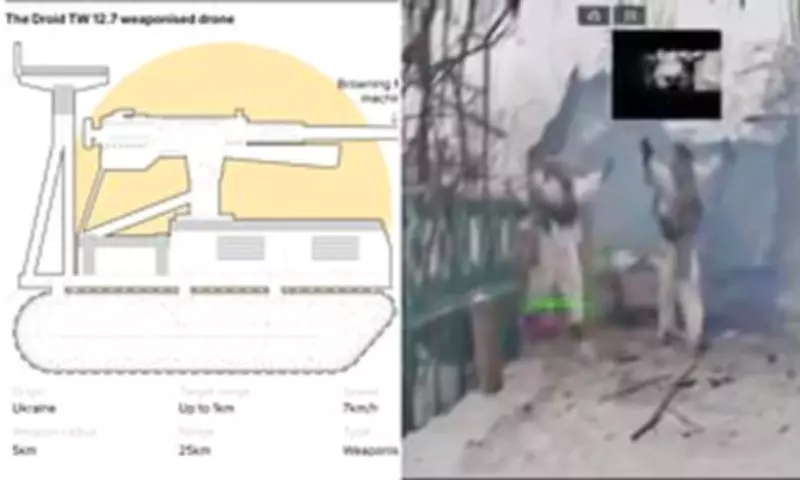
One particularly effective robot, known as DevDroid TW 12.7, resembles a ride-on lawnmower in size but carries formidable firepower with a .50-calibre M2 Browning machine gun. This system can be operated remotely from distances up to 15 miles or navigate challenging terrain using artificial intelligence.
In a remarkable demonstration of capability last December, a DevDroid armed with a heavy machine gun defended Ukrainian positions on the eastern front for 45 consecutive days without a single soldier present. Russian troops were pinned down by relentless gunfire, mistakenly believing they faced multiple Ukrainian fighters. Even under cover of fog and adverse weather conditions, they failed to break through the automated defense.
'The enemy conducted daily offensive pressure on forward positions,' recounted Mykola 'Makar' Zinkevych, commander of the NC-13 Strike Company at the time. 'Until the very end, the enemy was unable to determine that an unmanned ground vehicle with a combat module was present at the position.'
The NC-13 Strike Company, a specialized unit within Ukraine's Third Army Corps focused on uncrewed ground vehicles, reported that the machine defended positions that would typically require up to six soldiers, keeping Ukrainian troops safely out of harm's way.
Maintenance and Operational Details
The drone required brief maintenance every two days, leaving its post for approximately four hours for weapon servicing, ammunition resupply, and battery recharging. A support crew stationed about 2.4 miles from the front line performed these essential functions.
Videos documenting the drone's operations show it traversing rugged terrain and delivering rapid-fire shots toward Russian positions with precision and effectiveness.
Surrender to Machines
In January, extraordinary footage emerged showing multiple Russian soldiers surrendering to an armed Ukrainian Droid TW-7.62 combat robot. The video captures three Russian troops dressed in white military gear lying on snowy ground as the robot advances toward them, compelling the soldiers to stand and raise their hands in surrender. One visibly injured soldier, covered in blood, cautiously approached the machine before all three submitted to the unmanned weapon.
This drone was mounted on a NUMO platform and equipped with a remotely operated 7.62mm machine gun turret, demonstrating the psychological impact of facing automated combat systems.

Expanding Robotic Warfare
Commander Zinkevych explained that the NC-13 Strike Company, established in September 2025, is concentrating this year on 'maximum involvement' and broader deployment of UGVs in both defensive and offensive operations. Additional drone variants have recently received approval for frontline use, including two vehicles equipped with grenade launchers.
'The demand for these systems is high,' Zinkevych noted. 'Robots do not bleed.'
This development follows another significant robotic warfare achievement in March last year, when Ukraine destroyed a Russian frontline position north of Kharkiv without deploying a single soldier. The attack, believed to be the first of its kind, involved approximately 50 unmanned aerial vehicles from the 13th National Guard Brigade Khartiya during a five-hour operation that left several Russian casualties.
Broader Conflict Context
Meanwhile, recent reports indicate a Ukrainian drone brigade eliminated 8,000 Russian troops in a single month as the conflict continues. In a potentially significant diplomatic development, Russia's foreign minister subsequently issued a statement suggesting 'the prospect of a political and diplomatic settlement is on the horizon,' while maintaining criticism of Western nations.
Ukraine's top negotiator, Lieutenant General Kyrylo Budanov, confirmed Russia is shifting its stance, stating: 'They all understand the war needs to end. That's why they are negotiating. I don't think it will be long.'
This historic shift toward unmanned combat systems represents not only a tactical evolution but a fundamental transformation in how modern warfare is conducted, with profound implications for military strategy, defense manufacturing, and the preservation of human life in conflict zones.