
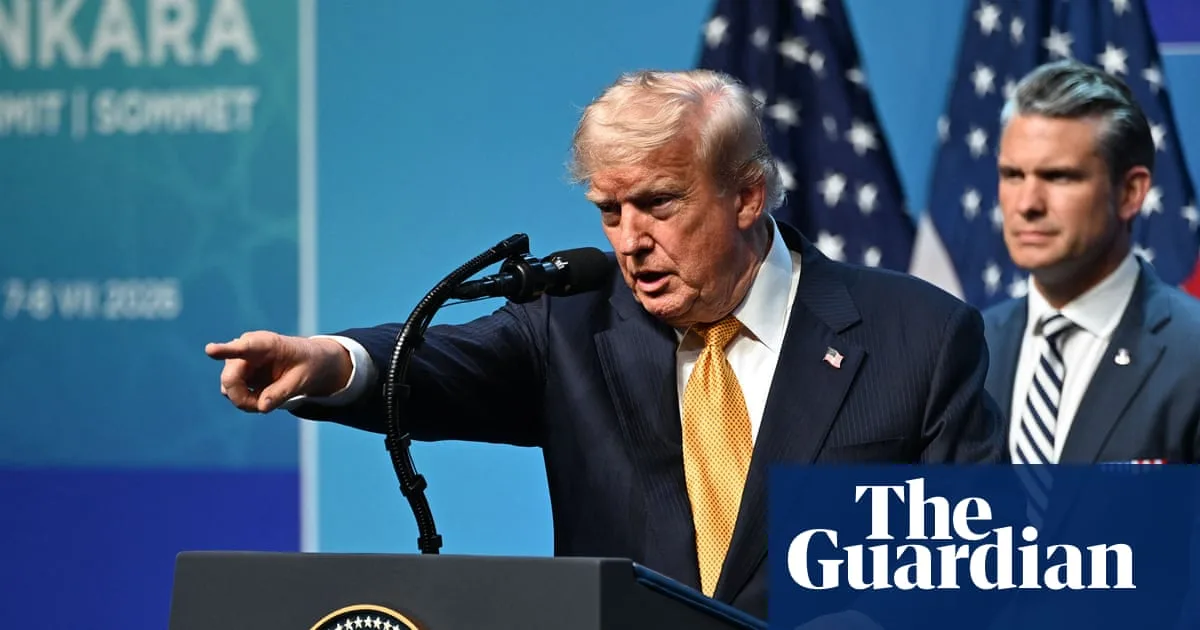
At this week's Nato summit in Ankara, European leaders confronted a difficult truth: the United States can no longer be counted on as the continent's ultimate security guarantor. For decades, American military bases and nuclear deterrents have underpinned European defence, but President Donald Trump's unpredictable foreign policy has shattered that assumption. Ahead of the meeting, diplomats worked frantically to secure a joint statement reaffirming Article 5, the alliance's mutual defence clause, yet the summit was overshadowed by Trump's outbursts over Iran, Greenland, and European defence spending.
Trump's behaviour during the summit — threatening further strikes on Iran, demanding an end to trade with Spain over low defence budgets, and reiterating his desire to annex Greenland — underscored the volatile nature of US commitment. While the subsequent closed-door meeting with Nato leaders was described as constructive, the underlying anxiety remained. Nato Secretary General Mark Rutte sought to frame the summit around delivery, noting that Europe and Canada were 'stepping up' after US demands for greater military investment.
Europe has now accepted the need to shoulder more of its own defence. Dan Sabbagh, the Guardian's defence editor, observed that the continent has 'gone through the five stages of grief and arrived at acceptance,' with countries beginning to plan for reduced US support. However, commitment varies widely: Poland and the Baltic states are spending over 4% of GDP on defence, while Spain has refused to sign up to 3.5%.
In a significant move, Britain and 11 other Nato nations have pledged £37 billion over the next decade to develop new missile capabilities for European protection. Additional joint projects, including potential German participation, are underway. Yet the question remains whether Europe can fully defend itself without American support, especially as the US signals a more transactional approach to alliances under President Trump.




