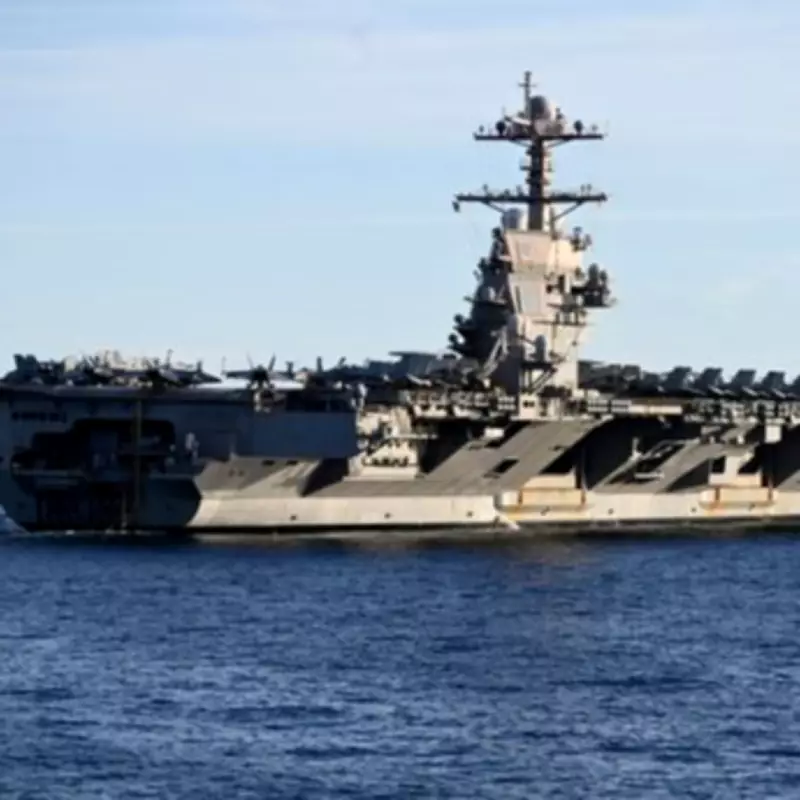
In a significant military manoeuvre, former US President Donald Trump has ordered the deployment of the USS Gerald R Ford, the world's largest and most expensive aircraft carrier, to the Middle East. The colossal vessel, which cost an astonishing £9.5 billion to construct, represents a formidable show of strength in a region already fraught with geopolitical tensions, particularly concerning Iran.
A Monumental Engineering Feat
The USS Gerald R Ford is an engineering marvel of unprecedented scale. Measuring approximately 1,106 feet (337 metres) in length, the carrier surpasses the combined length of three standard football fields. With a full displacement of 100,000 tonnes, it is the newest and most advanced addition to the United States Navy fleet, having been launched in 2013.
Despite its immense size, the nuclear-powered behemoth can achieve speeds of up to 34 miles per hour, powered by two nuclear reactors designed to operate for 50 years without requiring refuelling. The ship accommodates a crew of around 4,500 personnel and has the capacity to carry up to 80 aircraft, significantly enhancing the US military's ability to sustain prolonged aerial operations in the region.

Strategic Deployment and Regional Implications
President Trump's decision to redeploy the carrier from the Caribbean to the Arabian Sea, off the coast of Iran, follows high-level discussions in Oman regarding Iran's nuclear capabilities among other critical security topics. The move is interpreted as a clear strategic signal aimed at deterring adversarial actions and bolstering US military presence in the volatile Middle East.
The USS Gerald R Ford is expected to join the USS Abraham Lincoln in the region, with the voyage anticipated to take at least a fortnight. This deployment occurs amidst a backdrop of reported hesitancy within the White House regarding direct military engagement, based on assessments that such actions might not yield decisive outcomes.
Notably, the carrier was previously involved in operations targeting Venezuelan leader Nicolas Maduro at the beginning of 2026, underscoring its role in global power projection. The redeployment amplifies the United States' capability to execute intense, multi-day strike campaigns if necessary, marking a pivotal moment in international defence posturing.
Broader Context: Surveillance Concerns and Political Dynamics
This military development coincides with heightened debates over surveillance and civil liberties in the United States. Recently, Amazon introduced an AI-powered feature called Search Party for its Ring doorbell, utilising facial recognition technology ostensibly to locate lost pets. However, critics, including former adviser Pablo O'Hana, have raised alarms about potential misuse for human tracking, particularly by agencies like Immigration and Customs Enforcement (ICE).
O'Hana cautioned that such surveillance tools could undermine democratic processes by instilling fear among citizens, potentially deterring them from participating in public activities, reporting crimes, or engaging in electoral processes. While he noted that a doorbell itself cannot "hack democracy," the pervasive sense of monitoring could corrode public trust and civic engagement, especially in the context of upcoming elections.
These concerns are further amplified by ongoing legal matters, including Trump's $10 billion defamation lawsuit against the BBC, highlighting a complex interplay between military strategy, technological advancement, and political controversies. As the USS Gerald R Ford steams toward the Middle East, its presence not only reshapes naval power dynamics but also reflects broader themes of security, liberty, and global influence in an increasingly interconnected world.