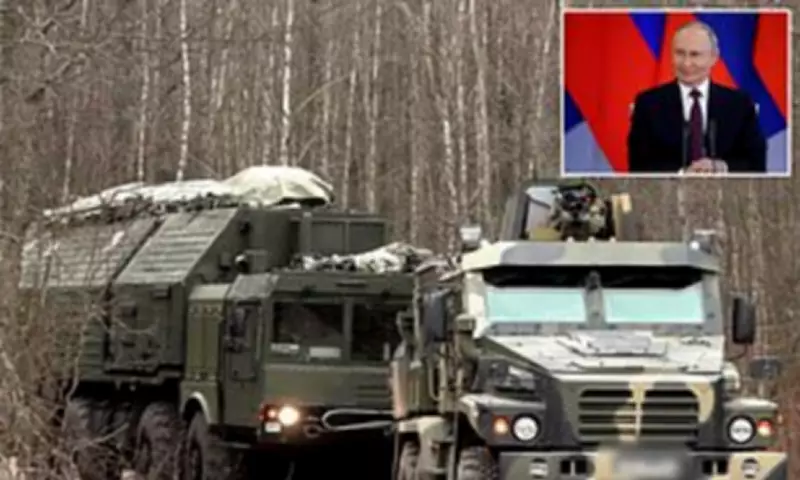
Putin's Nuclear Gambit: Belarus Deployment Raises EU Security Alarm
Vladimir Putin is poised to move nuclear weapons dangerously close to the European Union's border, according to stark warnings from Belarus's exiled opposition leader. This development follows Russia's recent deployment of its formidable 'unstoppable' Oreshnik missile system to Belarusian territory, marking a significant escalation in military posturing.
Tsikhanouskaya's Grave Warning
Sviatlana Tsikhanouskaya, the exiled Belarusian opposition figure, has revealed that Alexander Lukashenko's regime is actively deepening Russia's military footprint within Belarus. She asserts this preparation signals imminent escalation in the ongoing Ukraine conflict.
'We observe how Mr Lukashenko's regime intensifies Russia's presence on Belarusian soil. They are on the verge of deploying Russian nuclear weapons and missiles to our country,' Tsikhanouskaya stated unequivocally to The Telegraph. 'This clearly indicates they are preparing for further escalation.'

The Oreshnik Missile System: A Hypersonic Threat
This warning follows December footage released by Russia's defence ministry, purportedly showing nuclear-capable Oreshnik missile systems being placed on combat duty at an eastern Belarus airbase. Lukashenko, Putin's steadfast ally, confirmed plans to station ten such systems within Belarus.
The Oreshnik represents a formidable intermediate-range, nuclear-capable hypersonic ballistic missile system. Military experts note its capability to reach the United Kingdom in approximately eight minutes. While currently deployed with conventional warheads, its nuclear potential remains a grave concern.
Deploying these weapons to Belarus would dramatically reduce Russia's strike time against European Union territories, fundamentally altering regional security dynamics.
Strategic Implications and Western Analysis
Western analysts interpret Russia's public display of these systems as a calculated power demonstration. This move appears designed to intimidate Ukraine and neighbouring nations while signalling to domestic audiences Moscow's readiness for further escalation.
Recent satellite imagery suggests Russia may be positioning Oreshnik systems at a military installation near Krychau, a town in eastern Belarus proximate to the Russian border. Images reveal significant infrastructure development at this previously abandoned airfield, including new buildings and reconstructed railway facilities.
The Kremlin has already tested non-nuclear Oreshnik missiles in Ukraine, notably striking Lviv last month—a Ukrainian city merely forty miles from Poland's border.
Broader Belarusian Complicity
Tsikhanouskaya further warned that Belarus plays an extensive role supporting Moscow's war efforts. She estimates approximately three hundred Belarusian enterprises currently contribute to Russia's military production capabilities.
Regarding Ukrainian awareness, Tsikhanouskaya confirmed President Volodymyr Zelensky recognizes the risks posed by Belarusian military build-up. 'This escalation threatens not only Ukraine but European nations collectively. Consequently, we must intensify scrutiny of Belarusian developments,' she emphasized.
Diverging Expert Perspectives
However, Kurt Volker, former U.S. Special Envoy to Ukraine under the Trump administration, questioned the strategic novelty of nuclear weapons relocation. 'Russian nuclear command and control remains exclusively Russian, whether weapons are stationed in Russia or advanced several hundred kilometres into Belarus,' he told The Telegraph.
Volker cautioned against excessive alarm, noting: 'While Russia may have exercised this capability, the situation requires nuanced understanding rather than reactionary fear.'
Tsikhanouskaya's Personal and Political Context
Tsikhanouskaya, who identifies as Belarus's president-elect following the disputed 2020 election, fled into exile with her children after alleging Lukashenko's electoral manipulation. Her husband, previously detained for opposing Lukashenko, was released last year through U.S.-backed prisoner negotiations. The family now resides between Lithuania and Poland.

Broader Geopolitical Consequences
Tsikhanouskaya articulated the interconnected fates of Belarus and Ukraine, warning that insufficient democratic support for Kyiv would embolden Putin's expansionist ambitions. 'Should the democratic world fail to adequately support Ukrainian victory, Putin will feel empowered to advance beyond current boundaries,' she stated, citing Moldova, Armenia, and Georgia as potential targets.
'International borders would become negotiable commodities. Ukrainian defeat would cement Belarus's authoritarian status quo for decades, extinguishing hopes for democratic transformation,' she concluded with grave finality.