NORAD Intercepts Five Russian Military Aircraft Near Alaskan Airspace
The North American Aerospace Defense Command (NORAD) has confirmed the interception of five Russian military aircraft operating in international airspace off the western coast of Alaska. Military officials emphasised that the flights were not considered provocative or threatening, describing such activities as routine occurrences in the region.
Details of the Interception Operation
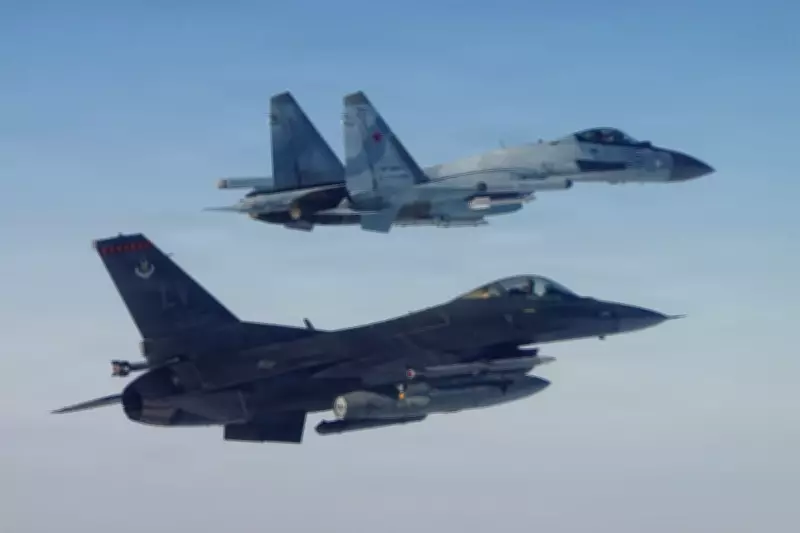
On Thursday, NORAD detected and tracked two Russian Tu-95 bombers, two Su-35 fighter jets, and one A-50 airborne early warning and control aircraft near the Bering Strait. In response, the command launched a coordinated interception mission involving two F-16 fighter jets, two F-35 stealth fighters, one E-3 airborne warning and control system aircraft, and four KC-135 refueling tankers.
These assets were deployed to intercept, identify, and escort the Russian aircraft until they departed the area. According to a formal release from NORAD, the Russian military aircraft remained strictly within international airspace and did not enter American or Canadian sovereign airspace at any point during the incident.

Context of the Alaskan Air Defense Identification Zone
The interception occurred within the Alaskan Air Defense Identification Zone (ADIZ), which begins where sovereign airspace ends near the Bering Strait. This narrow body of water, approximately 50 miles (80 kilometres) wide, separates the Pacific and Arctic oceans. While this zone is classified as international airspace, all aircraft are required to identify themselves upon entry for national security purposes, as outlined by NORAD protocols.
The command utilised a comprehensive network of satellites, ground-based radars, airborne radar systems, and manned aircraft to detect and track the Russian planes throughout the operation. NORAD, headquartered at Peterson Space Force Base in Colorado, maintains its Alaska operations at Joint Base Elmendorf-Richardson in Anchorage, which played a central role in coordinating this response.
Official Statements and Routine Nature
In its statement, NORAD explicitly noted that this kind of activity "occurs regularly and is not seen as a threat." This underscores the military's assessment that the flights were part of standard operational patterns rather than an escalation or provocation. The interception protocol is designed to ensure airspace security while maintaining transparency and adherence to international norms.
The incident highlights the ongoing monitoring and defence measures in place for North American airspace, particularly in strategically sensitive regions like Alaska. Such operations demonstrate NORAD's capability to respond swiftly to potential incursions while de-escalating situations through professional military engagement.