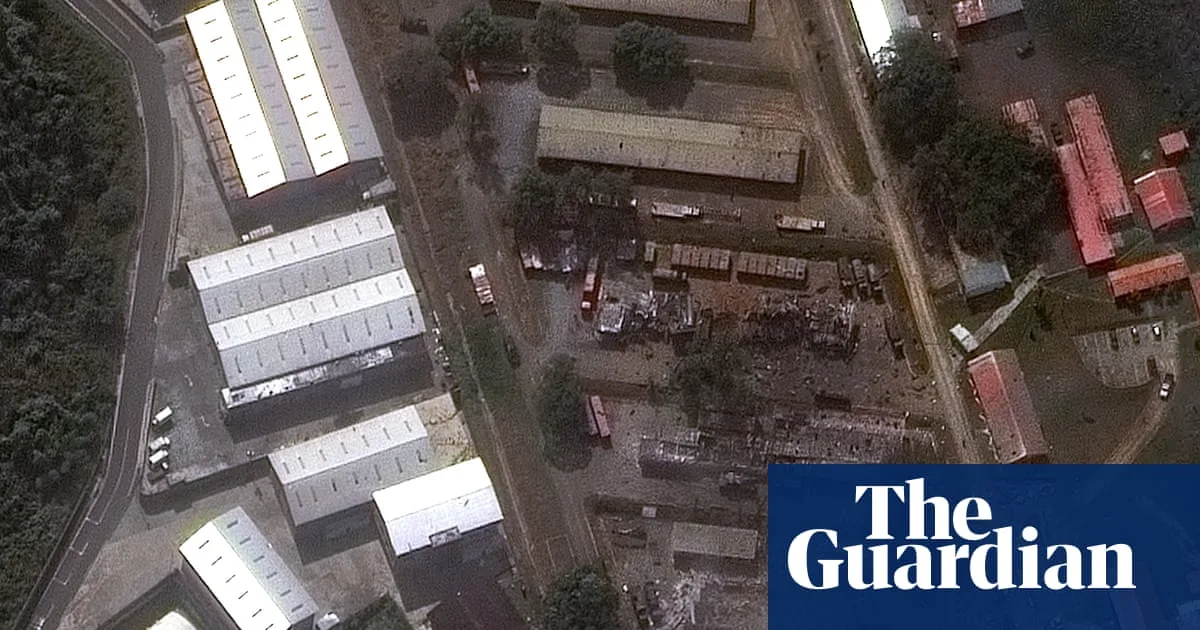
Inside the 148-Minute Raid: How US Forces Captured Venezuela's Maduro
How US captured Maduro in 148-minute raid

In a stunning display of military precision and intelligence gathering, the United States executed a lightning raid to capture Venezuelan President Nicolás Maduro and his wife, Cilia Flores. The operation, which unfolded in the early hours of Saturday, 3 January, lasted just two hours and 28 minutes, but was the culmination of months of intricate planning.

The Intelligence Build-Up: Tracking Maduro's 'Pattern of Life'

Critical to the success of Operation Absolute Resolve was an extensive surveillance campaign led by the CIA and other US agencies. From as early as August, intelligence operatives worked to establish President Maduro's detailed "pattern of life". This involved mapping his movements, sleeping locations, travel habits, and daily routines, a process described by General Dan Caine, chair of the US joint chiefs of staff, as understanding "how he moved, where he lived, where he travelled, what he ate, what he wore, what were his pets".

As the US bolstered its naval presence in the Caribbean from September, Maduro, aware of the growing threat, significantly tightened his personal security. He abandoned his well-publicised speaking engagements and began rotating between six to eight different sleeping locations each night to avoid detection. He also increased his reliance on Cuban counterintelligence officers and bodyguards, whom he trusted more than his Venezuelan security detail, the latter being forbidden from carrying mobile phones.

Despite these elaborate precautions, US intelligence pinpointed his location on the night of the raid. He was at a compound within Fuerte Tiuna, a major military base in the heart of Caracas. The CIA's monitoring reportedly used spy drones and, in a surprising post-operation revelation, a human source embedded within the Venezuelan government itself.

The Night of the Raid: Air Dominance and a Swift Ground Assault

The US had assembled a formidable force in the region, with up to a quarter of its navy warships in the Caribbean, spearheaded by the colossal aircraft carrier USS Gerald R Ford. The final go-ahead was given by US President Donald Trump at 10.46pm Eastern Time (11.46pm Caracas time).

The first phase was to establish total air superiority. Venezuela's air defences and aviation capabilities were swiftly neutralised, likely through strikes from Tomahawk cruise missiles and AGM-88 Harm anti-radiation weapons. Reports indicate F-35 fighter jets bombed Venezuelan Su-30 fighters on the ground. In total, more than 150 US aircraft participated in the night's actions.

With the skies secured, a team of elite Delta Force soldiers embarked on modified Black Hawk and Chinook helicopters. Flying at a mere 100 feet above the water to avoid radar, they navigated the short distance from the coast to Caracas, using mountain ranges as cover. A video from the city showed nine helicopters flying in formation towards Fuerte Tiuna.

The Capture at Fuerte Tiuna and Immediate Aftermath

The US forces were exceptionally prepared for the ground assault. They had constructed a replica of Maduro's compound for training and came equipped with tools like blow torches for steel doors and an FBI hostage negotiator. At 2.01am, the helicopters landed at the compound, meeting small arms fire which lightly damaged one aircraft.

A fierce gun battle ensued with Maduro's security team. Venezuela's defence minister later stated that a large part of the president's protective detail was killed. Maduro, in his final moments, attempted to flee to a safe room but was overwhelmed by Delta Force soldiers before he could secure the door. He and Flores were swiftly taken into custody.

By 4.29am, the helicopters had returned to international airspace, depositing the captives on the USS Iwo Jima. They were subsequently transferred to the United States, with Maduro arriving at the Metropolitan Detention Center in Brooklyn, New York.

While the military operation was a tactical success, its political consequences remain profoundly uncertain. The action plunges Venezuela's 30 million citizens into a new era of instability. As analyst Matthew Savill of the Royal United Services Institute noted, "The Americans have removed a couple. Impressive, but hardly 'decapitation'." The long-term ramifications for Venezuela and US relations in Latin America are yet to unfold.




