Pittsburgh's Media Landscape Stages Remarkable Recovery After Near-Collapse
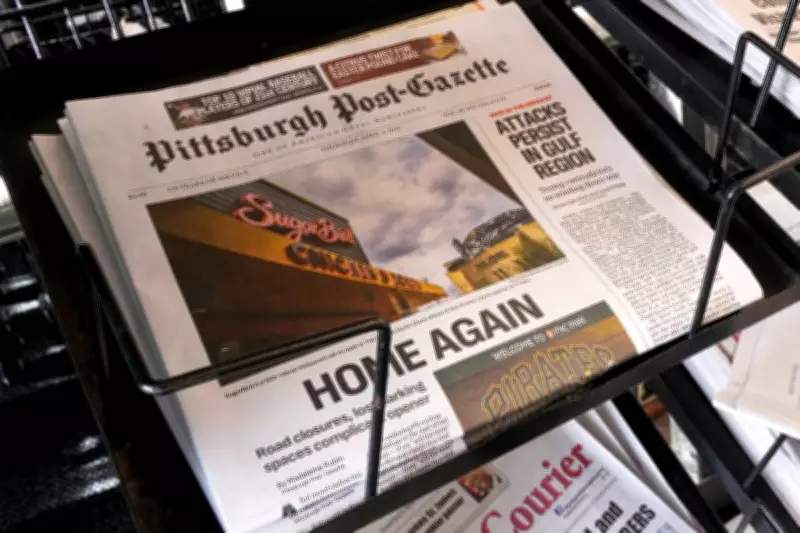
In a dramatic sequence of events this spring, Pittsburgh's media environment has undergone a near-death experience followed by an unexpected resurrection. The city's dominant newspaper, the Pittsburgh Post-Gazette, was slated for closure on May 3, which would have rendered the Steel City the largest American community without a locally based daily paper. However, owners announced last week that the publication has been sold to a nonprofit foundation committed to keeping it operational.
A Historic Institution Saved from Extinction
The Pittsburgh Gazette, established on July 29, 1786 as the first newspaper west of the Allegheny Mountains, has evolved through numerous incarnations over its 240-year history. Known variously as The Commercial Gazette, the Gazette-Times, and briefly as the Pittsburgh Gazette and Manufacturing and Mercantile Advertiser, it became the Post-Gazette in 1927 following the closure of the Pittsburgh Post. The publication has maintained this name for ninety-nine years, building a solid reputation that included winning a Pulitzer Prize in 2019 for coverage of the Tree of Life synagogue shooting.
"The Post-Gazette is really the paper of record for this city," said Kevin Acklin, chief of staff to a former Pittsburgh mayor and former president of the Penguins hockey team. The newspaper's survival had been in serious jeopardy due to prolonged labor strife, with much of the staff on strike between 2022 and 2025. Its owner, Block Communications, Inc., announced the closure on the same January day that the U.S. Supreme Court rejected its appeal of a ruling on health benefits seen as favorable to former strikers.

Parallel Revival for Alternative Voice
Weeks before the Post-Gazette's salvation, the alternative Pittsburgh City Paper experienced its own remarkable revival. Staff had learned on New Year's Day that the publication was closing after thirty-four years of operation, but it roared back to life under new ownership. "You thought we were dead and gone, didn't you?" wrote Ali Trachta, top editor at the Pittsburgh City Paper, on the outlet's revived website. "So did I. But, to be honest, only very briefly."
A new nonprofit called Local Matters, led by a former engineering manager at Apple, gathered investors to purchase the City Paper. The publication will return to printed editions on a monthly basis and is launching a membership program for readers to pledge support, with most of its original staff returning. Interestingly, the City Paper's previous owner was also Block Communications, which had reduced its print schedule to only four editions annually in 2025.
Nonprofit Model Offers New Hope
When Block announced its sale of the Post-Gazette last week, it was to another nonprofit entity—the Venetoulis Institute for Local Journalism, which publishes the successful digital platform The Baltimore Banner. The institute purchased the Post-Gazette despite not being the highest bidder, alleviating fears that the newspaper would be sold to a hedge fund notorious for stripping publications of resources.
"For better or worse, the Blocks will never get credit for that," said Andrew Conte, a journalism professor at Point Park University who runs Pittsburgh's Center for Media Innovation. "But it does seem like they made an effort to come up with the best outcome they could as they were leaving Pittsburgh. They could have just walked away and said, 'You know, we're done.'"
The Venetoulis Institute's benefactor, hotel magnate Stewart Bainum Jr., has committed to investing $30 million in both the Banner and Post-Gazette over the next five years. "This is going to be one of the most closely-watched newspaper acquisitions in years," said Tim Franklin, founding director of the Medill Local News Initiative at Northwestern University. "Can a money-losing newspaper with serious labor strife be saved and resurrected as a non-profit? If Stewart Bainum and his team pull this off—and I hope they do—it could be a model for the nation."

Broader Media Ecosystem Adapts
Anticipating a Pittsburgh without the Post-Gazette, other news sources in the city had begun making plans to fill marketplace gaps, and they're not necessarily changing those plans despite the sale. The Pittsburgh Tribune-Review will reinstate a Sunday print edition in Pittsburgh on May 9, having stopped printing in the city a decade ago. The Trib is also adding approximately a dozen new journalists to enhance coverage of business, health care, transportation, and education.
Meanwhile, Public Source, a digital news outlet launched in 2011 primarily for investigative journalism, is broadening its outlook. The organization has convened town halls over recent months for residents to discuss what they want in local news and has published a list of forty to fifty small news outlets in the region focusing on specific subject areas or neighborhoods.
"People are actively interested in where they get their information and who they can trust for it," said Halle Stockton, co-executive director and editor-in-chief of Public Source. "So we're leaning into that."
Fundamental Challenges Remain
Despite these positive developments, fundamental challenges persist for local journalism. A study released earlier this month by the Pew Research Center revealed that public interest in news has declined significantly across all age groups. In 2016, 37% of Americans said they followed local news very closely, but this dropped to just 21% in 2025.
This trend is particularly evident among younger audiences. When students in Andrew Conte's journalism class were asked how many had checked the Post-Gazette's website that morning, only a couple of hands tentatively went up. Sites like Instagram and TikTok are often their primary destinations for news due to convenience and absence of paywalls.
"It's human nature that sometimes you have to be shaken a bit to realize what's important in your life," Stockton observed. The experience has reinforced the need for news organizations to cooperate rather than compete destructively. "Literally, they were trying to kill each other," Conte recalled of the historical rivalry between the Tribune-Review and Post-Gazette. "I don't think any of us want to go back to a point where we're doing that. We've evolved. We're trying to work together."
As Pittsburgh's media landscape enters this new chapter, the city serves as a critical test case for whether local journalism can adapt to contemporary challenges through innovative ownership models and collaborative approaches.