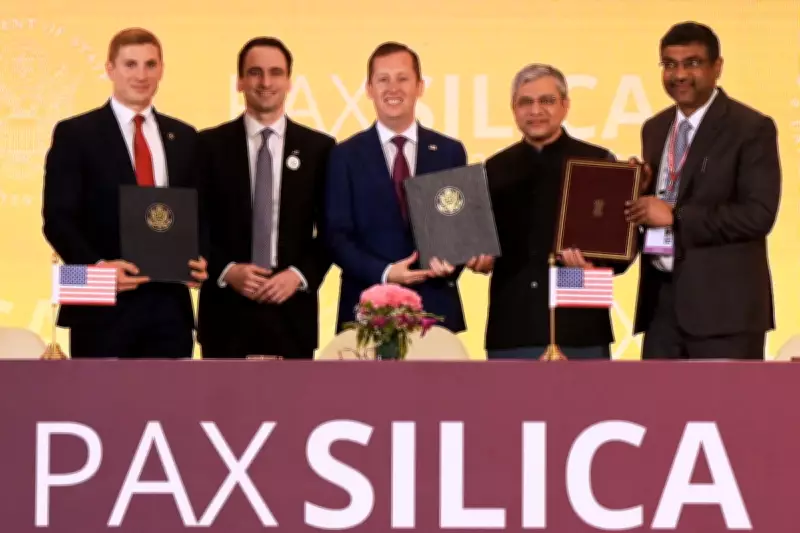
India has officially joined a United States-led international initiative designed to build secure technology supply chains, in a significant move announced on Friday that highlights the warming diplomatic relations between the two nations. This development follows a period of strain caused by New Delhi's continued purchase of discounted Russian oil, which had drawn criticism from Western partners.
Strategic Alignment and Geopolitical Context
The decision firmly aligns India with Washington's concerted efforts to establish resilient supply chains for semiconductors, advanced manufacturing, and other critical technologies. This comes at a time when geopolitical competition with China is intensifying globally, making such collaborations increasingly vital for national security and economic stability.
The Pax Silica Framework
Nations that have already joined the Pax Silica framework include Japan, South Korea, the United Kingdom, and Israel. U.S. Ambassador Sergio Gor emphasized the importance of India's participation in a speech preceding the agreement signing at an artificial intelligence summit in New Delhi.

"Pax Silica will be a group of nations that believe technology should empower free people and free markets. India's entry into Pax Silica isn't just symbolic. It's strategic, it's essential," Gor stated.
The initiative aims to strengthen cooperation among partner countries on semiconductor design, fabrication, research, and overall supply chain resilience. A primary objective is to reduce dependence on China-dominated manufacturing hubs while promoting trusted production networks across democracies and strategic allies.
Resetting Bilateral Relations
This development occurs just weeks after India and the U.S. reached an interim trade framework to reduce tariffs and grant greater market access to each other, easing tensions that had threatened to slow bilateral momentum. Earlier this month, President Donald Trump announced that the U.S. would lower reciprocal import tariffs on India from 25% to 18% and remove an additional 25% levy imposed earlier for buying Russian crude. This concession came after Indian Prime Minister Narendra Modi agreed to halt such purchases.
Background on Energy Trade Friction
India had significantly ramped up Russian oil imports following Moscow's invasion of Ukraine in 2022, drawing criticism from Western partners. New Delhi defended these purchases as necessary to manage inflation and protect its consumers, but the policy created a brief strain in relations with the United States and other allies.
Broader Strategic Implications
India's entry into Pax Silica, combined with the recent trade concessions, marks a notable strategic convergence that extends beyond mere commerce into long-term technology and security cooperation. This move reinforces India's role as a key U.S. partner in the Indo-Pacific region, with implications for regional stability and economic dynamics.
"From the trade deal to Pax Silica to defense cooperation, the potential for our two nations to work together is truly limitless," Ambassador Gor concluded, underscoring the multifaceted nature of the strengthened partnership.