

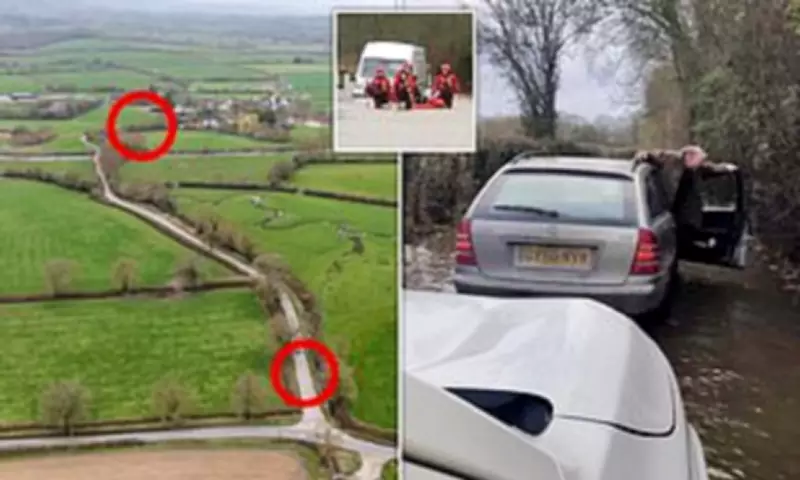
Dorset Village Flood Gate Row Sparks Fury as Council Takeover Causes Chaos
The picturesque hamlet of Hammoon, nestled near Shaftesbury in Dorset, is typically known for its serene 12th-century Norman church and scenic bridge spanning the River Stour. However, this tranquil setting has become the epicentre of an escalating conflict between frustrated locals, unsuspecting motorists, and the health and safety-conscious Dorset Council.
The Source of the Sinking Problem
At the heart of the dispute lies a deceptive dip in the single unclassified road that winds through Hammoon, connecting the neighbouring villages of Manston and Fiddleford. While the hamlet's twenty-odd houses remain safely elevated above flood levels, this inconspicuous hollow fills rapidly with water when the River Stour overflows during heavy rainfall. The entire road surface becomes submerged, creating an invisible hazard that has ensnared numerous vehicles.
For years, a simple yet effective volunteer system prevented disasters. Local residents monitored rising river levels via a WhatsApp group and promptly closed two iron-barred flood gates on either side of the Stour bridge once waters reached 2.3 metres. This community-led approach successfully kept the road clear of stranded cars.

Council Intervention and Immediate Fallout
Last autumn, Dorset Council officials intervened, declaring that volunteer operations no longer met health and safety standards. Council representatives argued that risks to volunteers on the highway could not be "satisfactorily mitigated," despite the road being a quiet country lane. Consequently, the council assumed responsibility for gate management, implementing a new system where the parish council would call a dedicated hotline, with a promised two-hour response window for gate closures.
This change coincided with the exceptionally rainy winter of 2025/6, as Dorset endured successive storms named Amy, Bram, and Chandra. The new system quickly proved inadequate. Gates were repeatedly left open too long, leading to a surge in vehicles becoming stuck in floodwaters. One resident reported counting ten stranded vehicles in just three weeks, while parish councillors highlighted that each emergency service callout costs taxpayers at least £3,000—and only rescues people, not their cars.
Victims Voice Their Anger
Building project manager and sculptor George Bingham, 67, experienced the consequences firsthand when his Mercedes estate car was written off after driving into floodwaters. "I knew the people in Hammoon have been very efficient at running these gates for the last few years," he explained. "So when I saw the gates were open, I thought the village was probably passable. Water got into the air intake and I came to a stop in the middle of it."
Mr Bingham, who had to be rescued in Wellington boots provided by a local, now labels the council's handling as "pathetic" and "totally inefficient." His sentiment is echoed widely among villagers. Local resident Vanda Goddard stated, "When the residents were operating the gates, we had no problems. Everything went smoothly and not a single car got stuck. But it's been a disaster since the Council took over."
A Community United in Criticism
Ken, a local farm worker, described the council as "morons" for their inconsistent gate management, sometimes closing roads unnecessarily while leaving them open during actual floods. "The council are doing a bad job," he said. "It was much better and safer when the residents were in charge."
Mary-Jane Wright, who keeps livestock in Hammoon, pointed out that satellite navigation systems often divert drivers onto this road as a shortcut, exacerbating the problem. "The gates being shut is a good deterrent," she noted, "but now the council are not shutting the gates quick enough. There are people who like to chance it and then fire engines get called out to rescue them. It's such a waste of resources and money."
Council Response and Future Measures
In response to the outcry, a Dorset Council spokesperson explained that the policy change followed a parish council review and "mutual discussion." The spokesperson thanked volunteers for their past efforts and emphasised the legal requirements involved in formally closing a highway.

The council is now exploring additional warning measures for motorists, including enhanced depth markers to provide clearer, real-time information about flooding risks. "We are aware that recent flooding has resulted in some vehicles becoming stranded," the spokesperson acknowledged, advising drivers to avoid floodwaters whenever possible due to their unpredictable nature.
Despite these assurances, Hammoon's residents remain deeply dissatisfied. With a history stretching back nearly a millennium to the Domesday Book and a population of just forty, this tiny community finds itself unexpectedly augmented by stranded motorists—a situation they blame squarely on bureaucratic interference replacing their proven, common-sense approach to flood management.





