

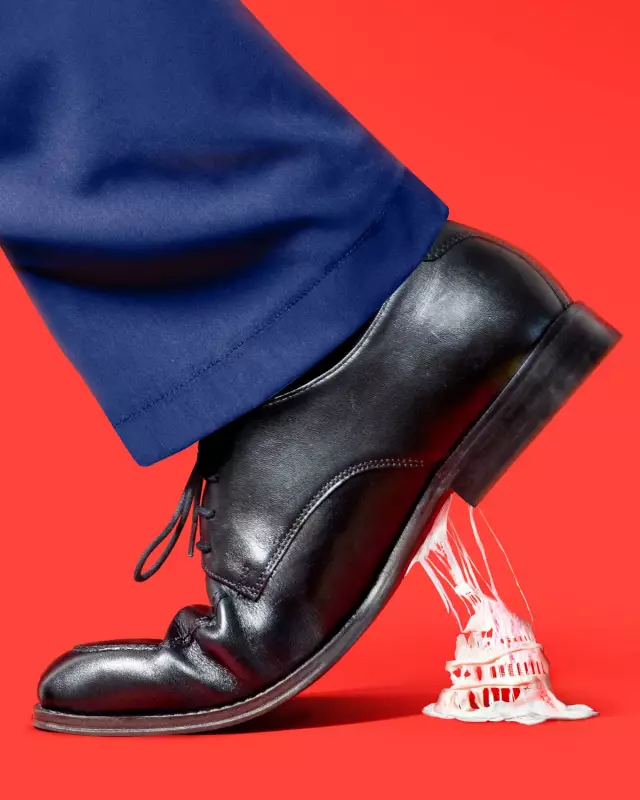
Donald Trump's second term has been marked by a systematic and unprecedented campaign to sideline the legislative branch and concentrate power within the White House, according to governance experts. From mass firings to unilateral tariffs, the president has tested the limits of executive authority, often with little resistance from his own party in Congress.
A Year of Escalating Intrusions
Almost immediately after his inauguration in January 2025, held inside the Capitol Rotunda due to cold weather, President Trump began actions seen as a direct challenge to congressional authority. Molly Reynolds, director of governance studies at the Brookings Institution, stated that the past year represents a significant escalation in executive intrusion into powers historically held by Congress.
"We've seen new and different ways that the executive branch has tried to intrude into congressional power," Reynolds said, noting a failure by congressional Republicans to mount a robust institutional defence.

The administration's tactics have been multifaceted. At the president's direction, leaders of independent agencies—including the National Labor Relations Board, Merit Systems Protection Board, and Federal Trade Commission—were fired. These officials, confirmed by the Senate, were intended to serve fixed terms insulated from presidential whims.
Later in 2025, Trump attempted to fire a Federal Reserve governor and opened a criminal investigation into Chair Jerome Powell over interest rate disagreements. David Mayhew, a professor emeritus at Yale University, labelled this assault on independent agencies the president's "most disturbing behaviour," calling it a violation of statute, norms, and potentially the constitution.
Circumventing Legislative Authority
The administration has also moved to dismantle or defund congressionally created entities. Trump ordered the dismantling of the Department of Education and gutted federal offices whose work it disliked. He has refused to spend funds appropriated by Congress and invoked emergency powers to impose wide-ranging tariffs on US trading partners.
Perhaps the most stark example of bypassing Congress came with the military raid to capture Venezuela's president, Nicolás Maduro. The operation was ordered without seeking permission from or giving advance notice to lawmakers, prompting fierce criticism from Democrats.
Nancy Pelosi, the Democratic former House Speaker, accused Republicans of having "abolished the Congress of the United States." However, as the minority party, Democrats' tools are limited, relying heavily on joining dozens of lawsuits against the administration, explained Jamie Raskin, the top Democrat on the House Judiciary Committee.
Norms Under Pressure and Limited Pushback
Philip Wallach of the American Enterprise Institute argues that decades of accumulated presidential power, tolerated by both parties, have created a dangerous precedent. "This president has very little respect for those norms," Wallach said, allowing him to use powers in "entirely new ways."
Republican lawmakers have largely defended Trump's actions as a continuation of tactics used by previous Democratic presidents, such as Joe Biden's student debt relief and airstrikes. Representative Mike Lawler dismissed Democratic complaints as "a lot of bunk."
Despite Republican control of both chambers, Trump's ability to pass legislation is constrained by Senate rules, requiring 60 votes for most bills. This has pushed the administration to rely on executive actions and the budget reconciliation process, used to pass the One Big Beautiful Bill Act making tax cuts permanent and funding deportations.
There have been flashes of congressional defiance. In the House, a small bipartisan coalition forced through a measure extending Affordable Care Act tax credits. Four Republicans also helped pass the Epstein Transparency Act, which Trump reluctantly signed. Democratic sponsor Ro Khanna called it a potential "turning point."

In the Senate, Republican Rand Paul collaborated with Democrat Tim Kaine on a war powers resolution to prevent future attacks on Venezuela without congressional consultation, motivated by opposition to "country being run by emergency." The resolution ultimately failed after sustained White House pressure.
As the first anniversary of his second inauguration passes, the long-term impact of Trump's power consolidation remains uncertain. Raskin expressed hope that future presidents would show more respect for the rule of law, but warned that "it's very hard to regather presidential powers gone wild." The battle for the balance of power, a cornerstone of the US Constitution, continues to unfold.





