
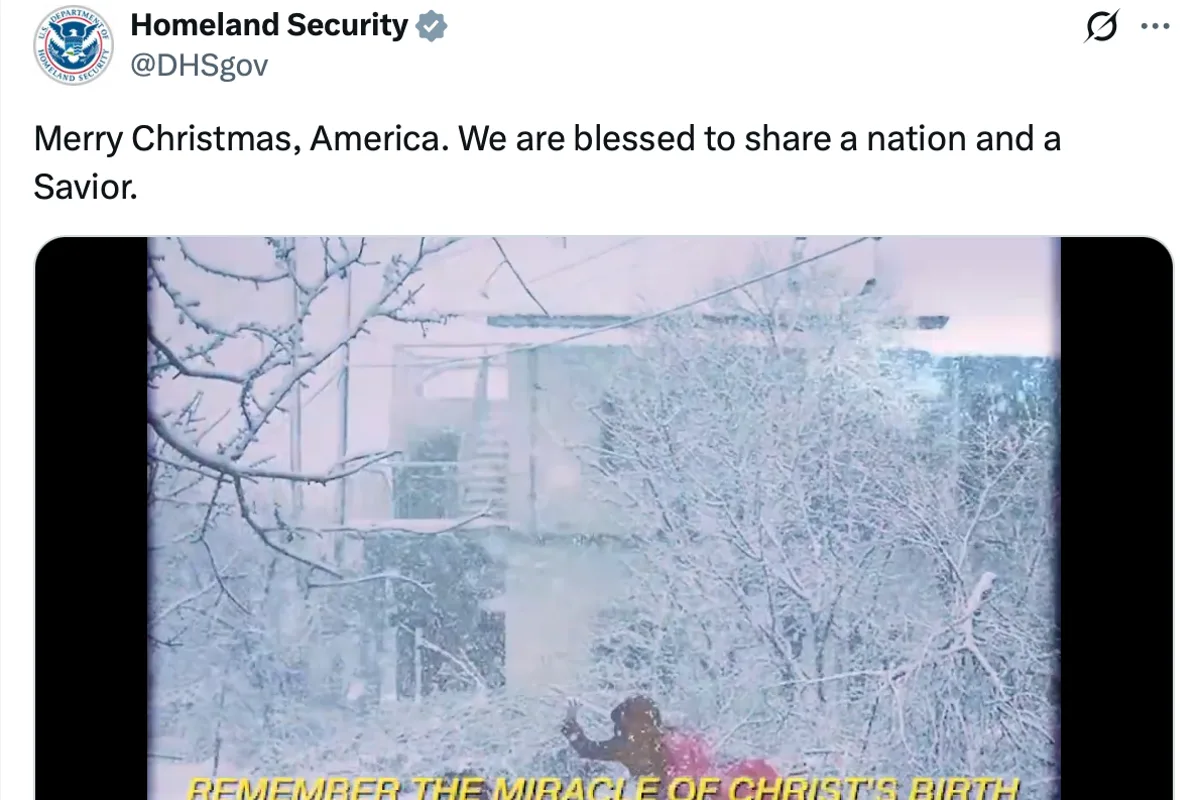
Top officials and federal agencies in the Trump administration have been accused of blurring the line between church and state after using official government social media accounts to share explicitly religious Christmas messages. The posts, which included declarations that Jesus Christ is the nation's saviour, have drawn criticism from First Amendment advocates who argue they breach the constitutional firewall between religion and government.
The Department of Homeland Security shared videos on X with the caption “Christ is Born!” and another post stating “we are blessed to share a nation and a Saviour”. Defence Secretary Pete Hegseth wrote: “Merry Christmas to all. Today we celebrate the birth of our Lord and Saviour, Jesus Christ.” Secretary of State Marco Rubio said “the joyous message of Christmas is the hope of Eternal Life through Christ.”
Agriculture Secretary Brooke Rollins claimed that “the very best of the American spirit … flows from the very first Christmas, when God gave us the greatest gift possible: the gift of his son and our saviour, Jesus Christ.” Education Secretary Linda McMahon wished “you and your family a day filled with lasting memories as we celebrate the birth of our Saviour.” The official account for the Department of Labor posted “Let Earth Receive Her King.”
Rachel Laser, president of Americans United for Separation of Church and State, described the messages as “one more example of the Christian Nationalist rhetoric the Trump administration has disseminated since Day One in office”. Former Homeland Security spokesperson Alex Howard called the use of official channels “inappropriate”, while Alex Nowrasteh of the Cato Institute noted that “Americans don’t share a religion. Our state is secular.”
Administration officials responded to criticism with “Merry Christmas”. The posts come amid broader efforts by the Trump administration to align with evangelical Christians, including the creation of a Religious Liberty Commission and a task force to prosecute anti-Christian violence. Nearly two-thirds of Americans identify as Christian, according to Pew Research, though this has declined by 16 percentage points over two decades.




