

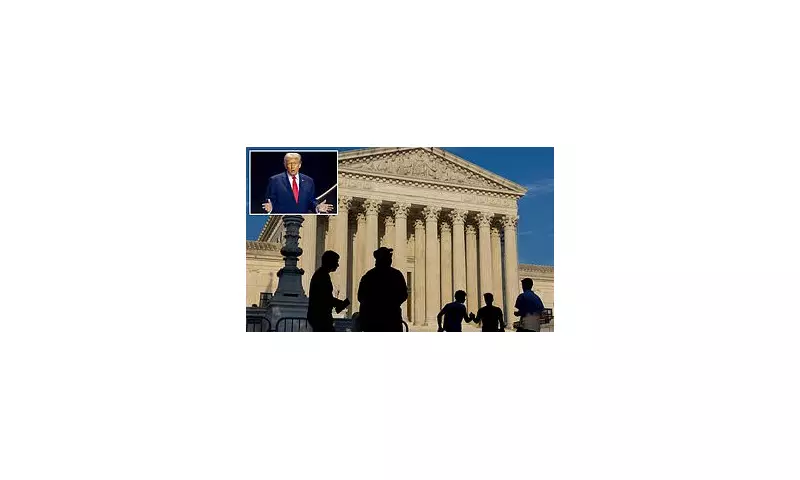
The United States Supreme Court, dominated by a conservative majority, has agreed to take up a landmark case that will decide the fate of former President Donald Trump's controversial attempt to end birthright citizenship. The court announced its decision on Friday, setting the stage for a constitutional showdown with profound implications for American identity and immigration law.
The Executive Order and Constitutional Clash
On the very first day of his hypothetical second term back in the White House, Donald Trump signed an executive order titled 'Protecting the Meaning and Value of American Citizenship'. This directive declared that children born on US soil to parents who are illegal immigrants or in the country on temporary visas would no longer be granted automatic citizenship.
The move was immediately challenged and struck down by multiple lower courts, which found it unconstitutional. Judges ruled it directly conflicted with the Citizenship Clause of the 14th Amendment, ratified after the Civil War. That clause states clearly: 'All persons born or naturalized in the United States, and subject to the jurisdiction thereof, are citizens of the United States and of the State wherein they reside.'

The Trump administration's legal argument hinges on a specific interpretation of the phrase 'subject to the jurisdiction thereof.' They contend that individuals in the US illegally or on non-immigrant visas do not meet this criterion and are therefore excluded from the amendment's guarantee. Furthermore, they argue the 14th Amendment was historically intended to address the rights of formerly enslaved people, not the children of undocumented migrants or temporary visitors.
Legal Battles and Heated Arguments
In legal briefs, Trump's Solicitor General, John Sauer, claimed that extending birthright citizenship to the children of illegal aliens has caused 'substantial harm' to the United States, by creating a powerful incentive for illegal immigration and impairing the nation's territorial integrity. He asserted that lower court rulings had 'invalidated a policy of prime importance' and undermined border security.
Opponents, including the American Civil Liberties Union (ACLU) which is leading a nationwide class action lawsuit, have fiercely rejected this. District Judge John Coughenour, who heard one challenge in Washington state, labelled the order 'blatantly unconstitutional,' noting in his decades on the bench he had rarely seen a legal question so clear-cut.
'No president can change the 14th Amendment’s fundamental promise of citizenship,' stated ACLU National Legal Director Cecillia Wang. 'For over 150 years, it has been the law and our national tradition that everyone born on US soil is a citizen from birth.' She emphasised that federal courts have unanimously found Trump's order contrary to the Constitution, a Supreme Court precedent from 1898, and federal statute.
What Happens Next and Potential Fallout
The Supreme Court has not yet scheduled a date for oral arguments, but legal observers expect them to be heard early in 2025. A final ruling from the nine justices would then be anticipated by the summer. The court's composition, with a 6-3 conservative majority including three Trump appointees, adds significant weight to the proceedings.
The case directly challenges the 1898 Supreme Court ruling in United States v. Wong Kim Ark, which affirmed that birth on US soil automatically confers citizenship. If the current court overturns or narrows this long-standing precedent, the legal status of thousands of children born in the US each year could be thrown into doubt, creating a complex and unprecedented administrative crisis.
This impending decision places the Supreme Court at the centre of a deeply polarising national debate, balancing presidential authority, constitutional originalism, and the very definition of who is considered an American.






