

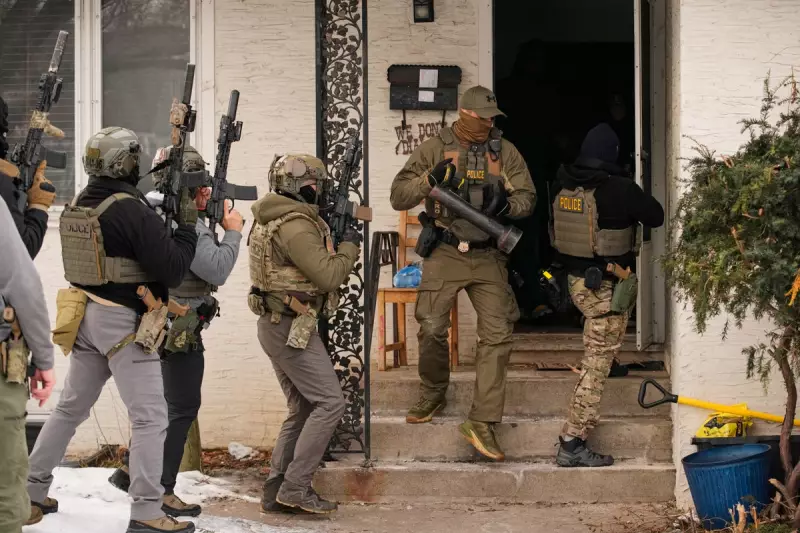
US Immigration and Customs Enforcement (ICE) agents have been accused of a 'blatant constitutional violation' following the forceful arrest of a Liberian man in Minnesota, an incident that has further inflamed tensions in a state already rocked by protests.
A Door Smashed, A Constitutional Question Raised
On Sunday, 15 January 2026, armed ICE agents used a battering ram to break down the door of Garrison Gibson, a 37-year-old Liberian national, before taking him into custody. His attorney, Mark Prokosch, has condemned the action, stating the agents did not possess a proper criminal warrant authorising forced entry into a private home.
Prokosch asserts the agents presented only an administrative warrant, which permits an arrest but does not grant the legal authority to break into a residence. "This was an illegal search, absolutely," he said, labelling the operation a "blatant constitutional violation."

Contrasting Portraits of the Detainee
Garrison Gibson fled the Liberian civil war as a child. Despite a 2008 drug conviction that was later dismissed by the courts, he had been living in the US legally under an order of supervision. This required him to check in regularly with immigration authorities, which he had done just days before his arrest at the very regional offices where recent enforcement raids have been staged.
"He would have had another check-in in a couple of months," Prokosch argued. "So if he’s this dangerous person, then, why are they letting him walk around?"
However, a spokeswoman for the Department of Homeland Security (DHS), Tricia McLaughlin, described Gibson as having "a lengthy rap sheet" including robbery and weapons offences. She did not clarify if these were arrests, charges, or convictions. Court records indicate a history dominated by minor offences, with the single felony drug conviction from 2008 having been dismissed.
Protests, Legal Moves, and a Widening Crisis
The arrest occurred amid waves of angry protests in the Twin Cities following the fatal shooting of Renee Good by an ICE agent in Minneapolis on 7 January. Activists attempted to disrupt Gibson's arrest by banging drums and honking car horns, with video showing agents pushing and pepper-spraying demonstrators.
In a rapid legal manoeuvre, Prokosch filed a habeas corpus petition after Gibson was flown to Texas. A judge ordered his return to Minnesota, where he is currently held at a detention centre in Albert Lea. The courts have yet to rule on the petition's central question: the legality of his detention.
The DHS has hailed the ongoing Minnesota operation, which began in December, as its biggest enforcement operation ever, resulting in over 2,000 arrests. Homeland Security Secretary Kristi Noem announced plans to send additional federal agents to the state to protect officers and continue enforcement.
Meanwhile, Gibson's wife, Teyana Gibson Brown, a nurse who was home with their nine-year-old child during the raid, was left deeply shaken. Prokosch said she "was having a hard time just completing sentences because she’s just been so distraught." The Department of Homeland Security did not respond to follow-up questions regarding the justification for the use of force in this case.






