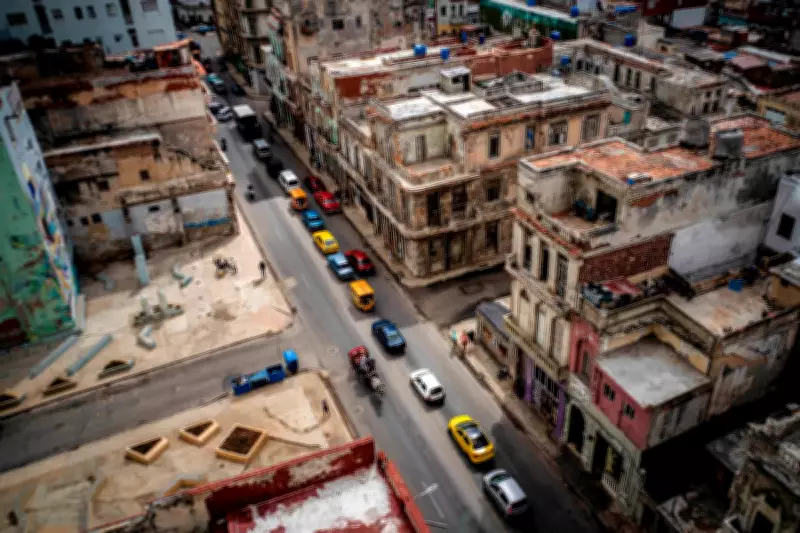
Havana has inaugurated its first two modular homes constructed from repurposed shipping containers, a significant development in a capital city where once-grand residences are crumbling. President Miguel Díaz-Canel and other officials attended the weekend ceremony, awarding the homes to two single mothers. One had lived in a shelter for over a dozen years, while the other shared a single room with her two teenage children, according to state media.
Rapid Construction Using Surplus Materials
The homes were built in just one month using surplus materials from tourism projects, technologies developed by Cuba's Revolutionary Armed Forces, and containers previously used to import parts for solar panel farms from China. Officials stated on Saturday that Cuba faces a housing deficit exceeding 800,000 homes, with the most acute need in Havana.
Living in Fear of Collapsing Buildings
Yurieska Artunet Martí, a 29-year-old beautician in historic Havana, was forced to leave her last apartment after it disintegrated. She now lives in the rear section of the same building, which remains standing—for now. "Everybody here in Havana lives in fear," she said, gazing at her rotting ceiling and crumbling walls. Pregnant with her fourth child, she shares the space with her three children, ages 7 months, 1, and 5. Plaster falls onto their bed while they sleep. Unable to afford alternative housing, she closed her home-based beauty business after clients avoided the hazardous conditions, including eroded steps and a gaping elevator shaft.

Widespread Decay in Historic Havana
The iconic homes of Old Havana, ranging from Spanish Colonial to Cuban Baroque, are notorious for collapsing, especially after heavy rains, sometimes killing residents. Government data from 2020 indicates that of the island's 3.9 million homes, nearly 40% are in fair or poor condition due to lack of maintenance, a deep economic crisis, and adverse weather. In Artunet Martí's building, the upper floors have been evacuated, leaving her family alone. "What are we going to do?" she asked. "We know we’re in danger, but we have to accept reality."
Carlos Sablón, a 60-year-old engineer in another historic district, recalls a night when part of his building's third floor collapsed. He was watching television but knew immediately what happened. "It’s quite damaged by time," he said, pointing to the crumbling courtyard. After firefighters evacuated everyone, Sablón returned to his undamaged apartment, hooking up power and water for himself and a few others. "You’re always going to be afraid," he lamented, noting the lack of safety enforcement. "This is the one I fear the most. I hope it’s not when someone is walking by."
Magalys Caro, 63, lives in a single room with a makeshift kitchen and bathroom in the front of a building that once housed a company. She moved in after her home next door collapsed during a hurricane. "The back there has collapsed," she said, gesturing to a spacious open area behind her. "I’ve been living here in these poor conditions for about 10 years. Nothing gets resolved. The Housing Department does nothing."
Expanding the Modular Home Program
At the unveiling, Prime Minister Manuel Marrero Cruz acknowledged that the container-to-home conversion program could be accelerated. "It is not moving at the desired pace," he said, though work continues. Delilah Díaz Fernández, housing director general at the Ministry of Construction, reported that over 2,000 containers have been approved for conversion, with about 700 currently being transformed. "The program holds immense potential and is here to stay," she stated, adding that new containers will be considered for housing. Beneficiaries will include those who lost homes to extreme weather or structural collapses.