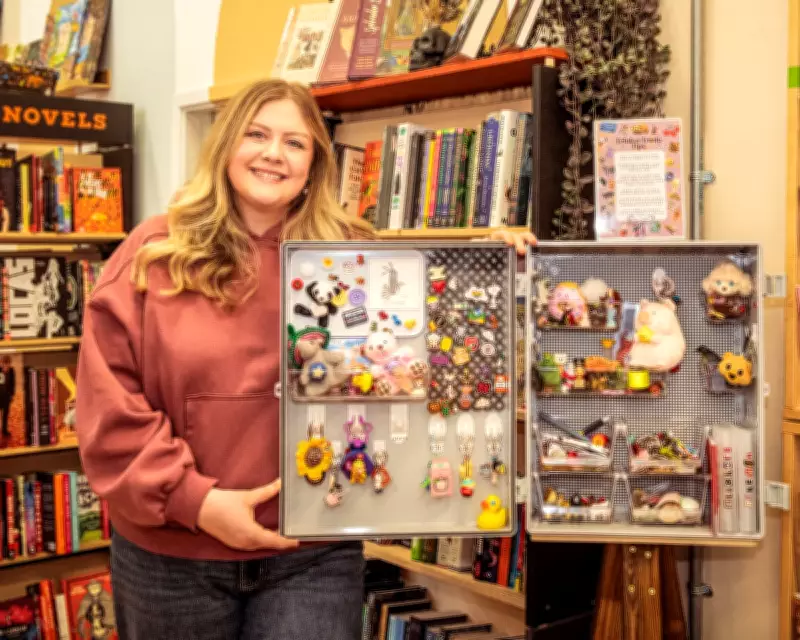
Sam Stevens, a 29-year-old pet-sitter originally from British Columbia, stands proudly beside a bright pink box brimming with miniature wonders at Argonaut Books in Edinburgh. Inside, a plush elephant in a sombrero, a rubber doughnut-frog hybrid, and a bubble tea keyring jostle for space. Stevens is part of a growing global movement: trinket exchanges, where people swap tiny treasures for free.
The Rise of Trinket Exchanges
These boxes, often homemade from electrical junction boxes, began appearing in the US last autumn, with Philadelphia hosting one of the first. They echo the Little Free Libraries trend and exploded during the pandemic into neighbourhood installations worldwide. Rachael Harms Mahlandt, a Portland artist, has catalogued these 'sidewalk joys' since 2022, starting a world map in 2024 that now lists nearly 1,500 exchanges, with the UK as a hotspot.
Edinburgh's Trinket Hub
Stevens' box at Argonaut Books in Leith has become a local sensation. Inspired by a San Francisco exchange, she filled it with finds from car boot sales. 'It's a way to recycle stuff,' she says. The box launched in early April and quickly gained 400 followers. Staff even raid it; a magnetic lobster now adorns the staff whiteboard.

Visitors like Franky and Liza Cannon, artists in their 30s, appreciate the nostalgia. Franky selects a crab coin purse, while Liza picks a tiny rocket pin. 'We all need more fun in our lives,' Franky says. Noa Carter, a 22-year-old photography student, came for a Littlest Pet Shop bird, reminiscing about childhood collections. Stevens encourages taking without trading: 'It all evens out.'
The Psychology of Collecting
Trinket trading offers instant gratification without ecological impact, as TikTok user @alottameg notes. Stevens agrees: 'It's a boost of joy without buying something, and you recycle unwanted items.' Research by Martin Reimann, associate professor at the University of Arizona, shows that collecting provides control during turbulent times, a desire heightened by the pandemic.
For many, it's about healing the inner child. 'Things are really bad, and people just want a tiny bit of joy,' Stevens says. Harms Mahlandt adds, 'The world has been heavy. People need joy.'
A Circular Tat Economy
While some might call the items 'tat', the exchanges promote a circular economy. Niamh O'Connor and Ellie Millar, both 27, brought stickers and a Barbie lipstick. 'I just want the entire box in my house,' O'Connor says. They left with a Sonny Angel doll and a magnetic tomato. Stevens plans to continue indefinitely, and the box has moved to another Edinburgh bookstore, Lighthouse, though Argonaut may install a permanent one.
As Barclay sums up, 'It's just nice to have little things.'