Viking Gold Coin Depicting John the Baptist Rewrites Christian History
A remarkable discovery in the English countryside has unearthed a potential link between Viking settlers and the teachings of Jesus Christ, dramatically challenging established historical narratives about the spread of Christianity approximately 1,200 years ago.
The Norfolk Discovery
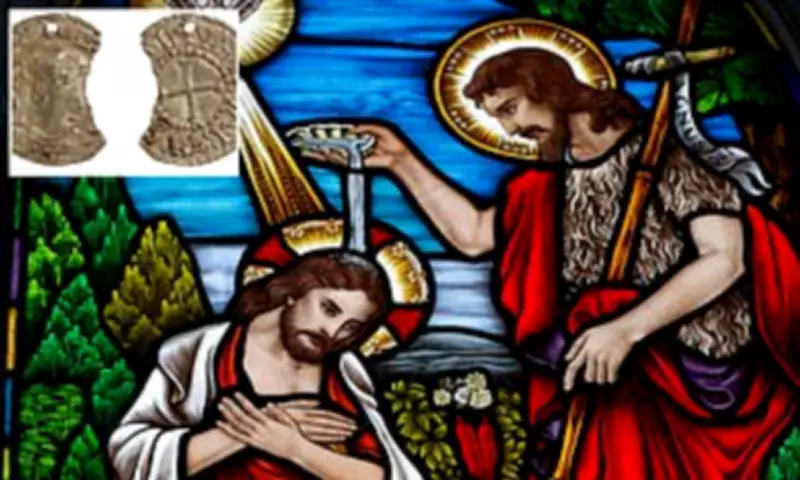
While searching for potential treasure with a metal detector in Norfolk, an individual recently discovered a small, incomplete gold coin that had been deliberately converted into a pendant for personal adornment. Detailed analysis has confirmed that this artefact dates from the late ninth century, most likely between the 860s and 870s AD. This period coincides precisely with the Viking conquest of the Kingdom of East Anglia in eastern England, as Norse warriors were consolidating their control over the region.
A Baffling Religious Depiction
The coin presents a profound historical puzzle. One side features the engraved face of a bearded man accompanied by the Latin abbreviation 'IOAN', which is the recognised shorthand for John. The reverse side bears a partial Latin inscription that, when translated by experts, appears to read 'Baptist and Evangelist'. This clearly identifies the figure as John the Baptist, the cousin of Jesus who is described in the Bible as preparing the masses for Christ's arrival and performing his baptism in the River Jordan.

This depiction is exceptionally unusual for the period. Coins from ninth-century Western Europe almost universally displayed portraits of contemporary kings or emperors to signify secular authority, not religious figures. The discovery is now believed to be the first coin or piece of jewellery from this era found in Western Europe to feature an image of Saint John the Baptist.
Challenging Viking Paganism
This find directly challenges the long-held assumption that Vikings of this era were exclusively pagan, worshipping Norse deities like Odin and Thor. The presence of a prominent Christian saint on a coin from a Viking-controlled area suggests that some Norse individuals may have turned to Christianity decades before historians currently believe widespread conversion occurred.
Dr Simon Coupland, a noted coin historian, expressed his astonishment to the BBC. 'These imitations of gold solidus tend to be made by Scandinavians, who are not Christian at this point - so what are they doing depicting John the Baptist?' he questioned. 'A figure of John the Baptist on a coin is so unusual and remarkable - I don't know of another from the Carolingian period; it's bizarre - it's not like anything else I know.'
Historical Context and Significance
John the Baptist has been a central figure in Christianity since the time of Jesus. Early Christians viewed him as a crucial bridge between the old Jewish prophetic tradition and the emerging Christian faith. By the ninth century, he was already a well-known and venerated saint across Christian Europe, though depictions were more common in the Byzantine Empire than in the West.
Until this discovery, the historical consensus held that Vikings arrived in Britain as pagans in the late eighth and ninth centuries, with widespread conversion to Christianity not occurring until after the tenth century, often through settlement and intermarriage with local Christian populations. This gold imitation coin now stands as one of the earliest and most intriguing pieces of evidence that Viking and Christian worlds may have overlapped and influenced each other far earlier than written records have indicated.
Interpretation and Caution
Experts urge caution, noting the pendant does not provide definitive proof that Vikings en masse had abandoned Norse gods for Christianity in the late 800s. Given that Vikings engaged extensively in both raiding and trading across Europe, the pendant could simply reflect cultural contact, an item acquired through trade or plunder, or even a single Viking's personal curiosity about Christian iconography, rather than signalling a full religious conversion.

A Pattern of Rewriting History
This unusual coin is not the first piece of jewellery to alter modern understanding of Christian history. In a parallel discovery announced in 2024, scientists revealed a tiny 1,800-year-old silver amulet found in a Roman grave near Frankfurt, Germany. Dating from 230 to 270 AD, it contained an 18-line Latin inscription repeatedly referring to Jesus as the son of God and including a direct biblical quote. That artefact was declared the oldest known purely Christian object ever found north of the Alps, pushing back the confirmed history of Christianity in that region by 50 to 100 years.
The Norfolk coin pendant, while perhaps more ambiguous in its origins, similarly forces a significant reconsideration of the timeline and nature of early Christian influence in Northern Europe, posing new questions about the complex spiritual landscape of Viking Age England.