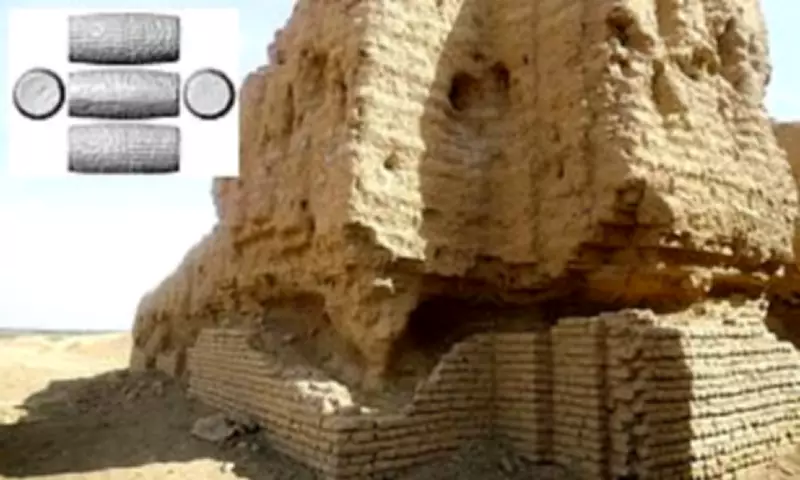
Archaeologists have uncovered a remarkable Babylonian 'time capsule' that has remained buried for more than two millennia beneath the ruins of an ancient ziggurat in modern-day Iraq. This extraordinary discovery reveals never-before-seen details about the biblical king Nebuchadnezzar II, offering a fresh perspective on one of history's most formidable rulers.
Discovery of the Sacred Cylinders
Two baked clay cylinders bearing royal inscriptions were originally unearthed at the ruins of a temple in the ancient city of Kish, one of Mesopotamia's most significant urban centers. These artifacts were discovered by local residents at the Kish archaeological site known as Tell Al-Uhaimir and subsequently handed over to Iraq's State Board of Antiquities and Heritage in 2013. The groundbreaking findings regarding the inscriptions were finally revealed to the public in December.
Ritual Foundation Deposits
The cylinders served as 'foundation deposits' - ritual objects deliberately buried beneath ancient structures as divine blessings believed to ensure architectural longevity. Each cylinder features a royal inscription written directly on its clay surface using ancient Babylonian cuneiform script, with King Nebuchadnezzar II himself 'speaking' through the text.

Nebuchadnezzar's Personal Account
In the inscription, the king proudly describes how he restored an aging, crumbling stepped temple tower in Kish dedicated to the Mesopotamian war deities Zababa and Ishtar. He explains that previous monarchs had both constructed and repaired the ziggurat, but time and weather had once again taken their toll. The time capsule concludes with a heartfelt prayer in which Nebuchadnezzar asks the gods for longevity, old age, and assistance in vanquishing his enemies.
The Biblical Destroyer as Temple Builder
Nebuchadnezzar II, who ruled the Neo-Babylonian Empire from 605 BC to 562 BC, appears in the Bible as an agent of destruction. He famously besieged Jerusalem, destroyed the kingdom of Judah, and deported much of its population during what became known as the Babylonian captivity. Biblical texts describe him as a 'destroyer of nations' who abducted Israelites including the prophet Ezekiel.
However, the Kish cylinders present a strikingly different aspect of the warrior-king. They highlight his role as a dedicated builder and restorer, closely aligning with his portrayal in the Book of Daniel where he walks on Babylon's royal palace roof declaring, 'Is not this great Babylon, which I have built by my mighty power as a royal residence and for the glory of my majesty?'
Translation of the Inscription
The ziggurat in question was named É-u-nir-ki-tuš-maḫ, meaning 'House, temple-tower, exalted abode.' The translated inscription reads: 'The ziggurat of Kish, which a king of the past had built, but its walls had buckled and a former king had restored (the damaged walls), and made its structure suitable, with the passage of time, it again became weak, buckled, and showers of rain carried away its brickwork.'
Nebuchadnezzar attributes his motivation to divine devotion, specifically mentioning Zababa as 'the strongest one, the one who kills my enemies' and Ishtar as 'who magnifies my kingship.' The inscription continues: 'Zababa and Ishtar had pushed my heart (to do it). (so) I put its brickwork in good order, I built its collapsed sections anew, and I completed it and raised its superstructure. I embellished its outward appearance and made it shine like the daylight for Zababa and Ishtar, my lords.'
Archaeological Confirmation
Although such sacred time capsules were typically buried beneath temples, the Kish inscriptions were reportedly found on the surface at Tell Al-Uhaimir. Researchers from Iraq's State Board of Antiquities and Heritage confirm that the cylinders validate previous archaeological excavations referencing three kings: the original builder, the first restorer, and Nebuchadnezzar II himself.
Previous excavations identified four major construction and excavation phases for the ziggurat, with Nebuchadnezzar responsible for the final stage. Multiple temples dedicated to Zababa exist in the region, and bricks bearing Nebuchadnezzar's name have been discovered within the ziggurat's ruins.

Historical Context and Interpretation
During the Neo-Babylonian period, kings were expected to restore temples as part of their royal duties. Ancient Babylonian religion viewed temple construction and maintenance as fundamental to maintaining religious order. Lauren K. McCormick of Biblical Archaeology notes: 'The biblical authors, writing in the aftermath of exile, understandably portray Nebuchadnezzar as a destroyer because he literally did destroy their temple. Babylonian inscriptions, on the other hand, depict the same ruler as a restorer of temples - a deeply pious and reverential figure.'
This discovery provides crucial insight into how historical figures can be perceived differently through various cultural and religious lenses. While the Bible emphasizes Nebuchadnezzar's destructive campaigns, Babylonian records celebrate his architectural achievements and religious devotion, revealing a more complex historical portrait of one of antiquity's most powerful rulers.