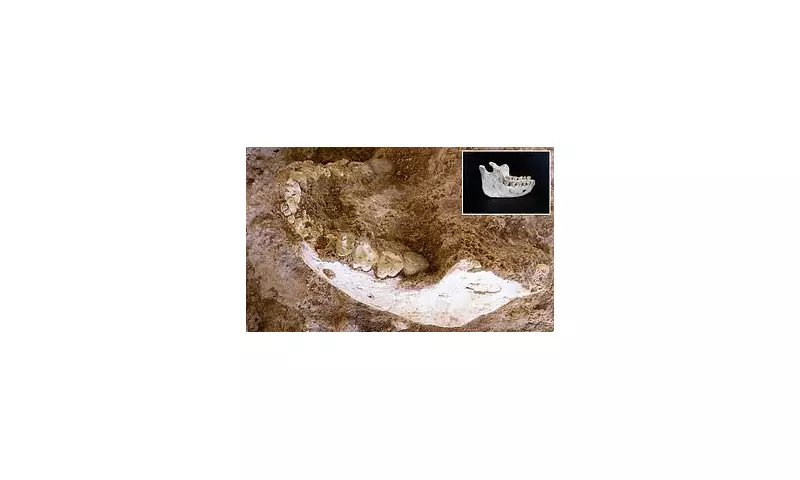
A groundbreaking discovery in a Moroccan cave has unearthed ancient human remains that scientists believe could be a pivotal 'missing link' in our evolutionary story. The fossils, dating back an astonishing 773,000 years, display a unique blend of modern and primitive features, placing them at a critical juncture near the divergence of African and Eurasian human lineages.
A Mosaic of Ancient and Modern Traits
The remarkable find was made at the Grotte à Hominidés cave within the Thomas Quarry I site in Casablanca. The collection includes the lower jawbones of two adults and a toddler, along with teeth, a thigh bone, and several vertebrae. Analysis reveals a fascinating mosaic: the facial structure was relatively flat and gracile, akin to later Homo sapiens, while other cranial features like the brow ridge, brain size, and overall skull shape remained archaic, similar to earlier Homo species.
One nearly complete jaw shows a long, narrow shape reminiscent of Homo erectus, yet its teeth and internal structures resemble both modern humans and Neanderthals. The teeth themselves are a patchwork. The canines are small and slender like ours, while some incisors fall within the size range of early H. sapiens, though with longer roots closer to Neanderthals. The molars mix traits from North African Middle Pleistocene teeth, Spanish Homo antecessor, and archaic African H. erectus.

The cave environment itself tells a story. It appears to have been a predator's den, with bite marks on the thigh bone suggesting the individual may have been hunted or scavenged by a hyena. Hundreds of stone tools and thousands of animal bones were also found alongside the human remains.
Reshaping the Human Family Tree
This discovery fundamentally challenges the traditional narrative of human evolution. It upends the view that Homo sapiens first arose in a single African location and later replaced other hominins during migration. Instead, it supports the idea that early human populations left Africa well before fully modern traits had evolved, spreading across Asia and Europe and gradually diverging into distinct groups over hundreds of thousands of years.
Lead study author, paleoanthropologist Jean-Jacques Hublin, offered a cautious interpretation. "I would be cautious about labelling them as 'the last common ancestor,'" he said, "but they are plausibly close to the populations from which later African - Homo sapiens - and Eurasian - Neanderthal and Denisovan - lineages ultimately emerged."
The age of the fossils, determined by analysing the magnetic signature of the surrounding cave sediments, is key. At roughly 773,000 years old, they align closely with the genetic estimate for the last common ancestor of modern humans, Neanderthals, and Denisovans, thought to have lived between 765,000 and 550,000 years ago. This makes them a strong candidate for representing what that ancestral population may have looked like.
Implications for Our Evolutionary Journey
The Moroccan fossils are roughly the same age as those of Homo antecessor found at Gran Dolina in Spain, and the two share some intriguing similarities. Hublin noted this could reflect "intermittent connections across the Strait of Gibraltar," a hypothesis demanding further study. This suggests a more interconnected prehistoric Mediterranean world than previously assumed.
Ultimately, the find from Grotte à Hominidés demonstrates that the features defining modern humans did not emerge suddenly in one place. Modern traits appeared gradually and piecemeal in multiple populations across Africa and beyond, long before the advent of fully modern Homo sapiens. The fossils reinforce the deep African ancestry of our lineage while highlighting the complex, branching nature of evolution that ultimately produced both us and our extinct Eurasian cousins, the Neanderthals.