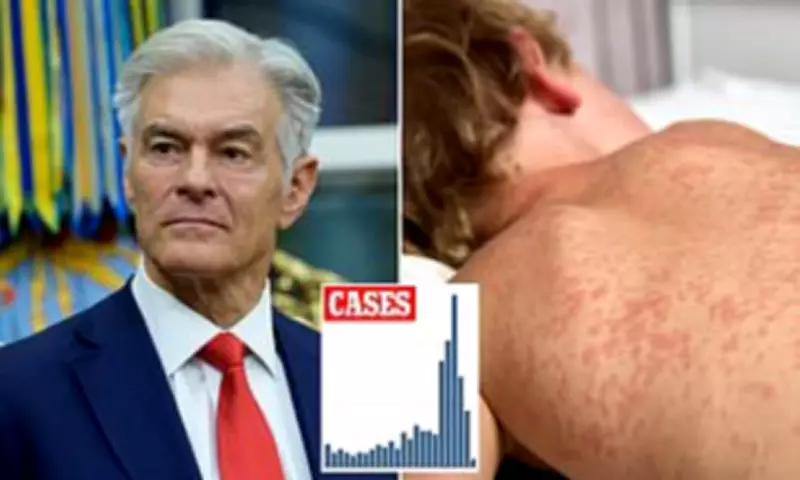
Officials from the Trump administration are now making urgent appeals for Americans to receive their measles vaccinations as the nation confronts a historic outbreak of the highly infectious disease. The call to action comes amid concerning data showing vaccination rates falling below critical public health thresholds in certain regions.
Federal Official Issues Direct Plea
Dr. Mehmet Oz, administrator of the Centers for Medicare and Medicaid Services (CMS), delivered a straightforward message during a Sunday address: "Take the vaccine, please." He emphasized that the solution to the measles outbreak currently raging in South Carolina—the largest in America since the disease was declared eliminated over two decades ago—is receiving both recommended doses of the measles, mumps, and rubella (MMR) vaccine.
"There will never be a barrier to Americans getting access to the measles vaccine," Dr. Oz insisted, addressing concerns about vaccine availability. Federal statistics indicate that 93 percent of Americans have completed the two-dose MMR regimen, typically administered in early childhood. However, this national figure remains below the Centers for Disease Control and Prevention's (CDC) 95 percent threshold necessary to achieve herd immunity.

South Carolina's Alarming Situation
The outbreak's epicenter reveals more troubling numbers. In South Carolina, where nearly 1,000 residents have contracted measles since October 2025, only 91 percent of kindergarteners have received both MMR doses. State health data details 933 confirmed infections, with 890 cases concentrated in Spartanburg County alone.
A breakdown of these cases shows that 859 infected individuals were unvaccinated, 20 were partially vaccinated, and 29 had unknown vaccination statuses. Notably, 25 people who had received both MMR doses still contracted the virus, highlighting that while the vaccine is 97 percent effective, it is not absolute. The age distribution reveals children are particularly affected: 418 cases were in children aged five to eleven, 242 in those under four, and 177 in teenagers aged twelve to seventeen.
Contrasting Views Within Health Leadership
Dr. Oz's unequivocal vaccine advocacy stands in contrast to the more complicated stance of Department of Health and Human Services (HHS) Secretary Robert F. Kennedy Jr. Secretary Kennedy previously chaired the anti-vaccine nonprofit Children's Health Defense, which advocated against school vaccine mandates during the 2019 measles outbreak that saw 1,261 cases across 31 states.
He has historically made claims that the MMR vaccine—credited with preventing approximately 60 million measles deaths worldwide—was not responsible for declining mortality rates, instead attributing measles deaths to malnutrition. Kennedy has also suggested a debunked link between MMR vaccines and autism, despite extensive research confirming the vaccine's safety and efficacy.
However, in a notable shift last year as measles cases surged in West Texas, Secretary Kennedy described the MMR vaccine as "the most effective way" to prevent the virus, illustrating the contradictory positions he has presented during his tenure.
The Serious Health Implications of Measles
Measles is a formidable viral illness characterized initially by flu-like symptoms including cough and fever. It progresses to a distinctive, blotchy rash that typically begins on the face before spreading downward across the body, accompanied by tiny white spots inside the mouth known as Koplik spots.
In severe instances, the virus can migrate to the lungs and brain, potentially causing pneumonia, brain swelling (encephalitis), seizures, and death. The CDC estimates that unvaccinated individuals exposed to measles have a 90 percent chance of contracting the disease.
While sometimes presenting with milder symptoms like diarrhea, sore throat, and general achiness, measles leads to pneumonia in approximately six percent of otherwise healthy children, with higher rates among malnourished children. Encephalitis, though rare at about one in 1,000 cases, proves fatal in 15 to 20 percent of occurrences and leaves roughly 20 percent of survivors with permanent neurological damage such as brain injury, deafness, or intellectual disability.

Furthermore, measles severely compromises a child's immune system, rendering them vulnerable to other bacterial and viral infections they were previously protected against. The disease spreads through direct contact with infectious droplets or via airborne transmission, with patients remaining contagious from four days before the rash appears until four days after. Enclosed public spaces like airports and airplanes present particularly high-risk environments for transmission.
Historical Context and Vaccination Protocol
The development of the MMR vaccine in the 1960s marked a turning point in global health. Before its availability, measles caused annual epidemics resulting in up to 2.6 million deaths worldwide. By 2023, that number had dramatically fallen to approximately 107,000 deaths annually, demonstrating the vaccine's profound impact.
The standard vaccination schedule recommends the first MMR dose between twelve and fifteen months of age, with a second booster dose administered between ages four and six. This two-dose regimen provides robust, long-lasting protection against all three diseases.
National Outbreak Data and Response
According to the Johns Hopkins Center for Outbreak Response Innovation, the United States has recorded 842 measles cases so far in 2026, with 605 of those cases—over 70 percent—occurring in South Carolina. This concentration underscores the regional nature of the current outbreak while highlighting the importance of maintaining high vaccination coverage nationwide to prevent further spread.
The measles virus initially invades the respiratory system before spreading to the lymph nodes and throughout the body, potentially affecting the lungs, brain, and central nervous system. Public health officials continue to monitor the situation closely, emphasizing that vaccination remains the most reliable defense against this preventable yet dangerous disease.