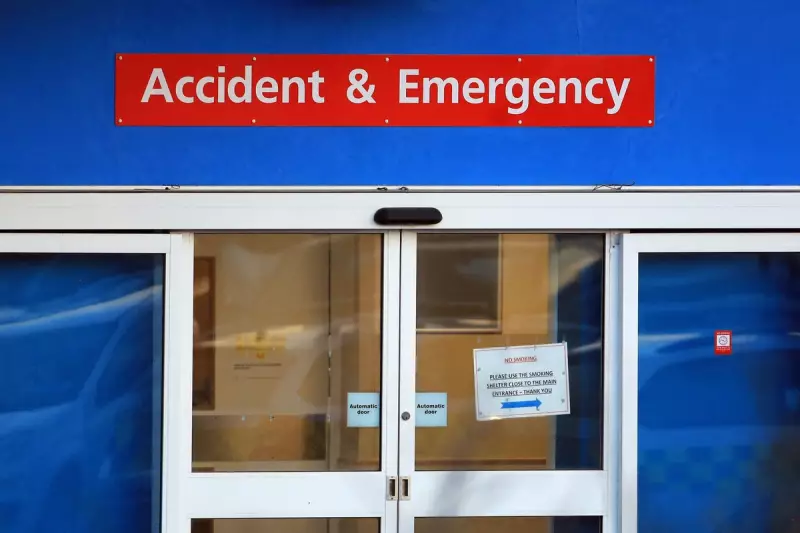
A senior doctor has issued a stark warning that the practice of treating patients in hospital corridors has become 'normalised' across the NHS, as he questioned the lack of public outrage over thousands of deaths linked to long emergency department waits.
'Howls of Outrage' Over Preventable Deaths
Dr Ian Higginson, President of the Royal College of Emergency Medicine (RCEM), stated there should be 'howls of outrage' about the estimated 16,600 deaths connected to excessively long waits for a hospital bed last year. This figure equates to roughly 320 fatalities every week.
'If we had 16,000 patients a year dying in bus crashes or in aircraft crashes or anywhere else there would be such howls of outrage something would be done about it,' Dr Higginson told the Press Association. 'And yet, we can't understand why those awful statistics don't provoke really determined action at the highest level across governments.'

A System 'Full to Bursting'
The emergency care expert described departments across the UK as being 'in big trouble' and 'full to bursting'. He attributed the core problem to a critical shortage of inpatient beds, forcing staff to deliver care in non-clinical areas like corridors.
'We can't deliver care in corridors,' Dr Higginson emphasised, highlighting the unsafe and undignified conditions for patients. He added that staff are 'run ragged, exhausted and suffering from a mixture of either burnout, moral injury or exhaustion, PTSD or a mixture of all of the above.'
Recent analysis supports his claims, revealing that in March, almost one in five patients in UK emergency departments were treated in 'escalation areas' such as corridors. Dr Higginson warned the situation is likely worse now.
A 'Normalised' Crisis and Political Promises
A deeply concerning aspect, according to Dr Higginson, is that the crisis has become accepted by all parties. 'Patients expect when they come to our departments to have to wait a long time, and they're not surprised when they are in a corridor. Staff are not surprised... and I think our leaders and politicians just accept it as normal.'
This warning comes despite a pledge from Health Secretary Wes Streeting earlier this month to end corridor care in English hospitals by the next general election, 'if not sooner'.
However, Dr Higginson criticised current efforts to resolve the crisis as insufficient, comparing them to 'trying to put out a fire with buckets of water, whilst at the same time chucking fuel on it from the other side.' He argued that solutions focusing on diverting patients away from A&E are not addressing the root cause.
'The solutions are to make hospitals more efficient; to provide more staff to beds in hospitals and to improve community based and social care so that patients can leave hospital where they need to,' he stated.
Widespread Condemnation from Health Leaders
The RCEM's warnings have been echoed by other leading healthcare bodies. Professor Nicola Ranger of the Royal College of Nursing called the situation a 'devastating collapse in care standards', noting it has been over 18 months since nursing staff declared a national emergency over corridor care.
'The failure to get to grips with the issue means that patients are routinely coming to harm and even dying unnecessarily,' Professor Ranger said.
Dr Helen Neary, co-chair of the British Medical Association's consultants committee, described corridor care as 'a symptom of a broken system'. 'Patients are lying in corridors, being assessed in cupboards and treated in waiting rooms because there are no beds and too few staff to provide safe care,' she said.
Official NHS England data for November shows 50,648 people waited more than 12 hours in A&E from a decision to admit to actually being admitted.
An NHS England spokesperson acknowledged the situation was 'totally unacceptable' and stated that specialist teams are working with hospitals this winter to drive down instances of corridor care. A Department of Health and Social Care spokesperson reiterated the government's determination to end the practice, pointing to some signs of recovery, including faster ambulance response times compared to last year.

Despite these assurances, Dr Higginson dismissed talk of 'green shoots of recovery' within the NHS as 'wishful thinking', bluntly summarising the general trend: 'things are getting worse and worse and worse and worse and worse.'