Black Fathers Step Up to Support Pregnant Partners Amid Maternal Health Crisis
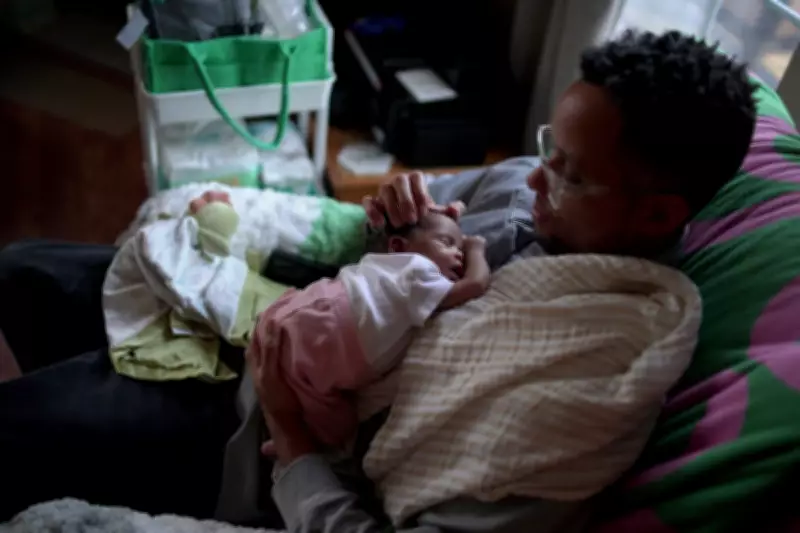
In a heartwarming scene from Indianapolis, JaKobi Burton cradles his newborn daughter, his affection palpable with every gentle touch. However, his dedication began long before her arrival. Burton actively participated in every medical appointment and enrolled in Dads to Doulas, a program by Dear Fathers that educates Black fathers-to-be on providing comprehensive physical, mental, and spiritual support during and after childbirth. Alongside his wife, Crystal Wilmot-Burton, they recognized the heightened risks of their pregnancy, not only due to their age in their 40s but also because of their racial background.
Alarming Disparities in Maternal Mortality Rates
Federal health data reveals a stark reality: Black women are nearly 3.5 times more likely than white women to die around the time of childbirth. This alarming statistic underscores a critical public health issue. Health professionals and advocates are now focusing on empowering Black fathers through government-funded initiatives and nonprofit resources, aiming to mitigate these odds by fostering hands-on involvement. Organizers report a significant shift in attitudes, with more Black men openly discussing their pregnancy-related fears and insecurities.
"I want you to know that I was involved and that I was looking out for you from the very beginning and I’m always going to be your biggest protector," Burton tells his one-month-old daughter. "That’s what I did from the beginning of this experience, trying to learn as much as I could."

Paternal Involvement Linked to Improved Health Outcomes
According to the National Center for Health Statistics, factors such as unequal access to prenatal care, health disparities, and systemic racism contribute to the mortality rate differences among women of various races. Recent viral videos, including one from Indiana, highlight instances where hospital staff dismissed the concerns of Black women in labor, exacerbating the crisis. In 2023, the maternal mortality rate for Black women was 50.3 deaths per 100,000 live births, compared to 14.5 for white women, 12.4 for Hispanic women, and 10.7 for Asian women, as reported by the Centers for Disease Control and Prevention.
The National Healthy Start Association, established in 1998 to address infant and maternal mortality, employs "fatherhood practitioners" across 116 project sites. These practitioners, along with case managers, offer men resources like webinars, texting services, and even cooking lessons. Kenneth Scarborough, the NHSA's fatherhood and men’s health consultant for a decade, notes a growing trend toward including male partners in efforts to safeguard pregnant women's health.
"There’s more research that is being done to be able to change those narratives, without a shadow of a doubt," Scarborough said. "The challenge with that is still getting these institutions to understand the value of making sure that Dad is there and he is at the table."
Systemic Barriers and Stereotypes in Healthcare
Dr. Ndidiamaka Amutah-Onukagha, founder and director of the Center of Black Maternal Health and Reproductive Justice at Tufts University, points out that doctors often marginalize Black fathers, leaving them "on the fringes of the conversation," while societal stereotypes portray them as "scary and rough." She emphasizes that paternal involvement is "directly correlated with better outcomes," yet many fathers report being ignored in medical settings.
Black patients are frequently advised to seek OB-GYNs who share their racial background, a strategy Wilmot-Burton adopted. "I thought maybe she would be more caring, be more willing to listen to my issues, which she was," she said. However, Black doctors represent a small fraction of OB-GYNs nationwide, with only 7.5% being Black women and 2.3% Black men, according to 2023 data from the American Medical Association and the Association of American Medical Colleges.

Deborah Frazier, CEO of National Healthy Start, urges medical organizations to overcome stigmas around paternal involvement, noting that Black and brown fathers often face stereotypes of absenteeism. "We have data and interviews with fathers, and those fathers have told us that they wanted to be there with their partners, and they wanted be present for their births," Frazier said.
Advocacy and Role-Playing for Empowerment
Charles Johnson IV founded 4Kira4Moms in 2017 after his wife, Kira, died from bleeding during a cesarean section at Cedars-Sinai hospital in Los Angeles, a tragedy he attributes to a culture of racism. Gabrielle Albert, the group’s executive director, advises fathers to navigate the fine line between assertiveness and aggression, becoming a "force in the room." "What if you happen to be 6-foot-5 and 200-something pounds? If you speak up, what’s gonna happen?" Albert said. "Let’s role play conversations. How do you push back against the doctor?"
From Expectant Dad to Doula Advocate
In August, two months before Wilmot-Burton gave birth, Burton attended a Dads to Doulas workshop, where facilitator Kyra Betts Patton emphasized that present fathers-to-be can reduce premature birth risks. "The largest timeframe for maternal mortality, you're looking at 43 to 100 days after you've had a baby. No one's there but the partner," Patton said.
Burton credits the classes with giving him the confidence to advocate throughout the pregnancy, using a checklist of questions at every appointment. "I pushed hard prior to the delivery to make sure that our birth plan was followed, even though it wasn’t completely. But she (Phoenix) still turned out great and was delivered successfully," said Burton, who also took classes with the Indiana Breastfeeding Coalition.
Wilmot-Burton praises her husband for balancing workshops with work and grad school, highlighting his vital support during moments of illness or anxiety. "I would encourage other Black women to make sure their partners are on board to attend some classes or read books," she said, "and definitely go to as many appointments as they can."