
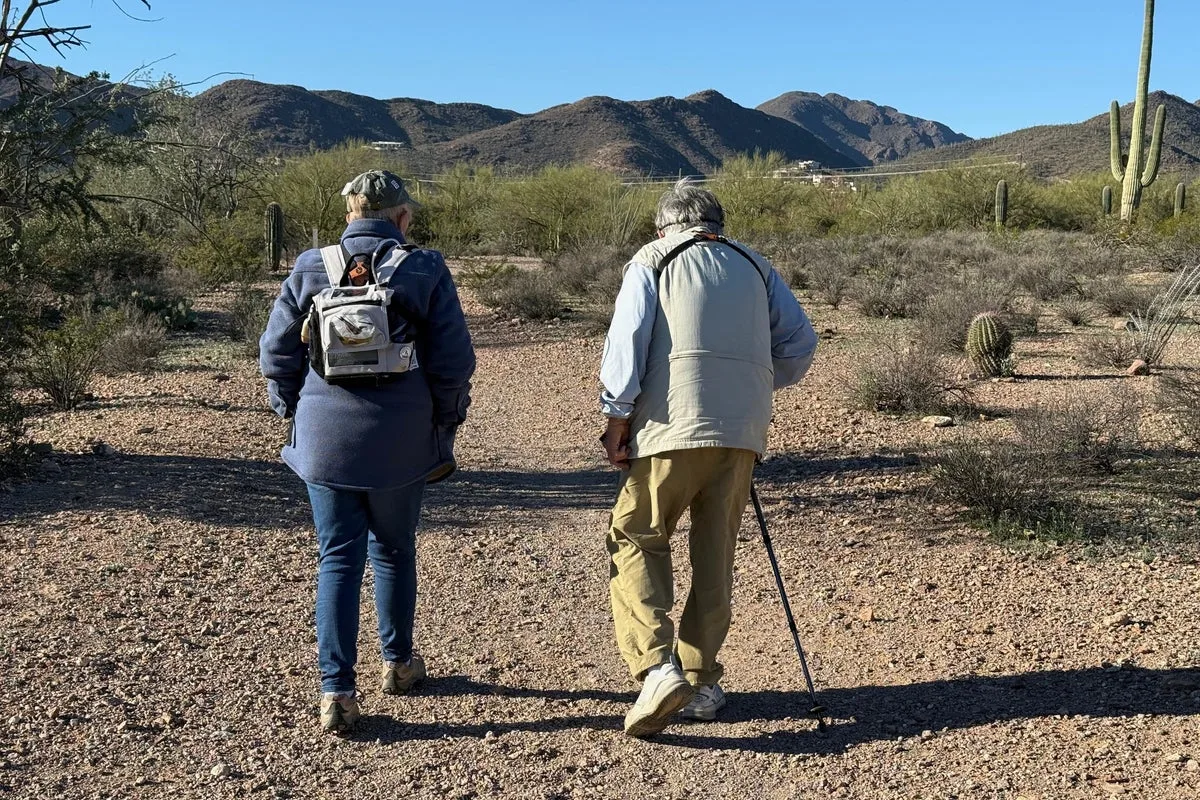
Marcia O'Bara, wearing an oxygen pack for her COPD, leads a group of nature enthusiasts on a mission to see birds. They walk on flat trails at their own pace, without pressure or competition, enjoying a sense of community. This is Birding for Every BODY, one of many excursions offered monthly by the nonprofit Tucson Bird Alliance with Arizona's Pima County.
It is part of a growing national movement to help people with physical and other limitations experience birding and nature. O'Bara, a retired nurse who has led accessible outings for three years, said disabled people often cannot keep up on traditional outings, especially when competitive birders focus on checking off a list of the greatest possible number of species.
For her walks, O'Bara ensures trails are easily traversable, bathrooms are open and large enough for mobility scooters and wheelchairs, and checks on drinking water, shade and benches. She modulates the pace as needed. While the outings are open to those with wheelchairs and scooters, few attend, perhaps because they do not think they will be able to keep up.
The organised effort to share birding with people with limitations dates back at least to 2018, when retired Texas teacher Virginia Rose founded the nonprofit Birdability. Rose has used a wheelchair since a spinal injury at age 14. “Our vision is that birding be truly for everybody and every BODY, regardless of disability,” said Cat Fribley, Birdability’s executive director. Participants' limitations include mobility issues, blindness, chronic illness, and other health concerns.
Birdability has helped compile a crowdsourced map of accessible birding locations nationwide with the National Audubon Society, and offers advice on being more inclusive. The group's website has resources and adaptive devices, such as car-window mounts for cameras and apps for identifying birdsong. Occupational therapist Freya McGregor recommends binocular harnesses, which are easier on the shoulders and neck than binoculars hanging around the neck.
“Birding really brings you joy,” said Jerry Berrier, a 73-year-old Massachusetts birder who has been blind since birth. “There is happiness from being out in nature.” Berrier got hooked as a college student when he learned to identify bird calls and songs. He later taught blind and blind-deaf people how to use laptops and cellphones at the Perkins School for the Blind.




