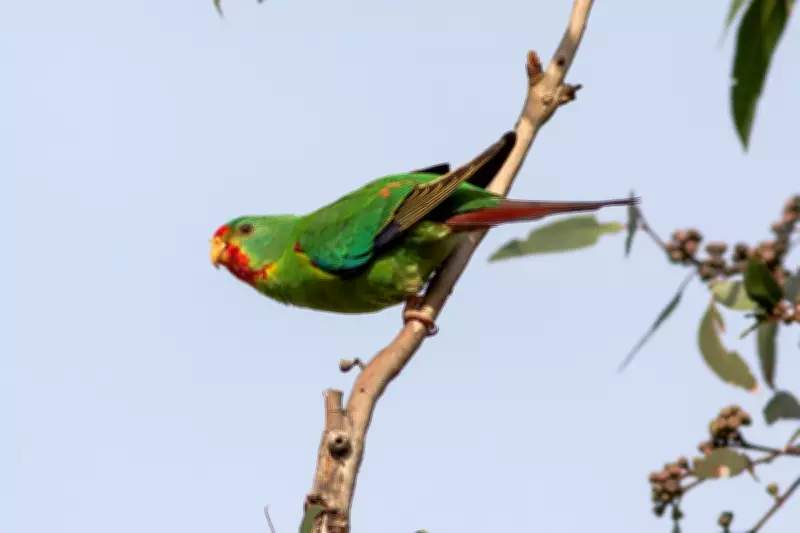
Swift Parrot's Song Silenced: Logging Clears Recorded Habitat in Tasmania
In a poignant environmental revelation, scientists have documented the birdsong of the swift parrot, a critically endangered species, in a section of Tasmania's Wielangta forest that was subsequently cleared. The recordings, made by the Bob Brown Foundation in December and January, captured the distinctive call of the world's fastest parrot in an area marked for clear-felling, highlighting a stark conflict between conservation efforts and forestry practices.
Recordings and Habitat Loss
Dr. Charley Gros of the Bob Brown Foundation described the swift parrot's call as unmistakable: "It's a tiny bird but has a very loud call. It's very sharp and quick and fast. You can't confuse it with something else." Over two months, 68 observations were recorded by foundation scientists and volunteers, reviewed by a government scientist, and uploaded to an environment department website. Gros emphasized that this evidence indicates the forest was used for foraging and nesting, not merely as a passageway. However, by the time a state regulator surveyed the area in February, the forest had been logged, and no parrots were observed.
Legal and Environmental Disputes
Sustainable Timber Tasmania, the logging agency responsible, stated it acted within the law, operating under Tasmania's strict forest practices framework. A spokesperson said, "We are committed to operating within Tasmania's strict forest practices framework and protecting environmental values through careful planning and oversight." Yet, this incident raises critical questions about whether current laws adequately protect threatened species. An overhaul of national environmental law, set to take effect in July 2027, may change this, ending exemptions for state-run forestry and requiring federal approval for logging that impacts endangered species.

Population Decline and Scientific Warnings
The swift parrot, which winters in Victoria and New South Wales and summers nesting in Tasmania, has seen its population plummet to about 750, down from 2,000 a decade ago, according to a 2021 CSIRO guide. Peer-reviewed studies warn that the species could be extinct by the early 2030s, with forestry identified as the primary threat. Scientific advice has long urged protection of all potential habitat on public land, regardless of immediate bird presence, due to extensive habitat loss. The Bob Brown Foundation accuses governments of ignoring this advice, allowing logging to drive the parrot toward extinction.
Broader Conservation Efforts
Campaigners are now targeting retailers like Bunnings, pressuring them to stop selling timber from contentious areas. The Wilderness Society has lobbied Bunnings to cease sourcing from a mill linked to the logged coupe, arguing that certification schemes do not guarantee sustainability. Alice Hardinge, the society's Tasmanian campaigns manager, stated, "Bunnings customers don't want to be sold timber that destroys unique forests and pushes the swift parrot to extinction." Bunnings responded that a review found no evidence of non-compliance with environmental laws, affirming its commitment to sourcing from compliant operations.
This case underscores the urgent need for stronger environmental protections and highlights the ongoing tension between economic activities and biodiversity conservation in Australia's forests.