Festive Firs Fortify Fylde Coast Against Climate Threats
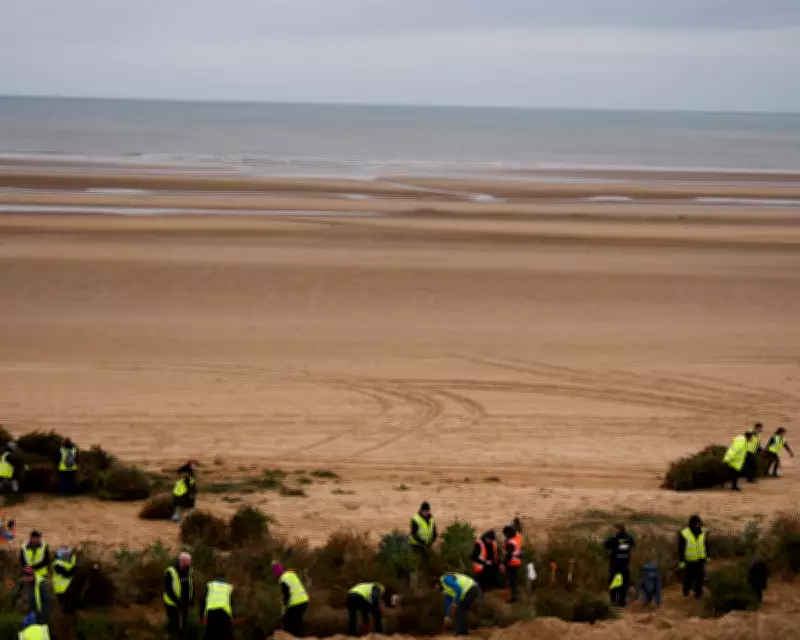
In a unique environmental initiative, volunteers have planted more than 2,000 discarded Christmas trees on the beach at St Anne’s on the Fylde coast in Lancashire. This effort is part of a broader sand dunes project aimed at protecting the coastline from rising sea levels and restoring vital habitats.
From Tinsel to Tidewall: A Creative Coastal Defence
Britain’s battle against climate breakdown often involves large-scale renewable energy projects, but on the Lancashire coast, the frontline defence takes a more festive form. Tens of thousands of used Christmas trees are being partially buried on beaches south of Blackpool to serve as a natural barrier against coastal erosion.
Hundreds of volunteers, braving biting February winds, haul tinsel-free trees into shallow trenches. Within weeks or even days, these trees morph into sand dunes, shielding seafront homes from the encroaching sea. This might seem like an unusual tradition, but conservationists emphasize its growing importance.

Historical Loss and Urgent Need
Since the mid-1800s, the Lancashire coast has lost an estimated 80% of its sand dunes due to the rapid expansion of seaside towns like Blackpool and Lytham St Annes. Amy Pennington of the Lancashire Wildlife Trust explains, "Sand dunes once extended miles inland, but urban development has reduced them to a thin fragment. They are crucial as the only form of sea defence for local communities."
Volunteers began this practice over three decades ago, with efforts intensifying in the past decade as sea levels have risen. The UK has lost about 30% of its sand dunes since 1900, while sea levels have increased by approximately 19.5 centimetres, with two-thirds of this rise occurring in the last 30 years—a rate higher than the global average.
Accelerated Erosion and Wildlife Revival
Increased storm surges have accelerated dune loss, putting coastal properties at greater risk of flooding. Pennington notes, "Storm surges push tides further up beaches, washing away dunes more frequently." Beyond their role in climate defence, these dunes are essential habitats for wildlife.
Among the Christmas tree dunes in Lytham St Annes, one of Britain’s rarest reptiles, the sand lizard, has found a new home. Hundreds were released here in 2020 after a 60-year absence, and they are now thriving. Andy Singleton-Mills, area conservation manager for Fylde council, reports, "We spot more each year, including young, indicating successful breeding." However, these elusive creatures are hard to see, as they avoid human contact.
Community Efforts and Future Challenges
Recently, 650 volunteers worked on Lytham beach, burying around 2,000 donated Christmas trees along a two-mile stretch. These trees, adorned with marram grass that helps anchor them, can grow up to 3 metres high. Pennington hopes they will last indefinitely but acknowledges future challenges: "As sea levels rise, we’ll need to build dunes upwards within five years to prevent them from being swept away."
Cultural and Emotional Significance
While some view sand dunes as obstacles, others cherish them for recreation and solace. Artist Holly Moeller, who has painted the dunes, says, "They may look sparse, but they’re teeming with life. For me, they offer a place of solace during difficult times." This project not only protects the coast but also fosters a deeper appreciation for these natural landscapes.